Neck & Back Pain
Lasting neck, back, or shoulder pain that your size makes worse.
Breast reduction at our MD clinic takes away excess tissue, fat, and skin to relieve neck, back, and shoulder strain and leave a lighter, firmer, better-balanced shape.
Call for availability This clinic is not booking appointments right now. Call us and we will help you book at a nearby Goals clinic.
From $10,000

Free Consultation
Your consultation is free and carries no obligation.
Goals Aesthetics & Plastic Surgery – Gaithersburg
438 N Frederick AveMon–Sat, 10:00–19:00 local time
Surgeons: Dr. Sergey Voskin, Dr. George Iskander
Breast Surgery with a Steady Hand and an Eye for Balance
Breast reduction, or reduction mammoplasty, takes away excess breast tissue, fat, and stretched skin so the breasts end up lighter, firmer, and better proportioned. The same surgery lifts and reshapes the breast and resets the nipple. Many choose it to relieve neck, back, and shoulder pain, not only for looks, at our MD clinic.
Your surgeon weighs size, tissue, and symptoms, discusses how much should come off, and maps the reduction and new nipple position with you.
Surplus tissue, fat, and skin come away, and what remains of the breast is rebuilt into a lighter, firmer, higher shape.
The nipple moves to a higher, natural spot, the incisions are closed with care, and the surgeon guides your recovery. Most people wear a support bra and ease back across several weeks.
Candidacy
Breast reduction is for those whose breast size brings pain or limits day-to-day life, and who want a lighter, firmer shape that sits in better balance with their frame.
Lasting neck, back, or shoulder pain that your size makes worse.
Hard to exercise, hard to find bras or clothes that fit, or deep grooves left by your bra straps.
Rashes or soreness in the fold under the breasts, plus real discomfort in the heat.
A wish for a lighter, firmer shape that suits your frame and feels balanced.
Wondering if reduction suits?
Our surgeons
Experienced surgeons
Each surgeon’s training and licenses are listed on their own page.
Results
See real breast-reduction results from patients.
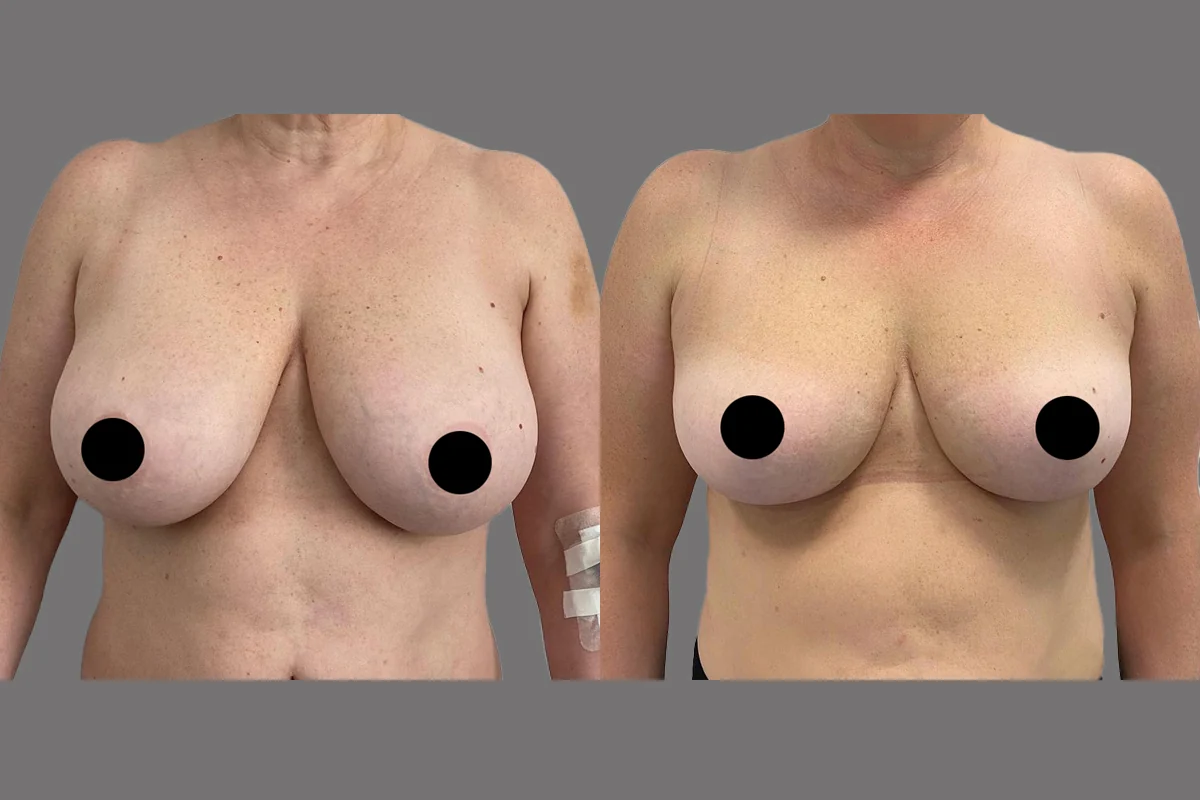
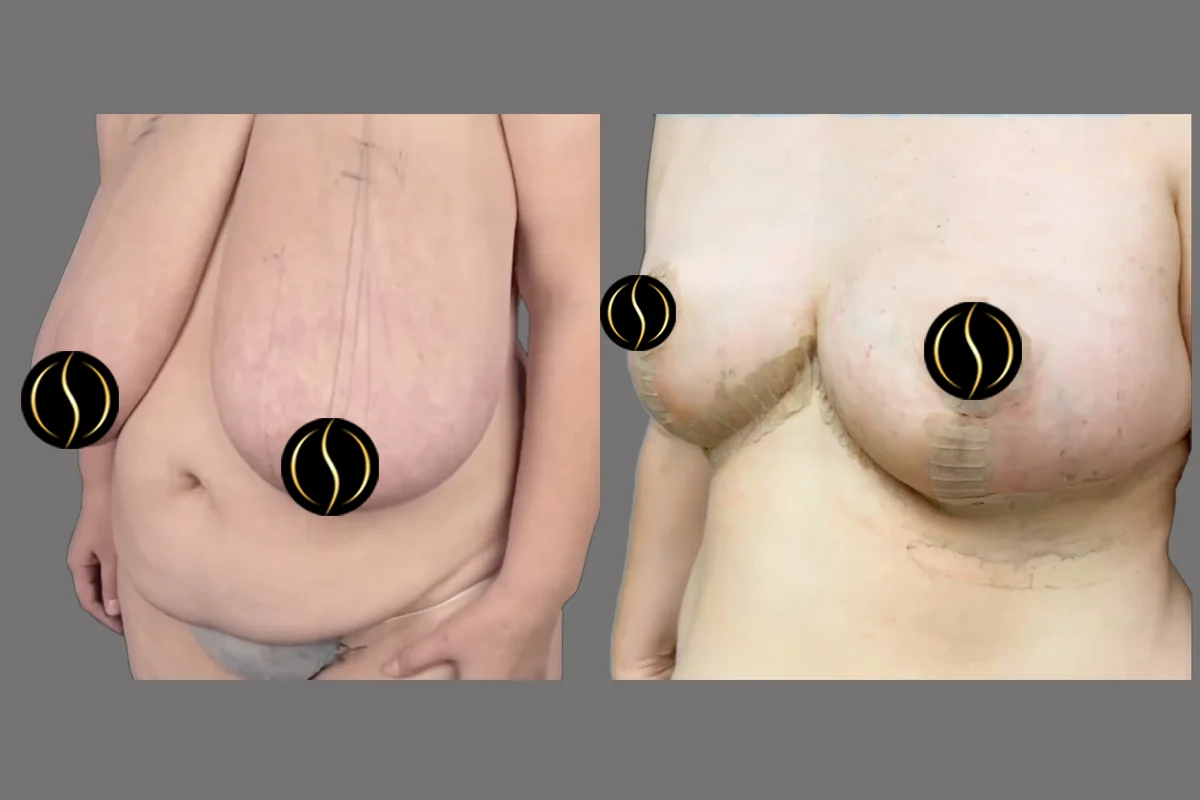
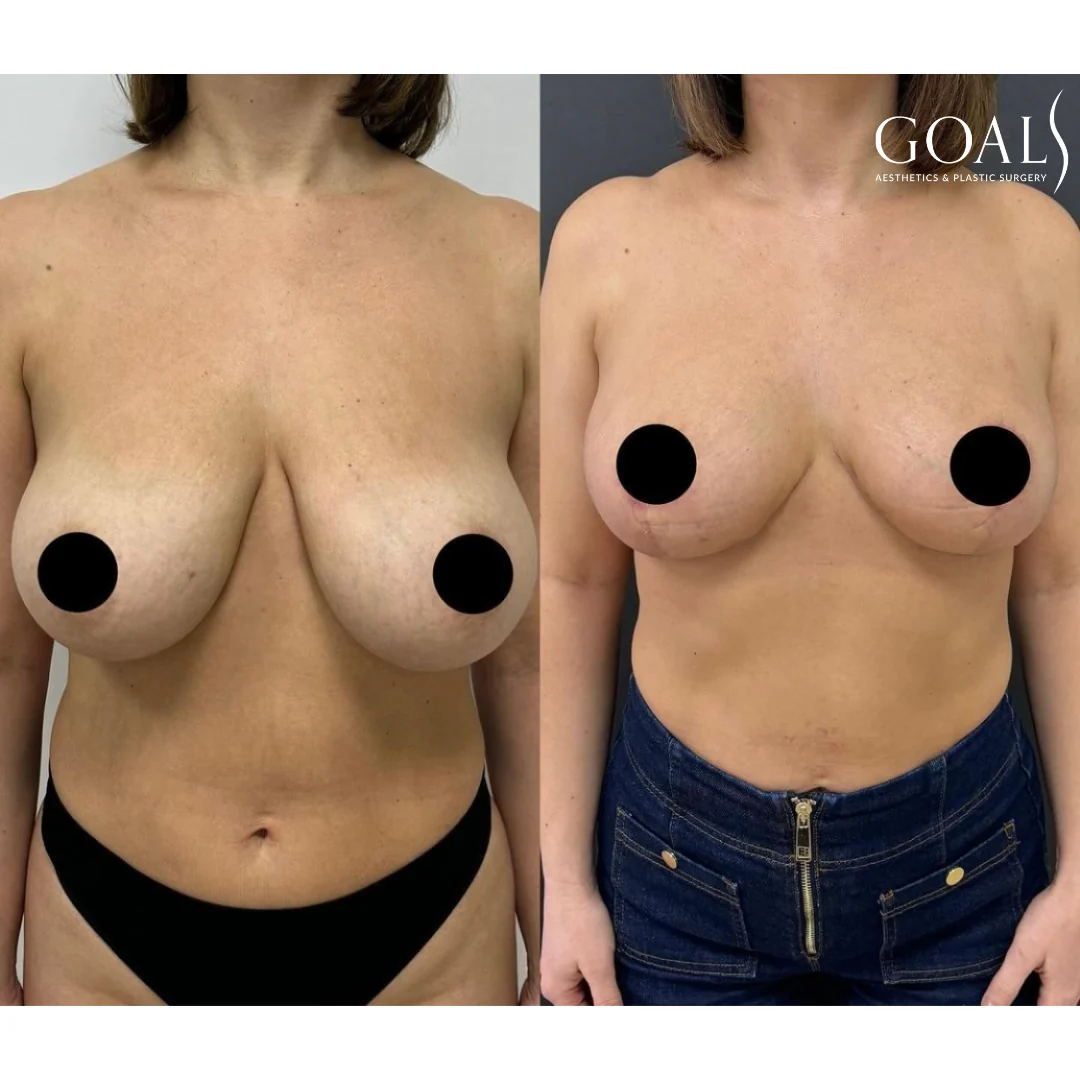
Real patients, published with written consent. Photographs are not retouched or AI-generated. Individual results vary — these images show outcomes for these patients and are not a guarantee of your own.
Try it
Type your height and weight. Your numbers stay on your device. We do not see or save them.
BMI is just one number. Your surgeon also looks at your health and your goals. BMI alone does not decide if you can have surgery.
Setting size, weight, and symptoms side by side helps you and your surgeon choose between a full breast reduction and a lift by itself.
| Criterion | Reduction | Lift Only |
|---|---|---|
| Removes | Tissue, fat, and skin. | Mainly skin. |
| Size | Clearly smaller. | Roughly unchanged. |
| Pain Relief | Lifts the strain. | Little change. |
| For | Large, heavy breasts with symptoms. | Sagging at a good size. |
| Insured | Can be covered at times. | Usually not. |
Your journey
6 Steps to Lasting Relief.
Sit with our team to go over goals and symptoms, study your shape, and see whether reduction is right.
Map out how much tissue to remove along with the new shape and nipple position, so the result you can expect is clear.
Complete the medical checks so the team can confirm you are ready, then they take you through each step of getting prepared.
The surgeon takes off excess tissue, fat, and skin, reshapes the breast, and resets the nipple for a natural, balanced look.
You wear a support bra and take it easy at first, with simple aftercare that helps everything settle well.
Stick with the aftercare plan and check-ins, where we follow healing and protect your result.
Benefits
Breast reduction leaves breasts that are lighter, firmer, and in better proportion, and for many people it lifts the strain that heavy breasts place on the body.
Relief from neck, back, and shoulder strain.
Lighter, firmer breasts that ride higher and feel far more comfortable.
During a workout or in a fitted top, a lighter shape can make moving and dressing feel easier in everyday Gaithersburg life.
Walking, running, and training feel easier and more comfortable.
Bras and tops that finally fit the way you want.
Safety
We assess every patient first, work with careful technique that keeps scarring down, and offer clear support before and after, so the procedure stays safe throughout.
We go over your health, symptoms, and goals before the day, so the plan suits you and you are cleared.
Skilled reduction technique, placed to keep the scarring discreet.
Clear pre- and post-op support, with the MD team easy to reach.
Pricing
Final cost reflects how much is removed and your case details; some reductions may qualify for insurance, confirmed at consult.
Financing / payment plans
Your price is locked at booking, after the consult.
Transparent pricing: no hidden fees, every figure set out in the contract.
Prices shown are starting prices and depend on the number of areas treated. Final pricing is confirmed at your consultation. Cosmetic procedures are not covered by insurance.
Try it
Pick a procedure to see an estimate. Your numbers stay on your device. We do not see or save them.
This is an estimate, not a quote. It splits the starting price over the months you pick, with no interest. Lenders set your real rate and terms. Your price is confirmed at your consultation.
Why Goals
An N Frederick Ave spot in Gaithersburg, with easy parking and access.
Thorough aftercare and easy in-person follow-ups at the MD clinic.
Surgeons who handle breast work often.
Reduction technique placed to keep the scars discreet.
Thousands of procedures done well right across the network.
FAQ
You and your surgeon set the target together at the consult, weighing the look you want against what is safe for your frame and health. Most aim for a size that feels in proportion and lifts the strain, not the smallest. A breast reduction takes off a planned amount of tissue, but the final size also depends on your anatomy and how things settle. Your surgeon gives a realistic range, not one promised number.
Some change in nipple sensation is common early on, since the surgery works near the nerves there. For most people the feeling returns over the following weeks and months. A smaller share notice a lasting change, more or less than before, and larger reductions carry slightly higher odds of it. Your surgeon covers this honestly at the consult, since your technique affects the likelihood.
There is no strict age limit. What matters far more is your general health and whether your symptoms and goals match what the surgery delivers. Younger people with real pain, and older people who have carried discomfort for years, both do well, given good health and realistic expectations. Your surgeon weighs health, not a number, at the consult.
Tissue removed in a reduction does not return, so the lighter, firmer shape generally holds. Still, the breast answers to weight like the body. A big gain can add volume and soften the result, while a large loss can leave skin loose again. A steady weight protects the shape best, which is why surgeons suggest stability first.
Light walking is encouraged early to keep circulation moving, but real exercise waits. Most ease into a gentle routine over a couple of weeks and hold off on heavy lifting and hard upper-body workouts longer, until the surgeon clears them. Many feel the relief from neck and back strain almost at once, since the weight is already gone.
Learn more
One of the hardest parts of deciding on breast surgery is understanding how the options differ, since several procedures change the breast in very different ways. This page positions breast reduction against the alternatives people most often weigh it against, so you can see clearly where it fits. Comparisons make the choice concrete. For guidance on what suits you specifically, our experienced surgeons at our Gaithersburg clinic are glad to help.
The most common alternative people weigh is doing nothing and continuing to manage the symptoms, so it deserves honest comparison. Conservative measures, supportive bras, physical therapy, pain relief, and posture work, can ease the discomfort of large breasts, and for milder cases they may be enough. But when the symptoms stem directly from the weight and volume of the tissue, these approaches address the symptoms without resolving the cause, often providing only partial, temporary relief. A breast reduction removes the source of the problem. The comparison, then, is between ongoing management of a persistent burden and a one-time procedure that resolves it, a trade many people facing years of chronic discomfort find clearly worthwhile once conservative options have been genuinely tried. There is also a meaningful difference in motivation behind the two paths.
Choosing surgery is usually driven by symptoms that have proven persistent and resistant to management, whereas choosing to continue managing is reasonable when symptoms are milder or when someone is not ready for an operation. Neither choice is wrong in the abstract; the comparison simply clarifies that surgery uniquely resolves the underlying cause, which is why it tends to become the preferred route specifically for those whose conservative efforts have not delivered lasting relief.
These two are closely related and often confused, because a reduction includes a lift as part of its process, but their primary purposes differ. A breast lift raises and reshapes sagging breasts by removing excess skin and repositioning the tissue and nipple, without significantly reducing volume; it is for someone happy with their size but bothered by droop. A breast reduction surgery removes a substantial amount of tissue, fat, and skin to make the breasts smaller, and lifts and reshapes them in the process. So the deciding question is whether your concern is mainly size and weight, pointing to a reduction, or mainly position and shape at your current size, pointing to a lift.
A surgeon can clarify which fits, and for some the line between them is a matter of degree they help you navigate. It helps to think of it in terms of what is removed. A lift removes mainly skin to take up slack and reposition the breast, whereas a reduction removes skin together with a meaningful volume of tissue and fat. Someone whose breasts are the size they want but have descended over time is usually best served by a lift, while someone whose breasts are simply too large and heavy needs the volume removal that only a reduction provides. The fact that a reduction also lifts as it reduces is what sometimes blurs the distinction, but the presence or absence of significant volume removal is the clearest dividing line.
For some people the question is not which breast procedure but whether to address the breasts in isolation or alongside other concerns. A standalone reduction focuses solely on the breasts. A mommy makeover combines a reduction or other breast procedure with body contouring, such as addressing the abdomen after pregnancy, in a single coordinated surgery and recovery. The advantage of combining is one recovery period rather than several, which appeals to people with multiple post-pregnancy concerns. The trade-off is a larger single operation, so whether it is appropriate depends on your health, your goals, and what is safe to do at once. A surgeon weighs this honestly, and for the right candidate combining can be both efficient and sensible rather than simply more surgery.
The decision between standalone and combined also has a planning dimension worth weighing. A combined procedure requires that the patient be a suitable candidate for a longer operation and a more involved single recovery, so overall health and the total surgical load are carefully assessed. For someone in good health with several concerns they want addressed, consolidating them can be both efficient and satisfying; for someone who would prefer to keep things simpler, addressing the breasts alone first is entirely reasonable. The comparison is less about which is better and more about which suits the individual.
These sit at opposite ends of the spectrum, which makes the comparison straightforward in principle. Breast augmentation increases breast size, typically using implants or fat transfer, for people who want more volume or fullness. A reduction mammoplasty does the reverse, decreasing size and weight to relieve the burden of overly large breasts. They serve entirely different goals and patients, so the choice between them is rarely a genuine dilemma; it is determined by whether you want your breasts larger or smaller. The comparison is worth making explicit, though, because both fall under breast surgery and people new to the topic sometimes conflate the categories.
Occasionally someone seeking a change in shape rather than size benefits from a conversation about which direction actually serves their goal. In practice, very few people genuinely deliberate between making their breasts larger and smaller; the comparison mainly serves to orient someone new to breast surgery within the full landscape of options. Where it becomes useful is for the occasional patient whose underlying wish is really about achieving better balance or shape, for whom a frank discussion clarifies whether adding or removing volume, or simply reshaping what is there, is the route that actually matches the result they are picturing.
Recovery is another axis on which these options differ, and it often factors into the decision. A reduction and a lift have broadly comparable recoveries, typically one to two weeks off work with several weeks of restricted strenuous activity. An augmentation has its own recovery profile, and a combined mommy makeover, being a larger operation, generally requires a longer single recovery than any one procedure alone, though it consolidates what would otherwise be multiple separate downtimes. A notable feature specific to reduction is that the relief from the weight of the breasts is often felt almost immediately, which colors the recovery experience positively.
Weighing how much downtime you can accommodate, and whether to consolidate it, is a practical part of choosing among the options that a surgeon helps you think through. Anticipating the recovery realistically also helps with the practical logistics of arranging time off, support at home, and a gradual return to activity. Whichever option you choose, planning around the known recovery profile rather than hoping to rush it is what protects the result, and comparing those profiles in advance lets you choose the path whose downtime genuinely fits your life and responsibilities.
While the goal of restoring proportion is shared, the procedures for women and men differ enough to warrant separate consideration. A female reduction removes significant glandular tissue, fat, and skin and reshapes the breast, addressing the physical burden of large breasts. Male breast reduction, performed as gynecomastia surgery, addresses enlarged male chest tissue using techniques suited to the male anatomy, often combining gland removal with liposuction to produce a flatter, firmer contour. The comparison matters because the same word, reduction, describes two distinct operations with different techniques, incision patterns, and aesthetic goals.
Anyone researching the topic for a man should look specifically at gynecomastia surgery rather than assuming the female procedure simply applies, since the planning and approach are genuinely different. Understanding this distinction also helps set appropriate expectations for outcomes. The aesthetic goal of a male procedure is a flat, masculine chest contour, which differs fundamentally from the proportionate, reshaped breast that is the goal of a female reduction. Because the starting anatomy and the desired result are both different, the surgical planning, the incision strategy, and even the recovery emphasis differ accordingly, reinforcing why the two should be researched and discussed as the separate procedures they genuinely are.
Cost naturally differs across these procedures, and it is worth understanding in comparative terms. Each option, a reduction, a lift, an augmentation, or a combined makeover, carries its own cost depending on complexity and what is involved, so there is no single price that spans them. For a breast reduction Gaithersburg procedure specifically, the figure depends on the extent of reduction, the technique, and whether anything is combined. Importantly, because a reduction often addresses genuine medical symptoms, individual circumstances may bear on coverage in a way that purely cosmetic procedures would not, which is a meaningful point of difference worth raising. All of this is explained transparently at the consultation, with financing and payment plans available, so the comparison can be made on real numbers rather than guesses. It is also worth comparing the procedures on the durability of their results, since that affects long-term value.
A reduction's results are generally long-lasting, particularly when weight remains stable and, for women, childbearing is complete, whereas other procedures have their own longevity considerations. Factoring in how lasting a result is likely to be, alongside its upfront cost, gives a fuller picture than price alone, and it is part of what a thorough consultation helps you weigh when comparing the options against one another.
Comparisons in the abstract only take you so far, because the right answer depends on your body, your symptoms, your goals, and your circumstances. That is what a consultation is for: a surgeon weighs these options against what you actually need and tells you honestly which fits, whether that is a reduction, a different breast procedure, or a combination. Our Gaithersburg clinic offers breast reduction within a full range of options, with clear pricing at the consultation. You can see real outcomes in the before & after gallery or read more on the blog. When you want the comparison made personal to your situation, booking a consultation is the natural next step, with suitability and results determined individually by your surgeon.
About Breast Reduction
Breast Reduction at other Goals clinics
Get started
Whether you are weighing a breast reduction, a lift, or another procedure, our Maryland team will walk you through it and shape a safe, realistic plan together.
Prefer to talk now? (833) 462-5769
Free · No obligation
Tell us how to reach you. A patient coordinator calls you back — usually the same day.
Free · No obligation
Ask me anything. I usually reply straight away.
If you share your number, a Goals coordinator may call or text you about your consultation. Message and data rates may apply.
Nora is an automated chat. She cannot give medical advice or say whether a procedure suits you.