Neck & Back Pain
Ongoing neck, back, or shoulder pain your size makes worse.
Breast reduction at our Bronx clinic clears excess tissue, fat, and skin to ease neck, back, and shoulder strain and create a lighter, firmer, better-proportioned shape.
From $10,000

Free Consultation
Your consultation is free and carries no obligation.
Goals Aesthetics & Plastic Surgery – Bronx
174 E 205th StMon–Sat, 10:00–19:00 local time
Surgeons: Dr. Sergey Voskin, Dr. Christopher Johnson, Dr. Erwin Douyon
Breast Surgery With a Steady Hand and Real Balance
Breast reduction, or reduction mammoplasty, clears excess breast tissue, fat, and stretched skin to leave breasts that are lighter, firmer, and in better proportion. It also lifts and reshapes, and moves the nipple higher. Many people choose it to ease neck, back, and shoulder pain, not just for looks, at our Bronx clinic.
Your surgeon checks size, tissue, and symptoms, talks through how much to take out, and maps the reduction and new nipple position with you.
Excess tissue, fat, and skin are cleared, and the remaining breast is reshaped into a lighter, firmer, higher contour.
The nipple is moved to a higher, natural spot and the incisions closed with care, then the surgeon guides recovery. Most people wear a support bra and ease back across a few weeks.
Candidacy
Breast reduction suits people whose breast size causes pain or limits daily life, and who want a lighter, firmer, better-proportioned shape.
Ongoing neck, back, or shoulder pain your size makes worse.
Trouble exercising, finding bras or clothes that fit, or shoulder grooves dug by bra straps.
Rashes or irritation under the breasts, plus discomfort in the heat.
A wish for a lighter, firmer shape that better suits your frame and feels balanced.
Wondering if reduction fits?
Our surgeons
Experienced surgeons
Each surgeon’s training and licenses are listed on their own page.
Results
See real breast-reduction results from patients.
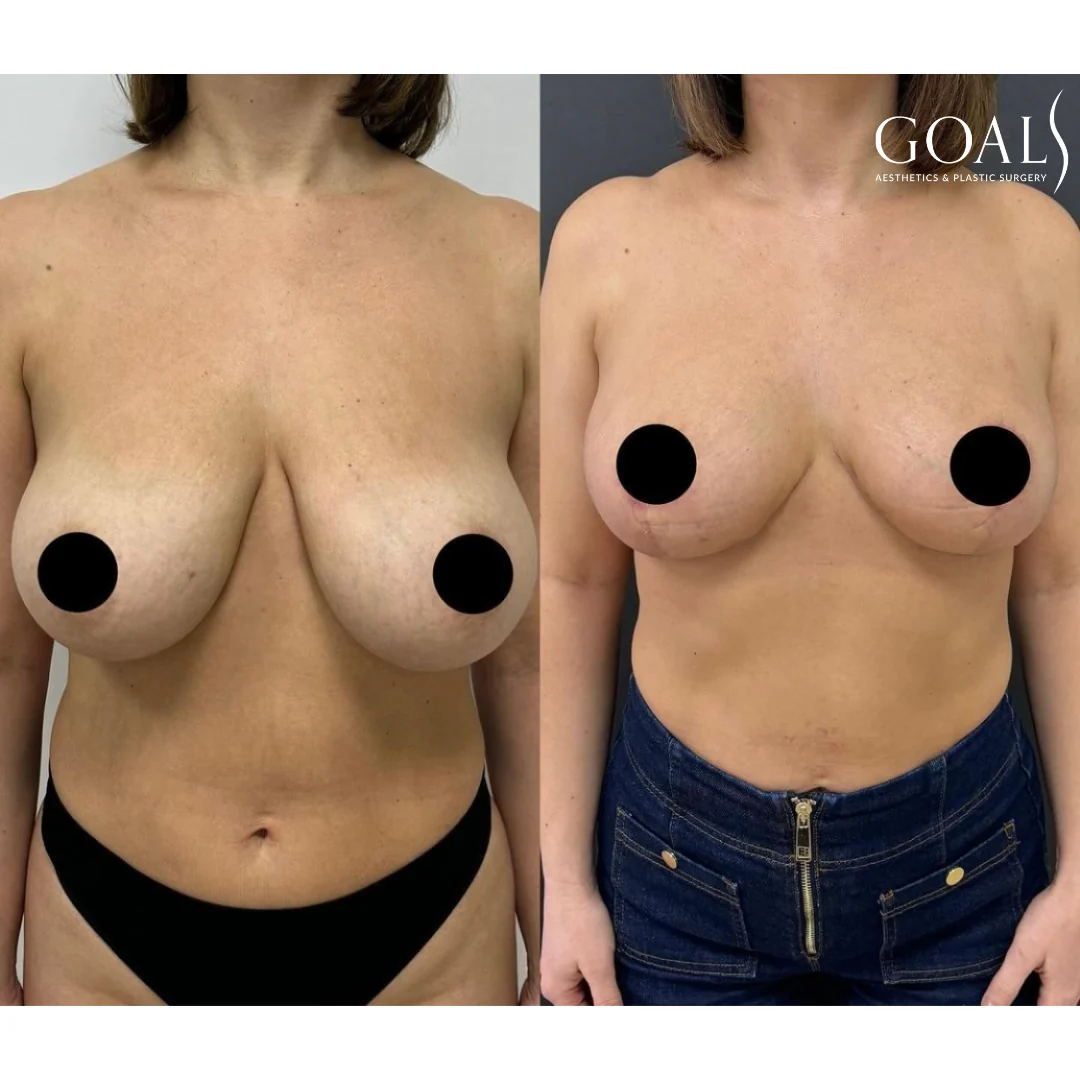
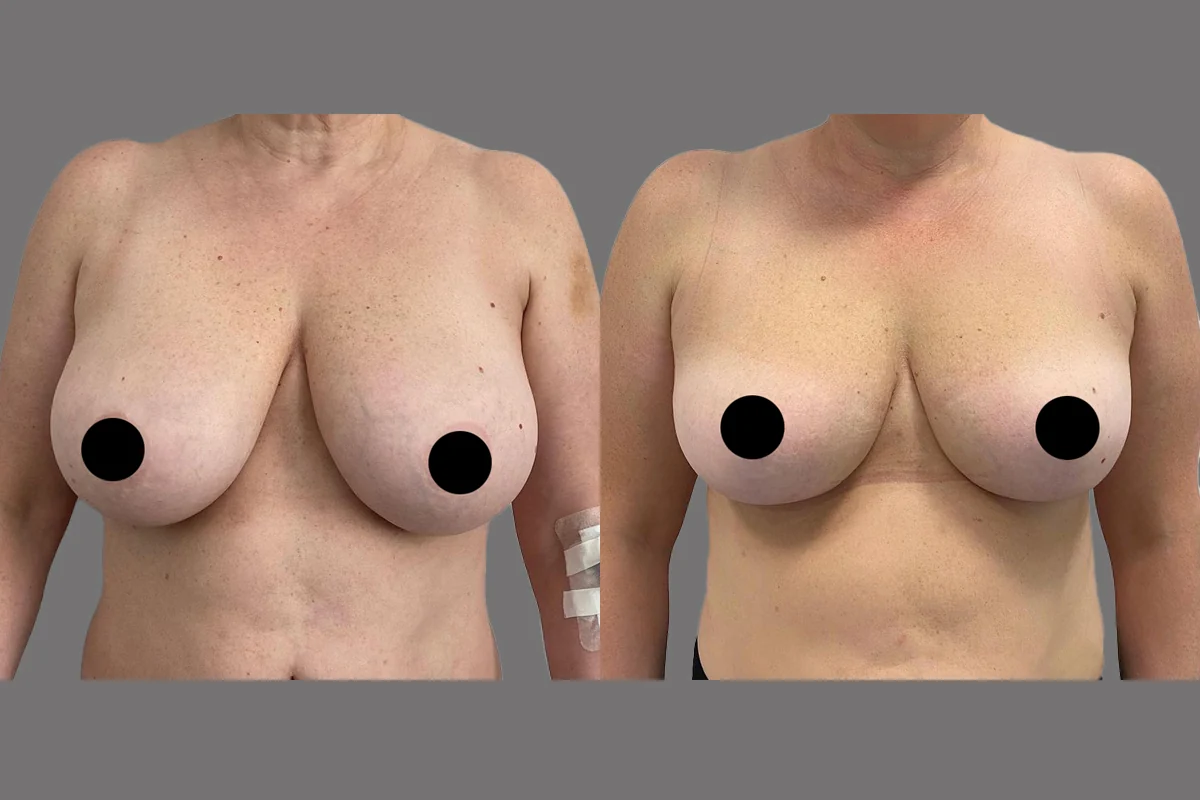
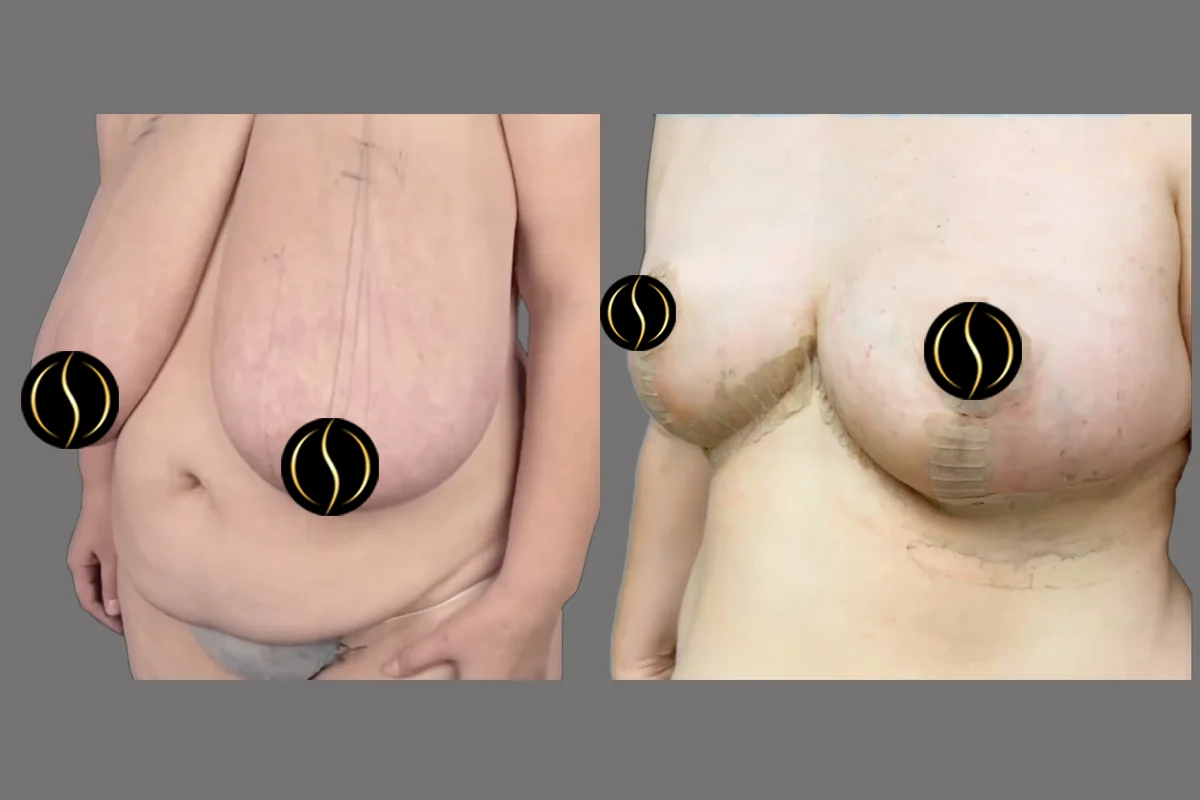
Real patients, published with written consent. Photographs are not retouched or AI-generated. Individual results vary — these images show outcomes for these patients and are not a guarantee of your own.
Try it
Type your height and weight. Your numbers stay on your device. We do not see or save them.
BMI is just one number. Your surgeon also looks at your health and your goals. BMI alone does not decide if you can have surgery.
Seeing what each does for size, weight, and symptoms helps you and your surgeon decide whether a full breast reduction or a lift alone is the better fit.
| Criterion | Reduction | Lift Only |
|---|---|---|
| Removes | Tissue, fat, and skin. | Mostly skin. |
| Size | Noticeably smaller. | About the same. |
| Pain Relief | Eases strain. | Little change. |
| For | Large, heavy breasts with symptoms. | Sagging, good size. |
| Insured | Sometimes covered. | Usually not. |
Your journey
6 Steps to Lasting Relief.
Sit down with our team to talk goals and symptoms, look over your shape, and see if reduction fits you.
Go over how much tissue to take and the new shape and nipple position, so you can picture the result and what fits you.
Run the medical checks so the team can sign off that you are ready, then walk you through each step of getting prepared.
The surgeon clears excess tissue, fat, and skin, reshapes the breast, and repositions the nipple for a natural look.
You wear a support bra and take it easy at first, with simple aftercare to help everything settle well.
Follow the aftercare plan with check-ins along the way to track healing and support your best result.
Benefits
Breast reduction leaves breasts that are lighter, firmer, and in better proportion, and for many people it relieves the strain that heavy breasts put on the body.
Relief from neck, back, and shoulder strain.
Lighter, firmer breasts that sit higher and feel more comfortable.
From workouts to fitted tops, a lighter shape can help you move and feel easier through everyday Bronx life.
Moving, running, and training feel easier and more comfortable.
Bras and tops finally fit the way you want.
Safety
We screen every patient up front, use careful surgical technique to limit scarring, and give clear pre- and post-op support, so the procedure stays safe.
Your health, symptoms, and goals get checked before surgery, so the plan suits you and you are cleared.
Skilled reduction technique placed to keep scarring discreet.
Clear pre- and post-op support, with easy access to the team.
Pricing
Final cost depends on how much is removed and the details of your case; some reductions may qualify for insurance, set at consult.
Financing / payment plans
Price locked in at booking, once your consult is done.
Transparent pricing: no hidden fees, all of it spelled out in the contract.
Prices shown are starting prices and depend on the number of areas treated. Final pricing is confirmed at your consultation. Cosmetic procedures are not covered by insurance.
Try it
Pick a procedure to see an estimate. Your numbers stay on your device. We do not see or save them.
This is an estimate, not a quote. It splits the starting price over the months you pick, with no interest. Lenders set your real rate and terms. Your price is confirmed at your consultation.
Why Goals
An E 205th St spot in Norwood, easy to reach by subway or bus.
Full aftercare and easy in-person follow-ups at the clinic.
Surgeons who handle breast work regularly.
Reduction technique placed to keep scars discreet.
Thousands of procedures carried out across our network.
FAQ
That is decided with you, not imposed on you. Your surgeon discusses the size that would relieve your symptoms while staying balanced with your frame, and plans the breast reduction around that rather than a fixed cup size. Most people aim for a size that eases the strain and fits their body. Exact cup sizes are hard to promise because tissue varies, but your surgeon gives a realistic range.
It is possible for some people but not guaranteed, since a breast reduction removes tissue and repositions the nipple, which can affect the milk ducts. The chance depends on the technique and how much is removed. If future breastfeeding matters to you, say so at the consultation, and your surgeon can plan to protect that connection as much as possible and be honest about what is realistic.
There is no single size requirement; it comes down to symptoms and proportion, not a number. People who benefit usually have breasts heavy enough to cause neck, back, or shoulder strain, skin irritation, or daily limits. Your surgeon assesses your size against your frame and symptoms. If sagging rather than weight is the issue, a lift may suit better.
Many people notice the weight is gone almost immediately, even while still healing, because the source of the strain is removed. Surgical soreness and swelling take time to settle, so full relief builds over the weeks. Easing of neck, back, and shoulder strain is among the most reported benefits, felt clearly once early healing is behind you.
The results are long-lasting, since the tissue removed does not come back. The breasts can still change with significant weight change, pregnancy, and aging, which may cause some settling. Keeping a stable weight and good support helps the result hold. Most people enjoy a lighter, firmer shape, and lasting relief, for many years.
Learn more
This is a structured, thorough overview of breast reduction as offered at our Bronx clinic: what the procedure is, who it suits, how the surgery is performed, what recovery involves, the results and risks, and how cost works. It is written to give you an organized understanding before deciding whether to book a consultation, where our experienced surgeons can assess your individual case.
Breast reduction, known medically as reduction mammoplasty, is a surgical procedure that removes excess breast tissue, fat, and skin to reduce the size of the breasts and bring them into better proportion with the body. It is both a functional and a cosmetic procedure: functional because overly large breasts impose a real physical burden, and cosmetic because the operation also reshapes and lifts the breast as part of reducing it. The procedure is well established, with a long clinical track record, and is among the more consistently satisfying operations in plastic surgery precisely because it addresses tangible daily discomfort rather than appearance alone. It is performed on women seeking relief from large breasts and, in a distinct form, on men, where the equivalent goal is achieved through specialized techniques. It is helpful to distinguish a reduction from related breast procedures it is sometimes confused with.
Unlike an augmentation, which increases size, a reduction decreases it; unlike a lift performed in isolation, which repositions tissue without removing significant volume, a reduction does both, taking away excess while also elevating and reshaping. Understanding the procedure as fundamentally about removing volume and weight, with lifting and reshaping as integral parts of that process, gives the clearest picture of what it sets out to achieve and why its effects are felt physically as much as seen.
The primary indications for breast reduction surgery are the physical symptoms that accompany disproportionately large breasts. These commonly include chronic neck, shoulder, and upper-back pain; painful grooving where bra straps bear the weight; skin irritation or rashes in the fold beneath the breasts; restricted physical activity; and difficulty finding well-fitting clothing. Many patients also report postural strain and headaches attributable to the constant forward load. Beyond the physical, there is frequently a significant impact on confidence and quality of life.
The condition of excessively large breasts is sometimes termed macromastia, and when its symptoms are pronounced and persistent despite conservative measures such as supportive garments or physical therapy, surgical reduction becomes the definitive solution rather than ongoing symptom management. The persistence of these symptoms is an important part of the clinical picture. Many candidates have spent years trying to manage the discomfort through better-fitting bras, posture correction, pain relief, or physical therapy, with only partial and temporary success.
When the root cause is the weight and volume of the breast tissue itself, these measures address symptoms without resolving the source. This is why, for appropriately selected patients, surgery is regarded not as a first resort but as the definitive intervention after conservative options have been exhausted.
Suitable candidates are generally individuals in good overall health who experience the physical or psychological burdens of disproportionately large breasts and hold realistic expectations about the outcome. Being at or near a stable weight is beneficial, since significant subsequent weight change can alter results, and for women, having completed childbearing is often advised because future pregnancy can affect both the breasts and the durability of the result.
Candidacy also depends on the absence of medical conditions that would make surgery unsafe, which the preoperative assessment evaluates. The procedure can be considered alongside related options such as a breast lift, breast augmentation for those seeking different changes, or a broader mommy makeover, with the consultation determining the most appropriate path. The timing of the procedure within a person's life is worth weighing thoughtfully. Because significant weight fluctuation and pregnancy can both alter the results, the most durable outcomes tend to follow when these factors are settled.
This does not mean the procedure is unavailable to others, but rather that the consultation includes an honest discussion of how individual circumstances might affect the longevity of the result, allowing each person to choose the timing that best serves a lasting outcome.
While reduction is most associated with women, enlarged breast tissue in men is a common and distinct condition requiring its own approach. Male breast reduction addresses gynecomastia, the development of excess glandular tissue, fat, or both in the male chest, which can be a source of considerable self-consciousness.
The procedure, available as gynecomastia surgery, uses techniques tailored to the male anatomy, typically combining the removal of glandular tissue with liposuction of excess fat to create a flatter, firmer, more masculine chest contour. Although the underlying objective, restoring proportion and relieving discomfort, parallels that of female reduction, the surgical approach differs meaningfully, which is why it is treated as a separate procedure with its own assessment and planning.
Recognizing gynecomastia as a legitimate medical and aesthetic concern, rather than something to be dismissed, is important, since many men live with it for years before learning that an established surgical solution exists. The condition can arise from hormonal factors, certain medications, weight changes, or no identifiable cause, and the assessment considers these contributors. For men whose chest contour has affected their confidence or comfort, the procedure can be as meaningful as a reduction is for women, which is why it warrants the same careful, individualized planning.
A reduction mammoplasty is performed under general anesthesia and generally takes between two and four hours depending on complexity. The surgeon removes the predetermined amount of breast tissue, fat, and skin, reshapes the remaining tissue into a more proportionate form, and repositions the nipple and areola to a natural height on the reduced breast.
Several incision patterns exist, with the choice depending on breast size, the degree of reduction required, and individual anatomy; the surgeon selects the approach that balances effective reduction against scar placement and explains where resulting scars will fall. Because the procedure simultaneously reduces and lifts, the result is intended to be a smaller, better-shaped, and more elevated breast rather than merely a deflated version of the original, which is central to a natural outcome.
The amount of tissue removed is planned in advance based on the patient's anatomy and goals, balancing the relief of symptoms against a natural, proportionate appearance. An experienced surgeon aims not simply to make the breasts as small as possible but to achieve a size and shape that suits the individual's frame and lifestyle. This planning is a collaborative part of the consultation, where the patient's own preferences regarding proportion are discussed alongside the surgeon's assessment of what will produce a balanced, lasting, and natural result.
Recovery follows a predictable course. Patients typically return home the same day or after a short stay and wear a supportive surgical bra throughout the initial healing period. The first several days involve soreness, swelling, and bruising that subside progressively, and most people take approximately one to two weeks away from work, depending on the physical demands of their occupation.
Strenuous activity, exercise, and heavy lifting are restricted for several weeks to protect the healing tissues and the developing shape. A frequently noted feature of recovery is that the pain caused by the former weight of the breasts often resolves almost immediately, even as surgical healing proceeds. Adherence to the surgeon's aftercare instructions, particularly the activity restrictions and garment use, materially influences both comfort and the quality of the final result. It is worth setting expectations about the longer arc of recovery as well.
While the acute phase resolves within weeks, swelling can take several months to fully settle, and the breasts continue to refine into their final shape over that period. Sensation changes, common in the early weeks, frequently improve over the months that follow. Patience through this gradual settling is rewarded, as the result seen at a few days or weeks is not the final outcome, which emerges more completely once healing is well advanced.
The results of breast reduction Bronx procedures are generally long-lasting and rate among the highest in patient satisfaction across plastic surgery, owing to the combination of symptom relief and improved proportion. Scarring is an inherent and unavoidable aspect, since the procedure requires incisions; scars fade considerably over time but do not disappear entirely, and the surgeon places them to be as inconspicuous as possible, typically concealed by the breast contour or a bra.
As with any surgery, there are risks to understand, including those associated with anesthesia, bleeding, infection, altered nipple or skin sensation, and, for some patients, effects on the ability to breastfeed in the future. A thorough consultation reviews these considerations individually, ensuring expectations are realistic and the decision is fully informed. Realistic expectations are central to satisfaction.
The trade of permanent scarring for relief from chronic symptoms and improved proportion is one the overwhelming majority of patients report being content with, but it is a genuine trade that should be understood clearly beforehand. A candid surgeon ensures patients grasp both the substantial benefits and the inherent limitations, including scarring and the possibility of altered sensation, so that the decision rests on accurate information rather than an idealized picture.
Cost is determined by the specifics of the procedure, including the extent of reduction, the technique employed, and whether it is combined with other procedures, rather than by a single fixed figure. It is detailed transparently at the consultation prior to scheduling, with no undisclosed charges, and financing and payment plans are available for those who prefer to distribute the cost. Because the procedure often addresses genuine medical symptoms, it is worth discussing individual circumstances that may bear on coverage.
At our Bronx clinic, breast reduction is offered as part of a comprehensive range of procedures. Documented outcomes may be reviewed in the before & after gallery, with further information on the blog. The appropriate next step is a consultation, recognizing that suitability, technique, and results are determined individually by the surgeon. Choosing where to have the procedure performed is itself part of a sound decision. An accredited facility, experienced surgeons, and a thorough, unhurried consultation are baseline expectations rather than extras, given that this is real surgery with real considerations.
Approaching the decision with that standard in mind, and using the consultation to ask questions freely and confirm you are both a suitable and a fully informed candidate, is the surest route to a result you will be satisfied with over the long term.
About Breast Reduction
Breast Reduction at other Goals clinics
Get started
Whether it is a breast reduction, a lift, or a different procedure, our Bronx team can talk it through and build a safe, realistic plan with you.
Prefer to talk now? (833) 462-5769
Free · No obligation
Tell us how to reach you. A patient coordinator calls you back — usually the same day.
Free · No obligation
Ask me anything. I usually reply straight away.
If you share your number, a Goals coordinator may call or text you about your consultation. Message and data rates may apply.
Nora is an automated chat. She cannot give medical advice or say whether a procedure suits you.