Thinning Crown
Scalp showing at the vertex, where growth factors reach tired follicles.
A no-surgery treatment in Atlanta that runs on your own blood. Platelets are concentrated and put back into thinning areas, where their growth factors do the work.
From $1,200

Hair restoration is done at our Atlanta clinic at 3576 Chamblee Tucker Rd. Call us and we will help you find the nearest Goals clinic that offers it.
Conditions we treat
PRP fits most early and moderate thinning, in men and in women alike.
Scalp showing at the vertex, where growth factors reach tired follicles.
A part that reads wider each year. Often the first sign in women.
Male and female pattern loss, where the evidence is strongest.
Heavy shedding a few months after birth, as hormone levels drop back.
More hair in the brush, before any bare patch has set in.
Backing up grafts and native hair, before or after a transplant.
Candidacy
Early or moderate thinning, and you want something natural without surgery. Since it runs on your own blood, it works while follicles are weak but still alive rather than long gone.
Fine hair still growing where it was thick.
Your own platelets. Nothing foreign goes in.
Non-surgical, no operating room, nothing much to recover from.
Keeping native hair strong around a graft.
Ready to run a course spaced over months.
Low-cost hair packages abroad look good on paper. What gets cut is what matters: an honest scalp check, someone to follow up with, and care near home.
| Left Step | Right Step |
|---|---|
| Left StepWeeks spent comparing clinics online, a deposit wired overseas, then flights booked. | Right StepYou come in, or connect online, for a real scalp assessment with a qualified hair restoration provider who reads your hair and history. |
| Left StepYou land where you don't really speak the language, and the scalp consult is rushed that same day. | Right StepYour plan and the session schedule are set out beforehand, in your language, under U.S. clinical standards. |
| Left StepThe session runs somewhere you've never set foot, often high volume, with barely a look at your scalp first. | Right StepOn the day your blood is drawn, spun, and injected in a clean accredited Atlanta room. About an hour, start to finish. |
| Left StepYou fly home tired. The scalp is sore and you've no idea whether that's normal or worth worrying about. | Right StepNothing much to recover from. You drive yourself home, head back to work, and the day carries on. |
| Left StepYour only option is urgent care nearby, where nobody treated you and no record exists of how your blood was handled. | Right StepIf something feels off between sessions, you reach the same local team that treated you. We see you in person, look, and adjust as needed. |
| Left StepThat visit costs more time and money, while the clinic abroad can only help over WhatsApp, a time zone away. | Right StepFollow-ups and progress photos happen at the same clinic, with the same team, right across the course. |
A general comparison. Which approach suits you is decided at a consultation with a licensed surgeon.
Compare
| Overseas Package | Goals U.S. Clinic | |
|---|---|---|
| Total cost (real) | The session price, plus flights, a hotel, and days off work on top. | No surprises. The treatment and a short local drive, spelled out. |
| Travel & time off work | Long flights, jet lag, days away from work and home. | A local visit, then straight back to your routine. |
| Blood handling | Variable. You're trusting foreign rules and a short stay. | Accredited U.S. handling, drawn and spun on site. |
| Provider/team | Hard to verify who treats you, and you won't see them again. | Qualified hair restoration providers you meet before and after. |
| Emergency backup | No local clinic. Urgent-care staff are left guessing. | In-person follow-up and local help if anything crops up. |
| Follow-up care | Messages only. Nobody can see your scalp. | Booked in-person checkups, progress photos, plan changes. |
| Communication | Language gaps, time zones, slow replies. | A local team, written aftercare, and a number to call. |
| Session protocol | No knowing the spin count or concentration. | A set protocol, gone through with you. |
A general comparison. Which approach suits you is decided at a consultation with a licensed surgeon.
Our surgeons
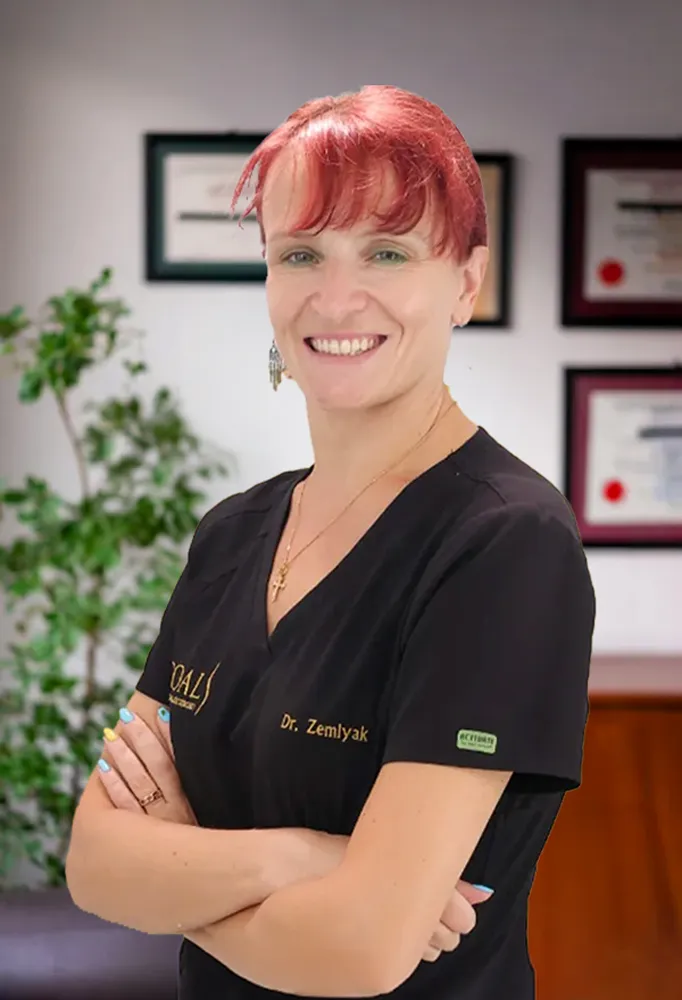
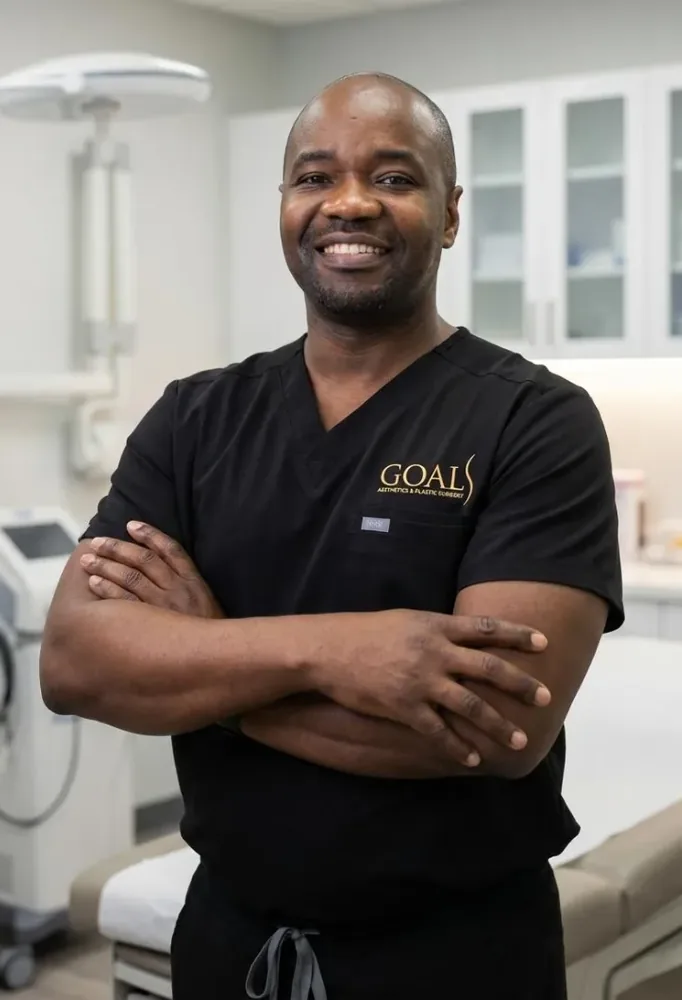
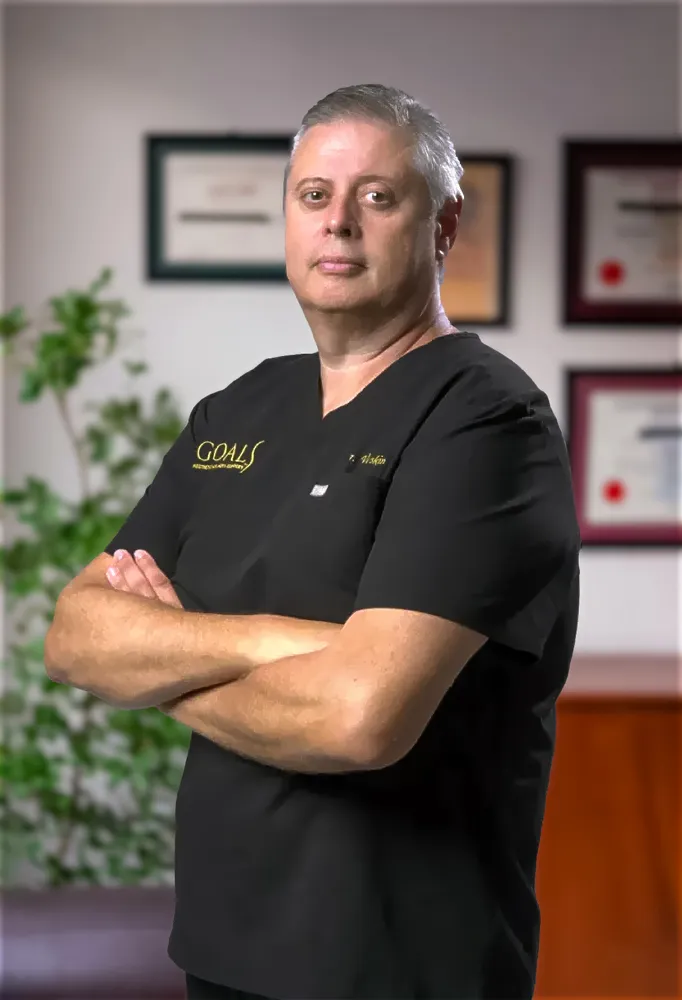
A qualified hair restoration provider oversees every session, never an unsupervised assistant. Meet the team before your first visit.
Licensed in NY · TX · CA
Safety
A treatment is only as good as the hands and the standards behind it. Every scalp session runs in a real clinical room, with people you can actually meet.
Sessions run in clean rooms held to U.S. accredited care.
Drawn from your own blood, so allergy is very rare.
Your provider and their team, reachable when questions come.
The scalp is numbed first, so the injections stay comfortable.
Same-angle photos each visit, so change is measured not guessed.
Why Goals
One local team runs your assessment, sessions, and follow-ups.
About an hour, so you can slot one in and get on with the day.
Take whichever location suits your commute. Same scalp protocol at both.
Skilled qualified medical providers run each visit and adjust as your scalp answers.
If PRP alone won't get you there, we say so before you pay.
A quote drawn from examining your scalp, with nothing added later.
FAQ
About the same as a routine blood test, drawn from your arm. It goes straight into the centrifuge, so nothing is stored or sent anywhere.
Yes. Eat normally and drink plenty of water the day before. Well-hydrated blood separates better and the draw itself goes easier.
Not automatically, but it matters. Bring your medication list. Anti-inflammatories blunt platelet activity, so we may ask you to pause them.
No. It's drawn, spun, and injected in the same room within the hour. Nothing is added, nothing leaves, and nothing is kept afterwards.
Because it does. Spin speed, time, and concentration all change the result. We follow a set protocol, not a per-visit guess.
Some people do, early on, as weaker hairs make way for stronger ones. It settles, and it isn't a sign the treatment is failing.
PRP is one of several ways we handle thinning. Here's what else the Atlanta team works with.
About PRP Hair Restoration
PRP Hair Restoration near you
Explore Goals
Non-surgical options
A transplant isn't the only route, and plenty of people don't need one. These in-office treatments back the scalp and natural growth without a scalpel. A sensible first move on early thinning.
Results vary with your skin, your starting point and how many sessions you have. Your consultation covers what is realistic for you, before you commit to anything.
Prefer to talk now?(833) 462-5769
Patient Guides
Written by the team that performs the procedure, to read before your consultation.
 How to Verify a Plastic SurgeonFour free checks that take ten minutes: the NPI registry, the state medical board, ABMS board certification and the facility’s accreditation. Step by step, with every link.Read the guide
 Questions to Ask Before Any SurgeryTen questions to ask any plastic surgeon before you book, what a good answer sounds like, the warning signs, and a version you can print and bring to your consultation.Read the guide
General information, not medical advice. What applies to you is decided at a consultation with a licensed surgeon.
Get started
PRP might be the whole plan or one part of it. Either way, the Atlanta team gives you a straight read and a route that actually fits.
Prefer to talk now? (833) 462-5769
Learn more
PRP is the treatment people find easiest to say yes to, and the reason is simple: nothing goes into your scalp that did not come out of your arm twenty minutes earlier. There is no drug, no synthetic filler, no donor material. We take a small amount of your blood, separate out the fraction that carries the repair signalling, and put that fraction back where the follicles are struggling. The technique came out of orthopaedics and wound care long before anyone pointed it at hair, which is part of why its safety record reads the way it does. What it asks of you is patience, because a single session is close to pointless and change arrives on the timescale of a hair cycle.
At Goals it runs as a short in-office visit with qualified hair restoration providers: a draw, a spin, a numbing step, then a set of injections across the thinning areas. About an hour from arrival to leaving. Where PRP earns its reputation is early to moderate pattern loss, and alongside a graft. Where it does not is a scalp that has been bare for years, because growth factors act on follicles that still exist. This page covers what is actually in the syringe, how it works on the follicle, how it compares to everything else we offer, who benefits, the schedule, results, how long they hold, safety, and cost, so you know what to expect before you walk into our Atlanta hair restoration clinic. Nobody here will promise a full head of hair from a course of injections. For the right candidate it is one of the more useful non-surgical options we have, and for the wrong one we will say so at the consult rather than after you have paid.
Blood is red cells, white cells, plasma, and platelets. Platelets are the ones everybody associates with clotting, and that reputation undersells them. Inside each platelet sit alpha granules, small packets loaded with signalling proteins the body releases wherever tissue needs repairing. Spinning your blood in a centrifuge separates it by density and lets us draw off the layer where those platelets are concentrated, typically several times denser than they sit in ordinary circulation. That concentrate is the PRP. Plasma, your platelets, nothing else. No preservative, no additive, nothing manufactured.
Once the plasma is placed in the scalp the platelets release their contents, and the growth factors go to work on several fronts at once. PDGF and IGF-1 push the dermal papilla, the cluster of cells at the base of the follicle that dictates whether it grows and how thick the hair comes out, to proliferate rather than shut down. VEGF drives the formation of small blood vessels around the follicle, since a better-supplied follicle produces better hair. Others calm the low-grade inflammation that sits around miniaturising follicles in pattern loss. The net effect is a follicle held longer in growth and pulled out of rest sooner than it would be.
You will run into PRF, platelet-rich fibrin, presented as the newer option. The difference is in the spin. PRF is processed more gently and without anticoagulant, which leaves a fibrin scaffold in the preparation. That scaffold holds the platelets together and releases their contents over days rather than dumping them at once, which in theory means a slower, longer signal. It also means fewer platelets per millilitre. Neither is clearly better and the evidence does not settle it. What matters more than the acronym a clinic advertises is whether they follow a consistent protocol.
PRP is one of several things we do without surgery, and they overlap. LLLT uses red light rather than injections and asks nothing of you but sitting still. Mesotherapy injects a prepared nutrient blend instead of your plasma. Darsonval passes a high-frequency current across the surface to lift circulation. PRP is the only one of the four that is autologous, meaning the active ingredient is manufactured by your own body, and it carries the largest body of published work behind it. That is the case for choosing it. The case against is that it involves needles and a blood draw, which some people would simply rather avoid.
Worth stating plainly what PRP cannot do. A transplant, such as FUE, lifts follicles out of a donor area and places them where hair has gone, and that coverage stays. PRP moves nothing. It works only on follicles that are already there and still capable of producing hair, which is why it does nothing at all on skin that has been smooth for a decade. The two are not competitors. PRP is routinely run around a graft to protect the native hair beside it, so a new hairline does not end up marooned in front of thinning that carried on regardless.
The people who do well have early to moderate thinning with follicles that are shrinking rather than dead. Fine, wispy hair growing where the density used to be is the signal there is something to act on. Pattern loss in both men and women is where the published results are strongest. Loss driven by a stressor or a hormonal shift also responds, since the follicles were never destroyed, only interrupted. Women are a large share of who we treat, and our women's restoration options are built around female patterns like a widening part and diffuse thinning across the top.
Pattern loss does not look the same across the sexes and the treatment plan follows that. In men it concentrates at the temples and the crown, and PRP is often used to hold ground at the hairline or to support a graft that has already been done. In women the loss is usually diffuse across the top with the part widening as the giveaway, and the hairline stays put. That diffuse pattern suits PRP well, since there is surviving follicle across the whole treated area rather than a bare zone to fill. Women also come in after pregnancy or a thyroid issue, where the cause is identifiable and the follicles recoverable.
The visit is unremarkable and that is the point. We take a small amount of blood from your arm, the same as any routine test. It goes into the centrifuge and spins for a few minutes while you sit. The provider draws off the platelet-rich layer, numbs the scalp, and injects the plasma across the thinning zones in a series of small placements. The numbing is the part people forget to expect; with it, most describe pressure rather than pain. You are upright and awake throughout, nothing sedates you, and you drive yourself home afterwards.
A course, not an appointment. The usual starting point is three sessions roughly a month apart, then a booster every six months or so. The month gap is not arbitrary: it lines up with how the follicle responds to repeated signalling rather than a single burst, and compressing the schedule does not speed anything up. Your provider sets the final rhythm after examining your scalp, because a diffuse thinning across the whole top is a different job from a small area at the crown. The people who report nothing happened are, in our experience, usually the people who did one session and stopped.
Results arrive in a sequence and knowing it prevents misreading the early weeks. Shedding eases first, which is subtle and easy to overlook. Existing hair then thickens, so the scalp reads less visibly through it. New growth comes last, often around the three or four month mark, filling in over the following months toward a fuller result near six. Some people shed slightly more at the very start as weaker hairs are pushed out ahead of stronger replacements; that is expected and passes. Photographs catch all of this well before a bathroom mirror does, which is why we take them. Real timelines sit in our before & after gallery.
This is where clinics tend to go quiet, so we will not. PRP is not permanent. It supports and strengthens the follicles you have, but it does nothing to the underlying reason they were miniaturising in the first place. Pattern loss is driven by hormones and genetics, and neither is affected by a platelet injection. Stop the boosters and the follicles drift back toward the trajectory they were on. Most people hold their result with a maintenance session once or twice a year, and many pair PRP with a medical treatment aimed at the underlying cause. Anyone selling it as a one-off cure is not being straight with you.
The safety profile is good largely because the material is yours. There is nothing to react allergically to, no rejection risk, and no foreign substance introduced. What people do get is tenderness at the injection sites for a day or so, sometimes mild swelling across the forehead, and occasionally small bruises where the needle went in. All of that settles on its own. The blood draw carries the same minor risks as any blood test. Tell your provider about blood thinners or anti-inflammatories, since those affect how platelets behave and may need pausing first.
Little is required of you. You can go straight back to work. We usually suggest leaving the hair unwashed for the rest of that day, skipping the gym, sauna, and pool for about twenty-four hours, and staying off anti-inflammatory painkillers for a few days, since blunting inflammation is working against the mechanism you just paid for. If the scalp is tender, paracetamol is fine. Beyond that, carry on as normal and book the next session before you leave rather than after you have forgotten.
The figure comes from how many sessions your scalp needs and how the course is built, so it is confirmed after an examination rather than quoted from an emailed photo. Nothing is added later. Compared with other **prp hair restoration atlanta** options, staying local is worth something concrete: no airfare, no hotel, and follow-up with the team that treated you rather than a message thread abroad. Financing options through outside partners are there so a course can be spread over time, and the team will go through what you need. You can read about the people who will treat you on our surgeon profiles page, and follow-up care is part of every plan.
If the thinning is early, a part that keeps widening, a crown you can see through, more hair in the drain than there used to be, the sensible next move is having someone look at it properly. An assessment is the only way to know whether your follicles are still viable, and viability is the whole question with PRP. It also tells you whether PRP alone is the right call or whether it belongs alongside something else. You can start with a virtual consult and come in for the sessions themselves. Either way you get a straight answer about what is realistic, including if that answer is a different treatment.
Free · No obligation
Tell us how to reach you. A patient coordinator calls you back — usually the same day.
Free · No obligation
Ask me anything. I usually reply straight away.
If you share your number, a Goals coordinator may call or text you about your consultation. Message and data rates may apply.
Nora is an automated chat. She cannot give medical advice or say whether a procedure suits you.