Want a Fuller Chest That Feels Natural
No device, no capsule, nothing that can rotate or need replacing.
Uses your own fat to add chest definition and fill, with no implant.
From $8,000
Goals Aesthetics & Plastic Surgery – Bronx
174 E 205th StMon–Sat, 10:00–19:00 local time
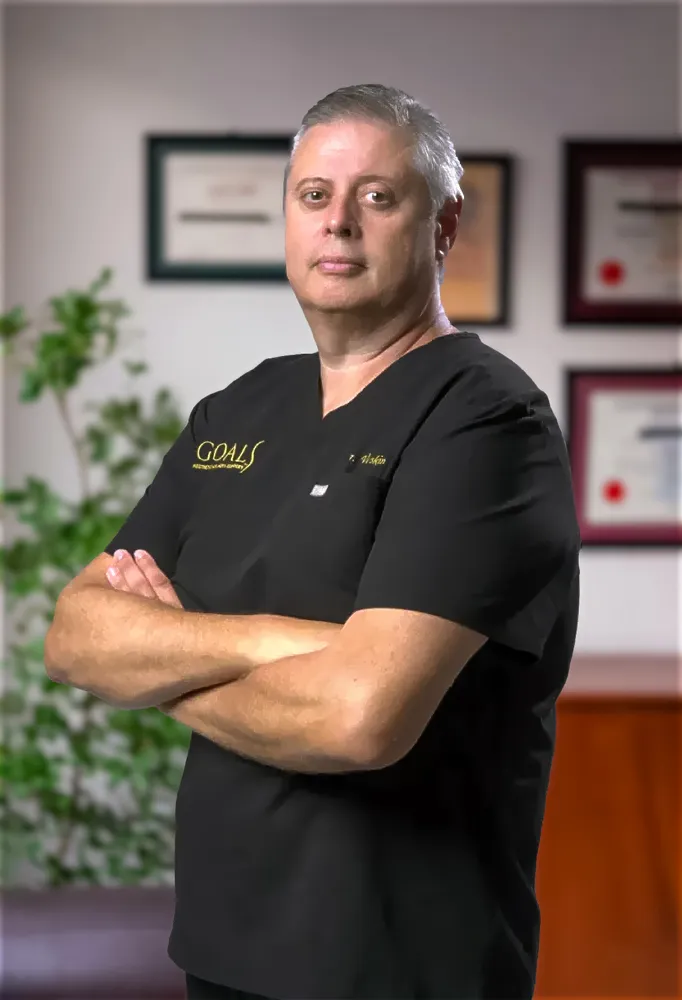
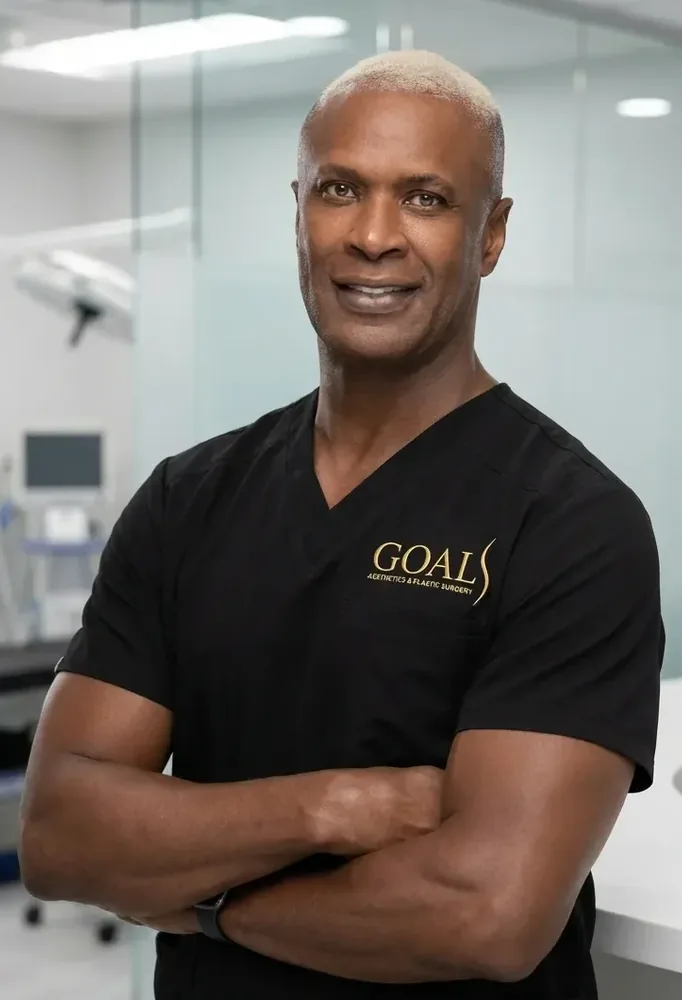
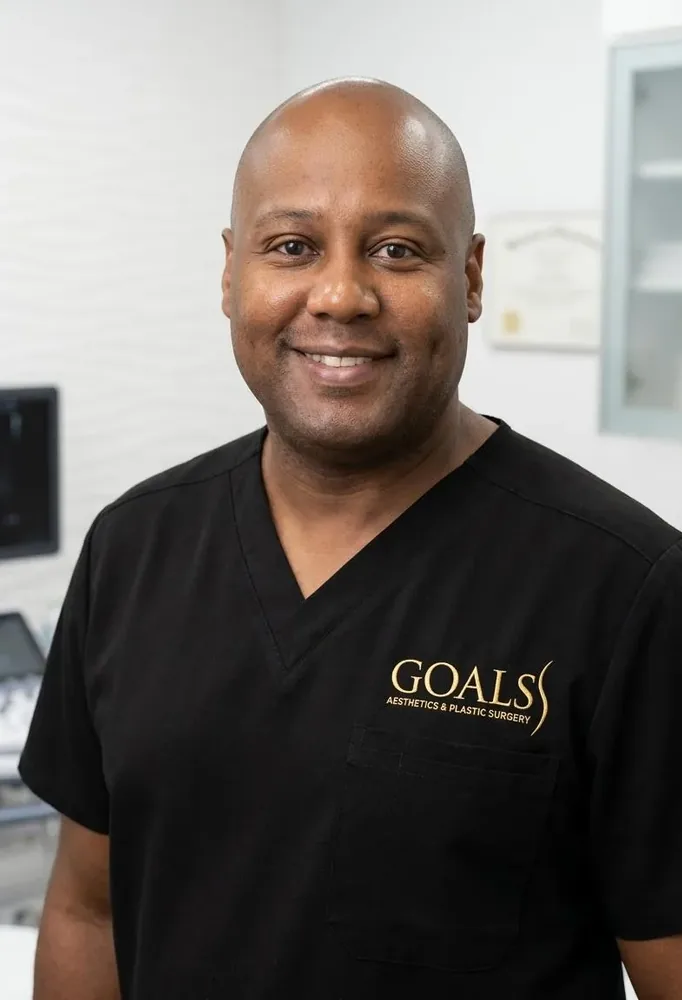
Surgeons: Dr. Sergey Voskin, Dr. Christopher Johnson, Dr. Erwin Douyon
Overview
Uses your own fat to add chest definition and fill, with no implant.
Fat is taken by FlexSculpt from the abdomen or flanks — which sharpens the waist at the same time — purified, and placed into the chest in fine layers so it establishes a blood supply.
How it works
Fat is taken by liposuction from wherever you have it — flanks, abdomen, back — which slims that area too.
The fat is purified so that what is grafted is fat cells rather than fluid and oil.
It is placed in fine passes across the chest so each parcel has a blood supply and survives.
Candidacy
Men who want more chest without an implant, and who have fat available elsewhere to move.
No device, no capsule, nothing that can rotate or need replacing.
Flanks, abdomen or back with enough to harvest — this is the limiting factor.
Most patients rate the flank reduction as highly as the chest.
Fat transfer refines a chest. It does not double it.
How pectoral fat transfer compares with pectoral implants.
| Where the volume comes from | Your own fat, taken by liposuction | A solid silicone implant |
|---|---|---|
| Feel | Soft and entirely natural | Firm, like muscle |
| Donor area | Slimmed at the same time | Untouched |
| How much volume | Modest, and some is reabsorbed | Substantial and predictable |
| If you are very lean | May not have enough to harvest | Works regardless |
Your journey
Here is how it goes, step by step.
Sit down with your surgeon in Bronx, go over your goals and your medical history, and confirm pectoral fat transfer is the right operation.
What is being done, where the incisions go, what it will cost, and what result is realistic for your anatomy.
Bloodwork and medical clearance, what to stop taking, and how to set your home up for the first week.
You arrive, you are marked and prepped, and the operation is performed by a licensed U.S. surgeon in an accredited facility.
Follow-ups, drains or sutures out where relevant, and clear instructions you can actually follow.
Swelling resolves over months, not days. The final result is judged at the end of that, not the week after surgery.
Recovery
Recovery is a sequence, not a date. This is the shape of it.
Compression at both the donor and chest areas.
Light routine.
No chest training; the graft is establishing.
Final volume once the surviving fat has settled.
Benefits
Fat transfer adds soft, natural volume to the chest and slims the area it came from. Expect some of the transferred fat to be reabsorbed over the first three months — that is planned for, not a complication.
Filled where training tends not to reach, particularly the upper inner chest.
It is your own tissue, so it moves and feels like tissue.
The liposuction that supplies the graft is part of the result, not just a means to it.
The fat that survives the first three months stays.
Safety
Every procedure is performed by a licensed U.S. surgeon in an accredited facility. Goals is a management company; the medical practice and the surgeon responsible in your state are named in our terms.
Our surgeons
Each surgeon’s training and licenses are listed on their own page.
Pricing
Pectoral Fat Transfer starts at $8,000. Your price is confirmed at consultation and depends on what your case actually needs. A $500 deposit reserves your surgery date.
Financing available, with monthly plans.
Reserves your date and comes off your balance.
No hidden fees. Everything is detailed up front.
Prices shown are starting prices and depend on the number of areas treated. Final pricing is confirmed at your consultation. Cosmetic procedures are not covered by insurance.
Try it
Pick a procedure to see an estimate. Your numbers stay on your device. We do not see or save them.
This is an estimate, not a quote. It splits the starting price over the months you pick, with no interest. Lenders set your real rate and terms. Your price is confirmed at your consultation.
Why Goals
Our clinic on 174 E 205th St, easy to reach across Bronx.
Thorough aftercare and in-person follow-ups in Bronx, not a phone call to another state.
Pectoral Fat Transfer is not an occasional case here. Volume is what makes a surgeon predictable.
Your quote is confirmed at the consultation and does not move afterwards.
Consultation, consent and aftercare in English or Spanish.
Clinics
FAQ
Usually half to three-quarters. What is there at three months is permanent.
Frequently. Gland is removed where it needs to be and fat is added where the chest needs shape.
Modestly. Fat transfer refines shape and adds fullness, particularly to the upper inner chest. If you want substantial projection in one operation, an implant is the honest answer.
Transferred fat behaves like the fat it came from, so significant weight loss will shrink it. A stable weight keeps the result stable.
Yes, usually after three to six months once the first has settled. Building in stages is a normal plan and often gives the best final result.
Learn more
This page is about pectoral fat transfer at Goals in Bronx. The clinic is at 174 E 205th St, Bronx, NY 10458, and consultations there are free and carry no obligation. Surgeons operating here include Dr. Christopher Johnson, MD, Dr. Erwin Douyon, MD. Everything below — what the operation does, who it suits, what recovery involves and what it costs — is the same wherever you have it done, because the anatomy is. What changes from clinic to clinic is who you meet, how far you travel, and how easily you can get back for follow-ups, and those are the things worth deciding on.
Our Bronx clinic is at 174 E 205th St, Bronx, NY 10458, and it is where your consultation, your procedure and your follow-ups all happen — you are not consulted in one place and operated on in another. Consultations are free, run in English or Spanish, and end with a written quote rather than a range. Patients travelling in for pectoral fat transfer should plan to stay locally for the first night or two rather than fly home the same day, and to be back at the clinic for their early follow-up. We also operate in Brooklyn, Central Park, so if another address in New York is an easier drive, the same procedure is available there at the same price. Whichever clinic you choose, the surgeon is licensed in that state and the facility is accredited, and the practice responsible for your care is named in our terms rather than left vague.
Fat transfer to the pectoral region takes fat from an area where you have a surplus — usually the flanks, abdomen or back — purifies it, and injects it in fine passes across the chest to add volume and improve shape. It is a two-part operation: liposuction of the donor area, which is a visible result in itself, and grafting to the chest. Because the material is your own tissue, there is no implant, no capsule, no risk of rotation or displacement, and nothing to replace in fifteen years. What is grafted feels exactly like the rest of you, because it is.
This is the part that decides whether you are happy, and it should be discussed frankly. Grafted fat needs to establish a blood supply within the first days, and the portion that does not is reabsorbed. Realistically, a meaningful proportion of what is placed does not survive — surgeons vary in what they quote, and anyone quoting near-total survival is overselling. What improves survival is technique: fine passes spread through the tissue rather than large deposits, gentle harvesting and processing, and not overfilling a space that cannot support the volume. What survives the first three months is permanent. Many patients plan a second session to build on the first, and that is a normal approach rather than a failure of the first.
If you are lean and want substantial projection, an implant is the more reliable answer, and fat may simply not be available in sufficient quantity. If you carry fat on the flanks or abdomen, want a softer and entirely natural result, and are after refinement rather than transformation, fat transfer is usually better — and it improves two areas instead of one. The combination is also common: an implant for structure and fat over the top to soften the edges and fill the upper inner chest, which is the area implants tend not to reach and where training rarely produces fullness.
Good candidates are in good health, at a stable weight, and have enough donor fat to harvest — this is the single limiting factor and it is assessed by examination, not by conversation. Being at a stable weight matters more than in most procedures, because transferred fat behaves like the fat it came from: lose a significant amount of weight and the graft shrinks with you. Patients wanting a large increase in size in one session should understand the limits and consider an implant instead. Patients whose chest fullness is glandular are dealing with gynecomastia, which needs a different operation.
Usually under general anesthesia or deep sedation in an accredited facility, taking two to three hours depending on how much liposuction is involved. Donor areas are infiltrated and the fat is harvested at low pressure to keep the cells intact. It is then processed to separate viable fat from fluid, blood and oil. The purified fat is injected into the chest through small entry points using fine cannulas, in multiple thin passes and layers, so that each parcel is surrounded by tissue that can supply it. Both sides are matched as you go. You wake in compression over the donor areas.
The donor sites are the sore part; the chest itself is usually just tight and swollen. Expect bruising over the flanks or abdomen for two to three weeks and a compression garment worn there for around six. Most people are back to desk work in a few days to a week. Light activity at two weeks, full training at four to six. The instruction people find hardest is avoiding pressure on the chest — no lying face down, no heavy pressing — for the first few weeks, because pressure on a fresh graft reduces how much of it survives. The chest looks fullest immediately and settles down over the first three months as the unsurvived portion is reabsorbed.
Pectoral fat transfer at Goals starts at $8,000, confirmed at consultation, with a $500 deposit to reserve your date. The price reflects how many donor areas are treated. Risks include asymmetry, contour irregularity in the donor area, fat necrosis producing a firm lump, oil cysts, infection and, as with any fat grafting, unpredictable take. Ask your surgeon how they process the fat, how much they typically graft per side, and to see results at six months rather than at one week — the week-one photograph is a swollen chest full of fat that has not yet been through its reckoning.
About Pectoral Fat Transfer
Pectoral Fat Transfer at other Goals clinics
Get started
A consultation for pectoral fat transfer is free and carries no obligation. A surgeon will tell you what is realistic for you.
Prefer to talk now? (833) 462-5769
Free · No obligation
Tell us how to reach you. A patient coordinator calls you back — usually the same day.
Free · No obligation
Ask me anything. I usually reply straight away.
If you share your number, a Goals coordinator may call or text you about your consultation. Message and data rates may apply.
Nora is an automated chat. She cannot give medical advice or say whether a procedure suits you.