Thinning Crown
Scalp showing at the vertex, where the light reaches weakening follicles.
Red light at the wavelength follicles absorb, delivered in short in-office sessions in Atlanta. Nothing to feel, nothing to recover from, no needles at any point.
From $800

Hair restoration is done at our Atlanta clinic at 3576 Chamblee Tucker Rd. Call us and we will help you find the nearest Goals clinic that offers it.
Conditions we treat
Laser therapy fits most early and moderate thinning, in men and in women alike.
Scalp showing at the vertex, where the light reaches weakening follicles.
A part that reads wider each year. Often the first sign in women.
Early genetic loss at the hairline and crown, where the evidence is strongest.
Heavy shedding a few months after birth, as hormone levels drop back.
Diffuse loss showing up weeks after illness, surgery, or a hard stretch.
Fine strands that snap easily and could use strengthening at the root.
Candidacy
Early or moderate thinning, and you want something with nothing to feel and nothing to do. The light works while follicles are weak but still active, and it rewards patience over intensity.
Fine hair still growing where it was thick.
Comfortable, with nothing to recover from after.
Only light on the scalp. No needles, no blade, nothing to numb.
Keeping native hair strong around a graft.
Ready to run a course over several months.
Low-cost hair packages abroad look good on paper. What gets cut is what matters: an honest scalp check, someone to follow up with, and care near home.
| Left Step | Right Step |
|---|---|
| Left StepWeeks spent comparing clinics online, a deposit wired overseas, then flights booked. | Right StepYou come in, or connect online, for a real scalp assessment with a qualified hair restoration provider who reads your hair and history. |
| Left StepYou land where you don't really speak the language, and the scalp consult is rushed that same day. | Right StepYour plan and the session schedule are set out beforehand, in your language, under U.S. clinical standards. |
| Left StepThe session runs somewhere you've never set foot, often high volume, with barely a look at your scalp first. | Right StepOn the day you arrive at an accredited Atlanta clinic, and the cap sits over your scalp in a clean room for a set time. |
| Left StepYou fly home tired. The scalp is irritated and you've no idea whether that's normal or worth worrying about. | Right StepNo downtime. You drive yourself home, head back to work, and the day carries on as planned. |
| Left StepYour only option is urgent care nearby, where nobody treated you and nobody knows what settings were used. | Right StepIf something feels off between sessions, you reach the same local team that treated you. We see you in person, look, and adjust as needed. |
| Left StepThat visit costs more time and money, while the clinic abroad can only help over WhatsApp, a time zone away. | Right StepFollow-ups and progress photos happen at the same clinic, with the same team, right across the course. |
A general comparison. Which approach suits you is decided at a consultation with a licensed surgeon.
Compare
| Overseas Package | Goals U.S. Clinic | |
|---|---|---|
| Total cost (real) | The session price, plus flights, a hotel, and days off work on top. | The treatment and a short local drive. Costs spelled out, no extras. |
| Travel & time off work | Long flights, jet lag, days away from work and home. | A local visit, then straight back to your routine. |
| Safety & standards | Variable. You're trusting foreign rules and a short stay. | Accredited U.S. clinic, equipment standards you know. |
| Provider/team | Hard to verify who treats you, and you won't see them again. | Qualified hair restoration providers you meet before and after. |
| Emergency backup | No local clinic. Urgent-care staff are left guessing. | In-person follow-up and local help if anything crops up. |
| Follow-up care | Messages only. Nobody can see your scalp. | Booked in-person checkups, progress photos, plan changes. |
| Communication | Language gaps, time zones, slow replies. | A local team, written aftercare, and a number to call. |
| Device quality | No way to know the output or wavelength used. | Clinical devices at known, set output. |
A general comparison. Which approach suits you is decided at a consultation with a licensed surgeon.
Our surgeons
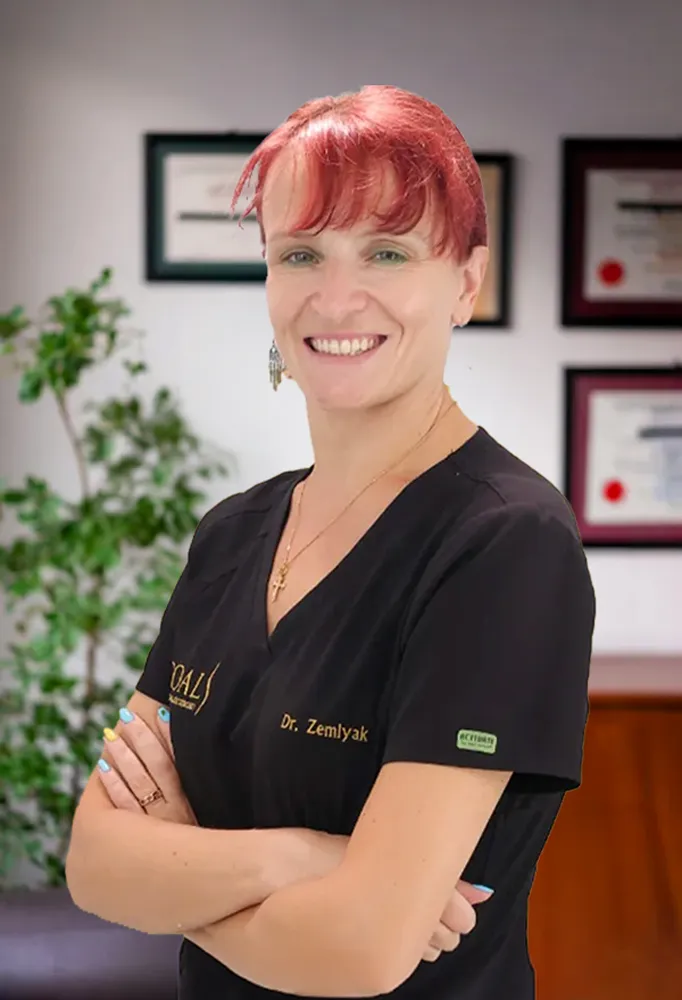
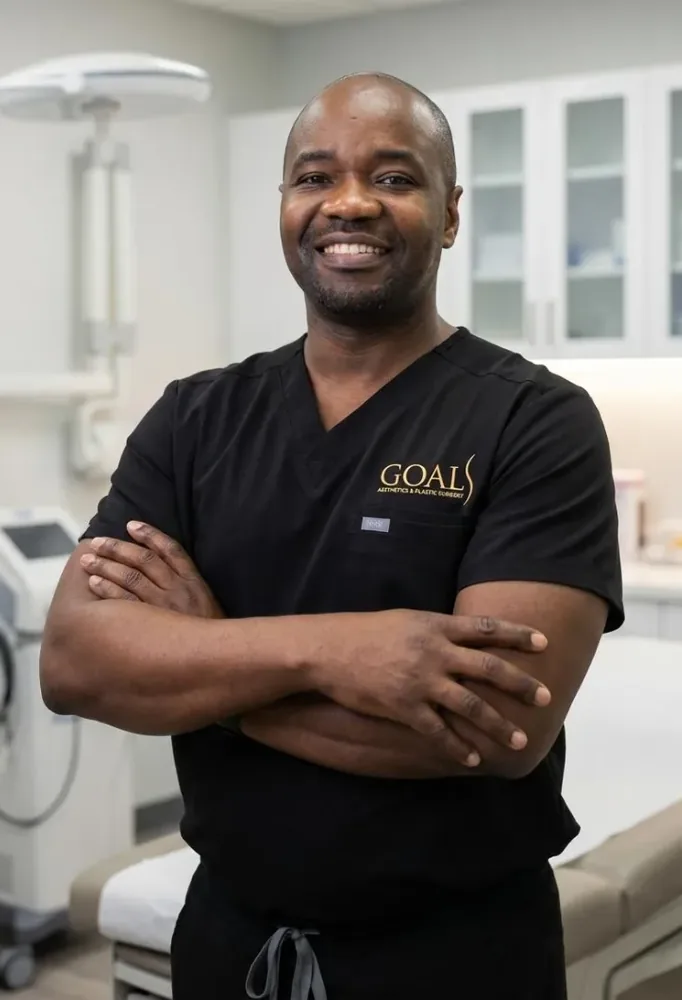
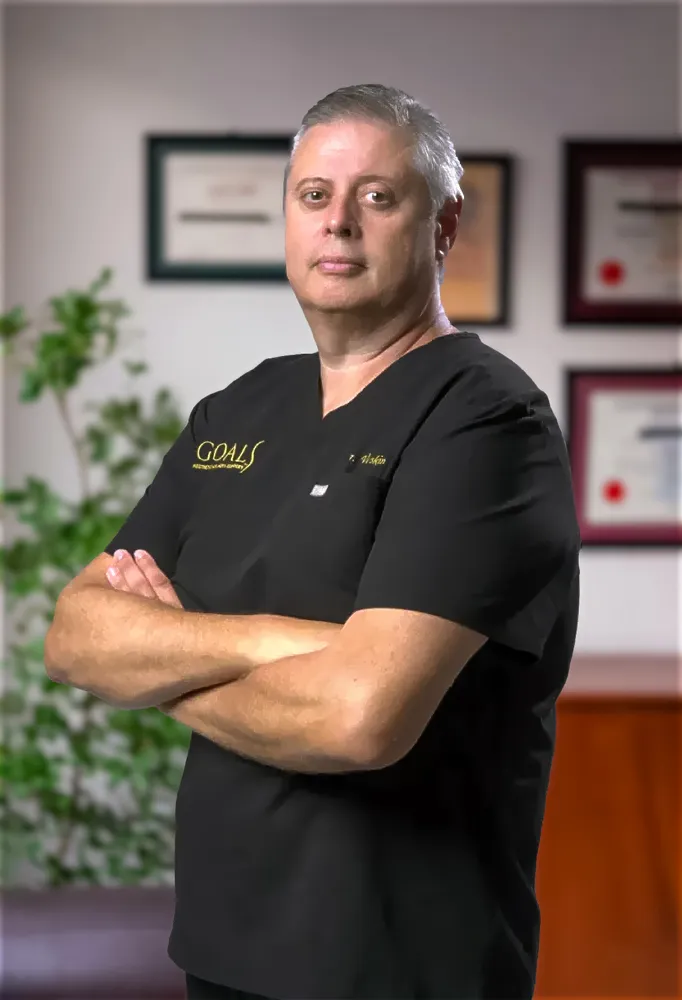
A qualified hair restoration provider oversees every session, never an unsupervised assistant. Meet the team before your first visit.
Licensed in NY · TX · CA
Safety
A treatment is only as good as the hands and the standards behind it. Every scalp session runs in a real clinical room, with people you can actually meet.
Sessions run in clean rooms held to U.S. accredited care.
Red light at the wavelength the hair research points to.
Your provider and their team, reachable when questions come.
The light carries no heat, so a session stays comfortable throughout.
Same-angle photos each visit, so change is measured not guessed.
Why Goals
One local team runs your assessment, sessions, and follow-ups.
Quick and hands-off, so you can drop in on a lunch break and leave.
Take whichever location suits your commute. Same scalp protocol at both.
Skilled qualified medical providers run each visit and adjust as your scalp answers.
If light alone won't get you there, we say so before you pay.
A quote drawn from examining your scalp, with nothing added later.
FAQ
Red light at this wavelength passes one to two millimetres in, which is where the follicle's growth centre sits. Depth is why wavelength matters.
No, but very dense or dark hair does absorb some light before it lands. Your provider factors that in when setting session length.
Home units run lower output and nobody checks whether it's working. Here the device output is set and known, and we photograph the response.
No burning. It carries no heat and won't damage skin. The cap directs light down at the scalp, so your eyes are out of the path.
Yes. Light doesn't interact with either. Come with hair clean and dry so nothing sits between the scalp and the light.
One or two undo nothing. A habit of skipping will, since the effect builds on repetition rather than any single visit.
Laser therapy is one of several ways we handle thinning. Here's what else the Atlanta team works with.
About LLLT Hair Restoration
LLLT Hair Restoration near you
Non-surgical options
A transplant isn't the only route, and plenty of people don't need one. These in-office treatments back the scalp and natural growth without a scalpel. A sensible first move on early thinning.
Results vary with your skin, your starting point and how many sessions you have. Your consultation covers what is realistic for you, before you commit to anything.
Prefer to talk now?(833) 462-5769
Patient Guides
Written by the team that performs the procedure, to read before your consultation.
 How to Verify a Plastic SurgeonFour free checks that take ten minutes: the NPI registry, the state medical board, ABMS board certification and the facility’s accreditation. Step by step, with every link.Read the guide
 Questions to Ask Before Any SurgeryTen questions to ask any plastic surgeon before you book, what a good answer sounds like, the warning signs, and a version you can print and bring to your consultation.Read the guide
General information, not medical advice. What applies to you is decided at a consultation with a licensed surgeon.
Get started
Laser therapy might be the whole plan or one part of it. Either way, the Atlanta team gives you a straight read and a route that fits.
Prefer to talk now? (833) 462-5769
Learn more
Low-level laser therapy is the least dramatic thing we do for hair, and that is precisely its appeal. There is no needle, no blade, no anaesthetic, and nothing to feel. You sit under a cap of red light for a set time and then leave. You may see it called photobiomodulation, red light therapy, or a laser cap, and the names all describe the same idea: light at a specific wavelength lands on the scalp and changes what the cells underneath are doing. Not by heating them, which is what a surgical laser does, but through a photochemical reaction closer in spirit to photosynthesis.
At Goals it runs as a short, hands-off, in-office session with qualified hair restoration providers watching the response. Being straight about the limits matters here more than with most treatments, because gentle things attract inflated promises. LLLT strengthens follicles that are weakening and can push resting ones back into growth. It does nothing for scalp that has been bare for years. It is also the slowest treatment on our list to show anything, which is why the people who quit at month two conclude it does not work. This page covers the mechanism, how it compares, who benefits, the schedule, the session itself, and cost, so you know what to expect before you walk into our Atlanta hair restoration clinic.
The discovery was an accident. In the 1960s a Hungarian researcher named Endre Mester set out to test whether laser light caused cancer in mice, using a setting far weaker than he intended. The mice did not develop tumours. They grew hair back faster than the untreated ones. Decades of work since have pinned down a plausible mechanism, and it sits inside the mitochondria. An enzyme called cytochrome c oxidase, the last link in the chain that produces cellular energy, absorbs red light particularly well. Under stress that enzyme gets partly blocked by nitric oxide sitting where oxygen should bind. Red light appears to knock that nitric oxide loose. Respiration picks up, ATP output rises, and a follicle with more energy available is more likely to shift out of its resting phase and back into active growth. That transition, telogen to anagen, is the whole objective. Worth noting what this is not. The light does not heat tissue, does not cut, and does not thicken a hair by coating it. Everything it does happens at the level of cell metabolism, which is exactly why the effect takes months to surface rather than weeks.
Four options, and the differences are mostly about how much is done to you. One option is more involved, and it uses needles. Mesotherapy delivers a nutrient blend through fine injections instead. Darsonval passes a high-frequency current across the surface rather than light. LLLT asks the least of you of any of them: you sit still and the device works. With FUE, follicles are physically relocated and the coverage is permanent, which no amount of light can replicate. What LLLT does well is pair. It is the standard thing to run alongside a graft to protect the native hair around it, and it combines comfortably with injectables because there is no overlap in what it asks of the scalp.
The strongest responders have early to moderate thinning with follicles that are weakening rather than gone. Fine, wispy hair growing where density used to be is the sign there is something to work with. Genetic pattern loss at the hairline and crown is where the published evidence is thickest, for men and women both. Women make up a large share of who we treat, and our women's restoration options are shaped around female patterns, where thinning spreads across the top and the part widens rather than the hairline receding. Two honest caveats. Very dense or very dark hair absorbs some of the light before it reaches skin, so session length gets adjusted. And a scalp that has been smooth for a decade is a conversation about grafting, not about light. We would rather say that at the consult than take payment for a course that cannot deliver. LLLT also has a place after surgery, protecting the hair that was already there so a new hairline does not end up stranded in front of continuing loss.
This is a course measured in months, not weeks. Regular sessions run across the first stretch, then spacing widens into maintenance once the scalp settles. Your provider sets the rhythm after examining your scalp rather than selling a fixed block. What changes, and in what order, is worth knowing before you start. Shedding slows first, and it is quiet enough to miss. Existing hair then feels thicker and looks less see-through under light. Actual new growth comes last and it is genuinely slow, because a follicle has to complete a cycle before anything shows. Most people are looking at several months before the mirror tells them anything, and the photographs usually notice before they do. Anyone promising visible density inside a month is selling something. The published trials that support this treatment ran over many months, and the results they report are modest and real rather than dramatic.
Very little, which is the point. You sit comfortably with the cap or helmet over your scalp for a set time. There is no heat, no noise beyond a fan, no sensation at all beyond the weight of the device. People read, answer email, or sit with their eyes shut. The light is directed downward at the scalp, so your eyes are out of its path and no protection is needed. Come with hair clean and dry and no product in it, since gel and oil sit between the light and the skin. You walk out and drive yourself home with nothing to show you were here. Sessions are short enough that people book them around a lunch hour, and because nothing about the visit affects your ability to drive or work, there is no planning required beyond turning up.
There is no aftercare to speak of. No recovery, little to no downtime, no products you are obliged to buy, and you carry on with your normal routine including colour and relaxer, neither of which the light interacts with. The one thing that reliably ruins a course is inconsistency. The effect accumulates across repeated exposures rather than arriving in any single one, so missing a session here and there is fine while a habit of skipping is not. We photograph from fixed angles under the same light at every visit, so you are judging progress against a record rather than a memory, and you can see how real timelines look in our before & after gallery.
Worth being precise about the evidence, because this treatment gets described in two incompatible ways. Controlled studies on low-level laser therapy for pattern hair loss do exist, they are not numerous, and what they report is modest improvement in hair count and thickness over several months rather than dramatic regrowth. That is a real finding and it is also a small one. The honest summary is that the effect is measurable, reproducible, and undramatic. Anyone quoting percentage improvements without mentioning the timescale or the starting point is selling something. Anyone dismissing the treatment outright is ignoring the published work. Both of those positions are easier to hold than the accurate one.
The obvious question is why anyone would attend a clinic when devices exist for home use, and it deserves a straight answer rather than a defensive one. Home caps do work, within limits. What you get here that a cap does not provide is a known and consistent output, a provider adjusting session length to your hair colour and density, standard-angle photographs tracking whether anything is actually happening, and a scalp examination that might identify a cause nobody has looked for. What a cap provides is convenience and no appointments. For some people that trade favours the cap, and we will say so rather than pretend otherwise.
Light therapy is rarely the whole answer and it is unusually good at being part of one. It asks nothing of the scalp, so it stacks with almost anything without competing for healing capacity: alongside injectables, before or after a graft to protect the surrounding native hair, or as maintenance once a course of something more intensive has finished. That combination role is arguably where it earns its keep. As a sole treatment for advancing pattern loss it will disappoint most people. As the thing running quietly in the background while something else does the heavy lifting, it is one of the easiest additions to a plan we offer.
One detail rarely mentioned is that the same session does not deliver the same dose to every head. Light has to reach the skin to do anything, and hair sitting between the device and the scalp absorbs some of it on the way. Dark hair absorbs more than light hair. Dense hair absorbs more than sparse hair. That means a man with thick dark hair and thinning at the crown receives less at the follicle than someone fairer or further along, from an identical session. It is one reason your provider sets timing individually rather than running everyone through the same slot, and one reason results vary between people who did apparently the same thing.
Every treatment page tells you when to start and almost none tell you when to stop, so here is our position. Give a course the time it was designed for, which means months rather than weeks, and judge it against photographs rather than impressions. If the record shows no change in shedding, thickness, or scalp coverage after a full course honestly completed, that is a real answer and continuing on hope is not a plan. Some people do not respond, and no one can predict who in advance. At that point the sensible move is a different treatment or a frank conversation about grafting, not another six months of the same. We would rather tell you that than keep a slot booked.
The figure comes from how many sessions your scalp needs and how the course is built, so it is confirmed after an examination rather than guessed from an emailed photo. Nothing is added later. If you have been comparing **laser hair therapy atlanta** options, this is among the easiest to plan around, and unlike a package abroad there is no airfare or hotel folded into the total. financing options through outside partners are there if spreading payments helps, and the team goes through the terms with you rather than pointing at a page. Follow-up visits with the same providers are part of the plan, not a line item, and you can read about who they are on our surgeon profiles page, so you are looked after from the first session through to the point the change has settled in.
Free · No obligation
Tell us how to reach you. A patient coordinator calls you back — usually the same day.
Free · No obligation
Ask me anything. I usually reply straight away.
If you share your number, a Goals coordinator may call or text you about your consultation. Message and data rates may apply.
Nora is an automated chat. She cannot give medical advice or say whether a procedure suits you.