Full Lower Cheeks
Fullness below the cheekbone that has been there regardless of your weight.
Removes the pad of fat in the lower cheek to bring out the cheekbone and the hollow beneath it.
From $5,000

Goals Aesthetics & Plastic Surgery – Philadelphia
1420 Locust St #421Mon–Sat, 10:00–19:00 local time
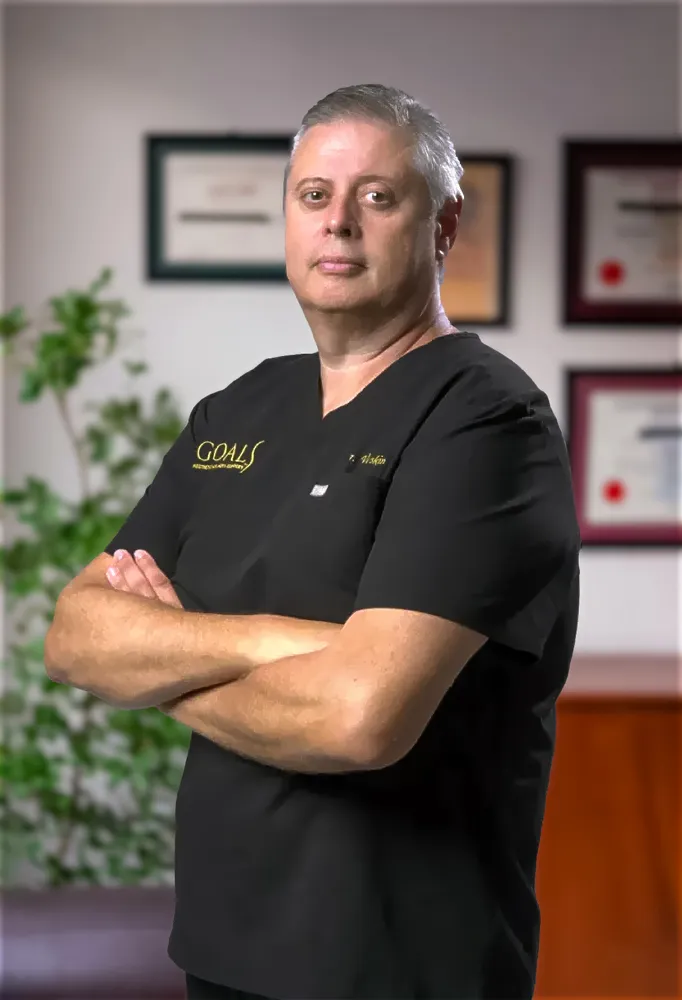
Surgeon: Dr. Sergey Voskin
Overview
Buccal fat removal is a procedure that takes out part of the fat pad in the lower cheek, giving the face a narrower, more defined look from within the mouth.
A small incision inside the mouth, so there is no scar on the face. The buccal fat pad is teased out and a measured amount removed. How much is the whole decision — this is not reversible, and faces thin with age on their own.
How it works
Your surgeon works out whether the fullness is the buccal pad, general facial fat, or the shape of the jaw muscle.
A small incision inside the cheek, so there is no scar anywhere on the face.
A conservative portion of the pad is teased out — conservative because this cannot be undone.
Candidacy
Round lower cheeks that stay full whatever your weight does.
Fullness below the cheekbone that has been there regardless of your weight.
You are not carrying weight, and the roundness is still there.
The aim is a shadow under the bone, not a hollow.
Faces lose volume with age. Removing volume early is a decision you live with later.
How buccal fat removal compares with cheek filler.
| What it does | Removes the fat pad in the lower cheek | Adds volume higher on the cheekbone |
|---|---|---|
| Effect | Hollows the area beneath the cheekbone | Projects the cheekbone itself |
| Permanence | Permanent — the pad does not come back | Nine to eighteen months |
| Reversible | No | Yes, if hyaluronic acid |
| Risk of overdoing it | Real, and it shows more with age | Low, and it wears off |
Your journey
Here is how it goes, step by step.
Sit down with your surgeon in Philadelphia, go over your goals and your medical history, and confirm buccal fat removal is the right operation.
What is being done, where the incisions go, what it will cost, and what result is realistic for your anatomy.
Bloodwork and medical clearance, what to stop taking, and how to set your home up for the first week.
You arrive, you are marked and prepped, and the operation is performed by a licensed U.S. surgeon in an accredited facility.
Follow-ups, drains or sutures out where relevant, and clear instructions you can actually follow.
Swelling resolves over months, not days. The final result is judged at the end of that, not the week after surgery.
Recovery
Recovery is a sequence, not a date. This is the shape of it.
Swelling inside the cheeks. Soft food and salt-water rinses.
Back to work. Swelling still obvious to you, less so to others.
Swelling resolves and the contour appears.
Final shape.
Benefits
Buccal fat removal defines the lower cheek permanently. Swelling makes the face look fuller before it looks thinner, and the result takes one to three months to appear properly.
A subtle shadow beneath the cheekbone that sharpens the whole midface.
The change is modest and permanent, and shows most in photographs.
Everything is done from inside the mouth.
Swelling for a week or two, and most people are out and about within days.
Safety
Every procedure is performed by a licensed U.S. surgeon in an accredited facility. Goals is a management company; the medical practice and the surgeon responsible in your state are named in our terms.
Our surgeons
Each surgeon’s training and licenses are listed on their own page.
Pricing
Buccal Fat Removal starts at $5,000. Your price is confirmed at consultation and depends on what your case actually needs. A $500 deposit reserves your surgery date.
Financing available, with monthly plans.
Reserves your date and comes off your balance.
No hidden fees. Everything is detailed up front.
Prices shown are starting prices and depend on the number of areas treated. Final pricing is confirmed at your consultation. Cosmetic procedures are not covered by insurance.
Try it
Pick a procedure to see an estimate. Your numbers stay on your device. We do not see or save them.
This is an estimate, not a quote. It splits the starting price over the months you pick, with no interest. Lenders set your real rate and terms. Your price is confirmed at your consultation.
Why Goals
Our clinic on 1420 Locust St #421, easy to reach across Philadelphia.
Thorough aftercare and in-person follow-ups in Philadelphia, not a phone call to another state.
Buccal Fat Removal is not an occasional case here. Volume is what makes a surgeon predictable.
Your quote is confirmed at the consultation and does not move afterwards.
Consultation, consent and aftercare in English or Spanish.
Clinics
FAQ
Faces lose volume with age, which is why a conservative amount is taken. A surgeon who removes the whole pad from a young patient is storing up a problem.
Not on the face. The incision is inside the cheek.
Indirectly, by creating a shadow above it. If the jawline itself is the concern, chin augmentation or submental liposuction will do more.
Not really. Fat grafting can add volume back but not in the same plane, which is why removal should be conservative in the first place.
You will lose facial volume with age as everyone does, and you will be starting from less. That is exactly why a good surgeon removes a modest amount, and why some young patients are advised against it entirely.
Learn more
This page is about buccal fat removal at Goals in Philadelphia. The clinic is at 1420 Locust St #421, Philadelphia, PA 19102, and consultations there are free and carry no obligation. A licensed U.S. surgeon operates here. Everything below — what the operation does, who it suits, what recovery involves and what it costs — is the same wherever you have it done, because the anatomy is. What changes from clinic to clinic is who you meet, how far you travel, and how easily you can get back for follow-ups, and those are the things worth deciding on.
Our Philadelphia clinic is at 1420 Locust St #421, Philadelphia, PA 19102, and it is where your consultation, your procedure and your follow-ups all happen — you are not consulted in one place and operated on in another. Consultations are free, run in English or Spanish, and end with a written quote rather than a range. Patients travelling in for buccal fat removal should plan to stay locally for the first night or two rather than fly home the same day, and to be back at the clinic for their early follow-up. Whichever clinic you choose, the surgeon is licensed in that state and the facility is accredited, and the practice responsible for your care is named in our terms rather than left vague.
The buccal fat pad is a discrete pocket of fat sitting deep in the cheek, between the muscles of the face, below and slightly in front of the cheekbone. It is not the same as the general layer of facial fat under the skin, and it does not shrink much when you lose weight — which is why people who are otherwise lean can still have full lower cheeks. Removing a portion of it hollows the area beneath the cheekbone slightly, creating a shadow that reads as definition. It is a small structure and the effect is correspondingly subtle; the transformations circulating online are usually a combination of weight loss, jaw filler, chin work and lighting.
It suits people with genuine buccal fullness at a stable, lean weight who want a modest increase in definition. It does not suit people whose roundness comes from overall facial fat, whose fullness is actually the masseter muscle at the jaw angle, or who are hoping to change the shape of their face substantially. The important restriction is age-related: faces lose volume steadily from the thirties onward, and fat removed at twenty-five is fat you do not have at forty-five. A surgeon who is prepared to tell a young patient that they will look better later by leaving it alone is a surgeon worth listening to.
Once the pad is removed, it is gone. There is no replacement pad, and the space it occupied is deep in the face where filler does not reliably or safely restore the same contour. Correcting an over-resected cheek generally means fat grafting, which is a bigger procedure than the one that caused the problem and does not always place volume in the same plane. This is the whole argument for conservative removal: taking a little and leaving the rest gives a defined cheek that continues to look well as the face ages, while taking too much produces a gaunt, older-looking midface that is difficult to repair.
It is usually performed under local anesthesia with or without sedation, in an accredited facility, and takes around thirty minutes. A small incision is made inside the cheek, opposite the upper molars, so nothing is visible on the outside. The fat pad is identified, teased gently forward through the incision, and a measured portion is removed. Both sides are compared during the procedure to keep them even. The incision is closed with dissolving sutures. It is frequently combined with chin augmentation, submental liposuction or a lower face lift, because definition is a product of several structures rather than one.
You will be more swollen than you expect for the first three to five days, and the face looks fuller before it looks thinner — which catches people out. Swelling peaks around day three and settles substantially by two weeks. A soft diet for a few days, salt-water rinses after eating while the internal incision heals, and no vigorous exercise for a week or two. Most people are back at work within a couple of days and presentable at one to two weeks. The definition you were after appears gradually over one to three months as the last of the swelling resolves and the tissue settles.
Cheek definition is a relationship between the cheekbone, the lower cheek, the jawline and the chin. Removing buccal fat in isolation produces a modest change; combining it with chin augmentation, jawline contouring or submental liposuction produces the look most patients are actually describing when they bring in photographs. That does not mean everyone needs all of it — it means the consultation should look at the whole lower face rather than at one fat pad, and should tell you plainly which single change would give you the most.
Buccal fat removal at Goals starts at $5,000, confirmed at consultation, with a $500 deposit to reserve your date. Risks are uncommon but specific: injury to a branch of the facial nerve or to the parotid duct, both of which run near the pad, asymmetry, infection, and over-resection — which is not a complication so much as a decision made badly. Ask your surgeon how much they intend to remove and why, ask to see results at a year rather than at a month, and take seriously any surgeon who tells you that you are not a good candidate.
About Buccal Fat Removal
Buccal Fat Removal at other Goals clinics
Get started
A consultation for buccal fat removal is free and carries no obligation. A surgeon will tell you what is realistic for you.
Prefer to talk now? (833) 462-5769
Free · No obligation
Tell us how to reach you. A patient coordinator calls you back — usually the same day.
Free · No obligation
Ask me anything. I usually reply straight away.
If you share your number, a Goals coordinator may call or text you about your consultation. Message and data rates may apply.
Nora is an automated chat. She cannot give medical advice or say whether a procedure suits you.