A Narrow, High Breast Base
The breast sits on a small footprint and projects forward rather than spreading.
Corrects the narrow base, high fold and puffy areola of tuberous breast, which an implant alone makes worse.
Call for availability This clinic is not booking appointments right now. Call us and we will help you book at a nearby Goals clinic.
From $12,000
Goals Aesthetics & Plastic Surgery – LA
18433 Roscoe BlvdMon–Sat, 10:00–19:00 local time
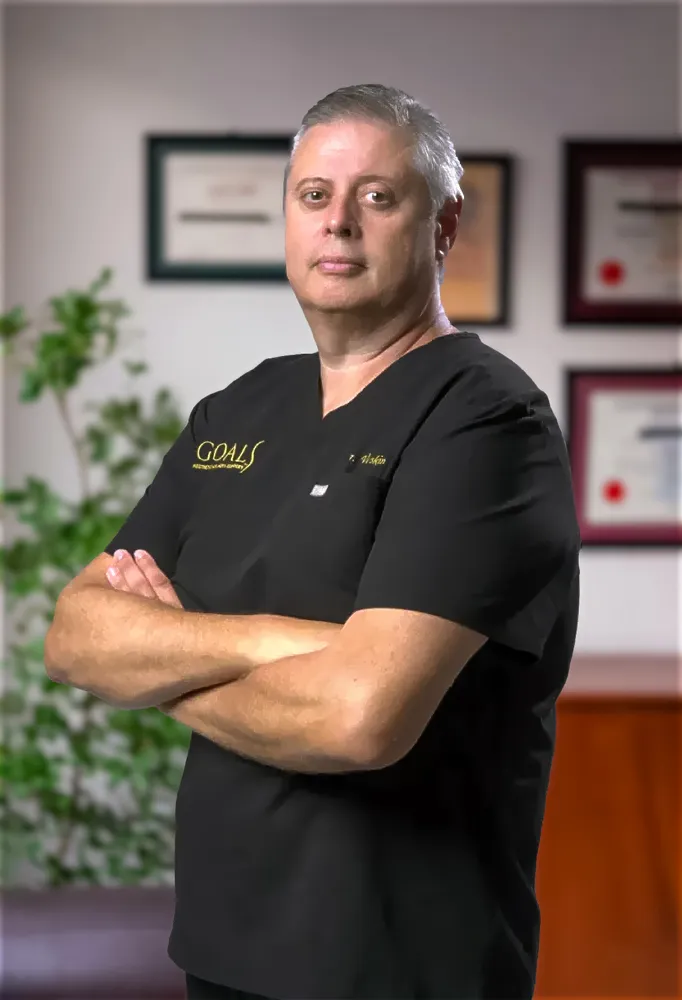
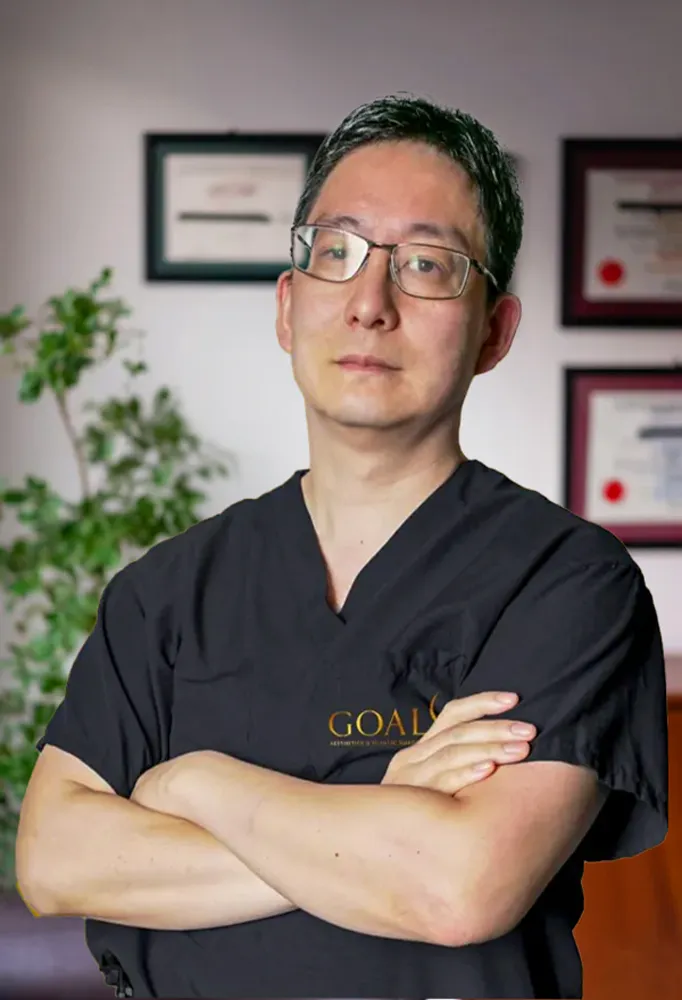
Surgeons: Dr. Sergey Voskin, Dr. Andrew Hsu, Dr. Debra L. Stafford
Overview
Tubular breast correction addresses breasts that developed with a constricted base, a high fold, and a narrowed, often puffy areola shape rather than the fuller rounded form of typical breast tissue.
The constricted tissue at the base is released and redistributed, the fold is lowered, the areola reduced where needed, and an implant or fat transfer added for volume. Putting an implant into an unreleased tuberous breast produces a double bubble, which is the commonest reason patients come for revision.
How it works
Tubular breast is graded by how constricted the base is and how much the areola has herniated.
The tight ring of tissue at the base is scored and released so the breast can expand into a normal footprint.
An implant or fat gives volume, the areola is reduced where needed, and the two sides are matched.
Candidacy
Breasts that are narrow and tube-shaped, sit high, are noticeably uneven, or have an areola that domes outward.
The breast sits on a small footprint and projects forward rather than spreading.
Breast tissue has herniated into the areola, making it dome outward.
Tubular breasts are frequently different from one another, sometimes markedly.
The operation is planned once development has finished, generally from around eighteen.
How tubular breast correction compares with standard breast augmentation.
| What it corrects | The constricted base, the tight ring and the areola | Volume only |
|---|---|---|
| The base of the breast | Released and expanded | Left constricted |
| Areola | Reduced and reshaped where herniated | Unchanged, and often made more prominent |
| Asymmetry | Addressed side by side | Often accentuated |
| Best for | A tubular or constricted breast | A normally shaped breast wanting more volume |
Your journey
Here is how it goes, step by step.
Sit down with your surgeon in Los Angeles, go over your goals and your medical history, and confirm tubular breast correction is the right operation.
What is being done, where the incisions go, what it will cost, and what result is realistic for your anatomy.
Bloodwork and medical clearance, what to stop taking, and how to set your home up for the first week.
You arrive, you are marked and prepped, and the operation is performed by a licensed U.S. surgeon in an accredited facility.
Follow-ups, drains or sutures out where relevant, and clear instructions you can actually follow.
Swelling resolves over months, not days. The final result is judged at the end of that, not the week after surgery.
Recovery
Recovery is a sequence, not a date. This is the shape of it.
Surgical bra, limited arm use.
Desk work.
No chest exercise or lifting.
Shape settles; asymmetry corrections take longest to read true.
Benefits
Correction changes the shape of the breast, not just its size. Swelling and settling take three to six months, and the two sides can settle at slightly different speeds.
Releasing the constricting ring lets the breast sit on the chest the way it should.
Reduced and flattened where tissue had herniated into it.
Correcting asymmetry is usually as important to patients as the shape itself.
Not a bigger tubular breast — a differently shaped one.
Safety
Every procedure is performed by a licensed U.S. surgeon in an accredited facility. Goals is a management company; the medical practice and the surgeon responsible in your state are named in our terms.
Our surgeons
Each surgeon’s training and licenses are listed on their own page.
Pricing
Tubular Breast Correction starts at $12,000. Your price is confirmed at consultation and depends on what your case actually needs. A $500 deposit reserves your surgery date.
Financing available, with monthly plans.
Reserves your date and comes off your balance.
No hidden fees. Everything is detailed up front.
Prices shown are starting prices and depend on the number of areas treated. Final pricing is confirmed at your consultation. Cosmetic procedures are not covered by insurance.
Try it
Pick a procedure to see an estimate. Your numbers stay on your device. We do not see or save them.
This is an estimate, not a quote. It splits the starting price over the months you pick, with no interest. Lenders set your real rate and terms. Your price is confirmed at your consultation.
Why Goals
Our clinic on 18433 Roscoe Blvd, easy to reach across Northridge.
Thorough aftercare and in-person follow-ups in Los Angeles, not a phone call to another state.
Tubular Breast Correction is not an occasional case here. Volume is what makes a surgeon predictable.
Your quote is confirmed at the consultation and does not move afterwards.
Consultation, consent and aftercare in English or Spanish.
Clinics
FAQ
Because the tissue is constricted. An implant pushes against that constriction rather than releasing it, and the result is a breast with a fold across it.
Usually much closer, and often very close. Perfect symmetry is not a promise anyone should make about any breast.
The typical signs are a narrow breast base, a breast that sits high, a short distance between the fold and the nipple, a puffy or enlarged areola, and asymmetry. An examination at the consultation settles it.
Mild cases can be, with release of the constricting ring, fat transfer and areolar reduction. Moderate and severe cases usually need an implant to fill the released footprint.
Usually yes. Revision for a double bubble means releasing the constriction that was never addressed and repositioning things properly. It is a more complex operation than primary correction, so ask to see revision results specifically.
Learn more
This page is about tubular breast correction at Goals in Los Angeles. The clinic is at 18433 Roscoe Blvd, Northridge, CA 91325, and consultations there are free and carry no obligation. Surgeons operating here include Dr. Sergey Voskin, MD, Dr. Andrew Hsu, MD. Everything below — what the operation does, who it suits, what recovery involves and what it costs — is the same wherever you have it done, because the anatomy is. What changes from clinic to clinic is who you meet, how far you travel, and how easily you can get back for follow-ups, and those are the things worth deciding on.
Our Los Angeles clinic is at 18433 Roscoe Blvd, Northridge, CA 91325, and it is where your consultation, your procedure and your follow-ups all happen — you are not consulted in one place and operated on in another. Consultations are free, run in English or Spanish, and end with a written quote rather than a range. Patients travelling in for tubular breast correction should plan to stay locally for the first night or two rather than fly home the same day, and to be back at the clinic for their early follow-up. Whichever clinic you choose, the surgeon is licensed in that state and the facility is accredited, and the practice responsible for your care is named in our terms rather than left vague.
During development, a ring of fibrous tissue at the base of the breast can restrict how far the breast spreads across the chest. Instead of expanding to a normal footprint, the tissue is forced forward and, in many cases, into the areola, which then domes outward. The signs are a narrow base, a breast that sits high with a short distance from the fold to the nipple, an enlarged or puffy areola, a high inframammary fold, and frequently significant asymmetry between the two sides. It is graded by severity, from mild constriction of the lower inner quadrant through to a severely constricted breast in all directions.
This is the single most important thing on this page. If you place an implant behind a breast whose base is constricted by a fibrous ring, the implant cannot spread — so it pushes forward, and it pushes into the path of least resistance, which is the areola. The result is a double-bubble deformity, where the implant sits below the constricting ring and the original breast sits on top of it, and an areola that is now larger and more domed than before. Patients arrive having had exactly this done elsewhere, having been treated as a straightforward augmentation. Recognising the diagnosis before surgery is most of the work.
The operation has three components and the mix depends on your grade. First, the constricting ring is released: the tissue at the base of the breast is scored radially from the inside so it can expand, and the inframammary fold is lowered where it sits too high. Second, volume is provided — usually an implant, sometimes fat transfer, sometimes a staged expansion in severe cases. Third, the areola is addressed: where breast tissue has herniated into it, a periareolar reduction reduces its diameter and flattens the dome. Where asymmetry is significant, the two sides get different plans, and that is normal rather than a compromise.
Anyone with a constricted or tubular breast who has finished developing, generally from around eighteen, and is in good health. Many patients have known something was different since their teens without ever having a name for it, and the consultation is frequently the first time anyone has explained it. Patients with previous augmentation that produced a double bubble are also candidates, though revision is a more complex operation than primary correction. Mild cases sometimes need only fat transfer and a small areolar reduction, which is worth knowing before agreeing to anything larger.
Similar to a breast augmentation with a lift. The first week involves soreness, tightness and swelling; most people are off strong pain relief within a few days. Desk work at one to two weeks. A surgical bra for four to six weeks, no overhead lifting for two, no full exercise for six. Swelling settles substantially by six weeks, but the shape continues to change for three to six months as the released tissue expands and the implant settles into the new footprint. The two sides can settle at different rates, particularly where they started asymmetric, and that is normal — judge symmetry at six months, not at six weeks.
Tubular breast correction has a higher revision rate than a standard augmentation, because you are changing shape and not simply adding volume, and because tissue that has been constricted for years does not always expand evenly. Small revisions — refining the areola, adjusting for residual asymmetry, adding a little fat — are relatively common and should be discussed as a possibility rather than presented as a failure if they happen. Severe cases are sometimes best staged deliberately into two operations, which is a plan, not a complication.
Tubular breast correction at Goals starts at $12,000, confirmed at consultation, with a $500 deposit to reserve your date. The price varies with grade, with whether implants or fat are used, and with how much areolar work is needed. Risks include those of any breast surgery — bleeding, infection, capsular contracture, changes in nipple sensation — plus incomplete correction and residual asymmetry. Ask your surgeon to name your grade, ask exactly how they intend to release the base, and ask to see photographs of tubular corrections specifically rather than of standard augmentations.
About Tubular Breast Correction
Tubular Breast Correction at other Goals clinics
Get started
A consultation for tubular breast correction is free and carries no obligation. A surgeon will tell you what is realistic for you.
Prefer to talk now? (833) 462-5769
Free · No obligation
Tell us how to reach you. A patient coordinator calls you back — usually the same day.
Free · No obligation
Ask me anything. I usually reply straight away.
If you share your number, a Goals coordinator may call or text you about your consultation. Message and data rates may apply.
Nora is an automated chat. She cannot give medical advice or say whether a procedure suits you.