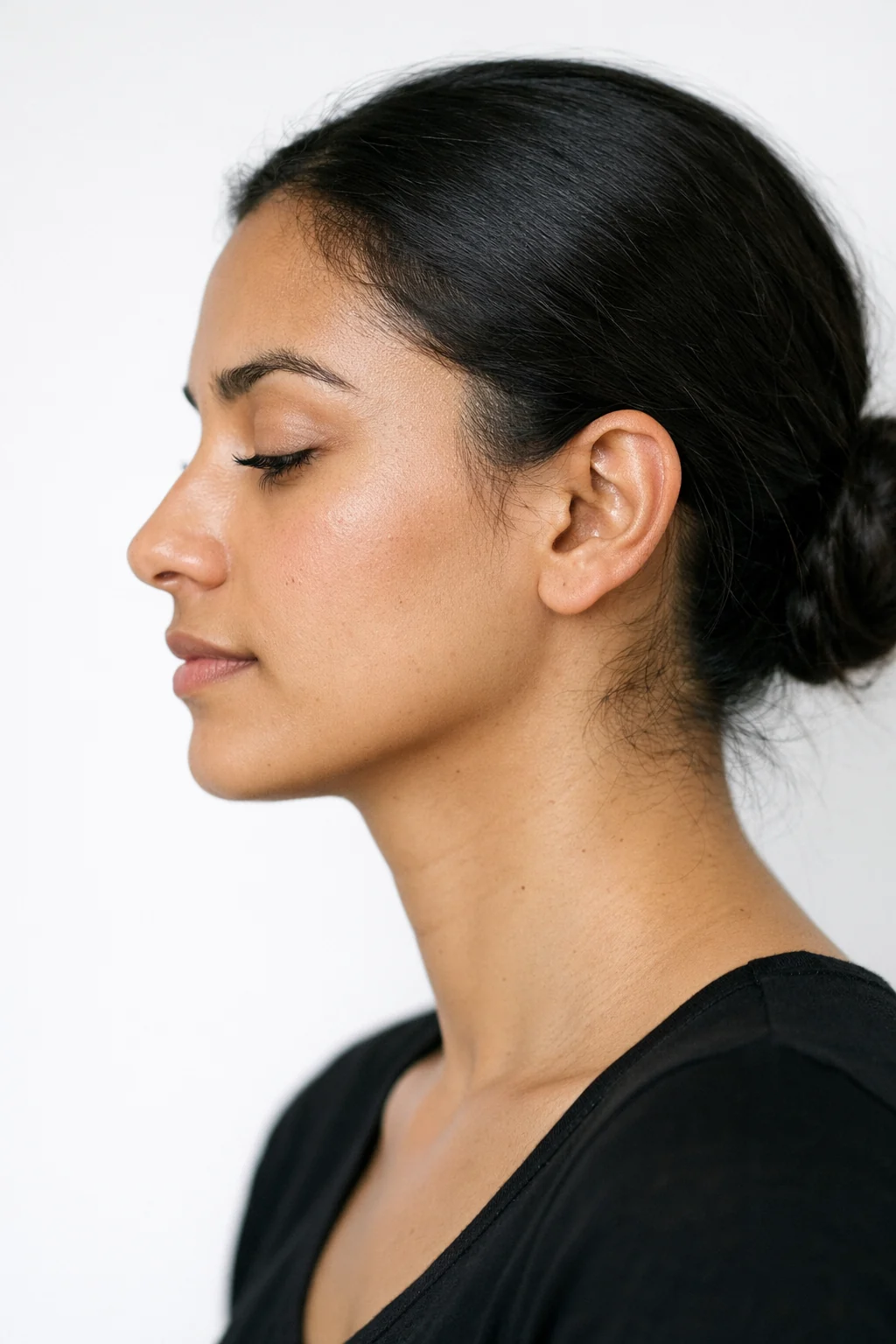
A Dorsal Hump
A bump along the bridge you notice most in profile and in photographs.
Reshapes the nose in proportion to the rest of your face, and can correct breathing at the same time.
Call for availability This clinic is not booking appointments right now. Call us and we will help you book at a nearby Goals clinic.
From $12,000
Goals Aesthetics & Plastic Surgery – LA
18433 Roscoe BlvdMon–Sat, 10:00–19:00 local time
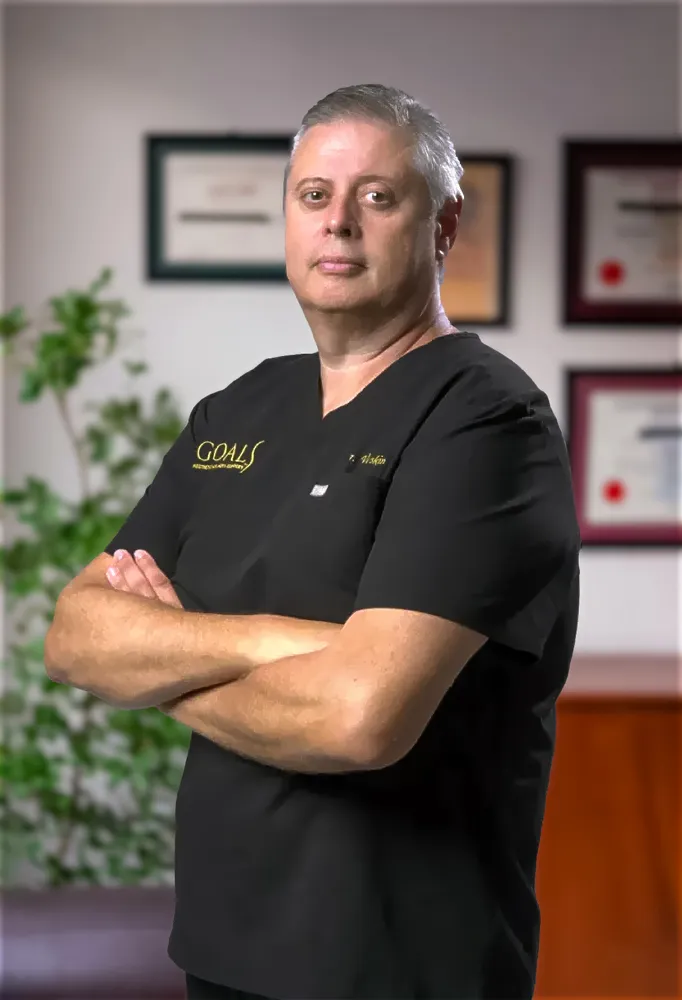
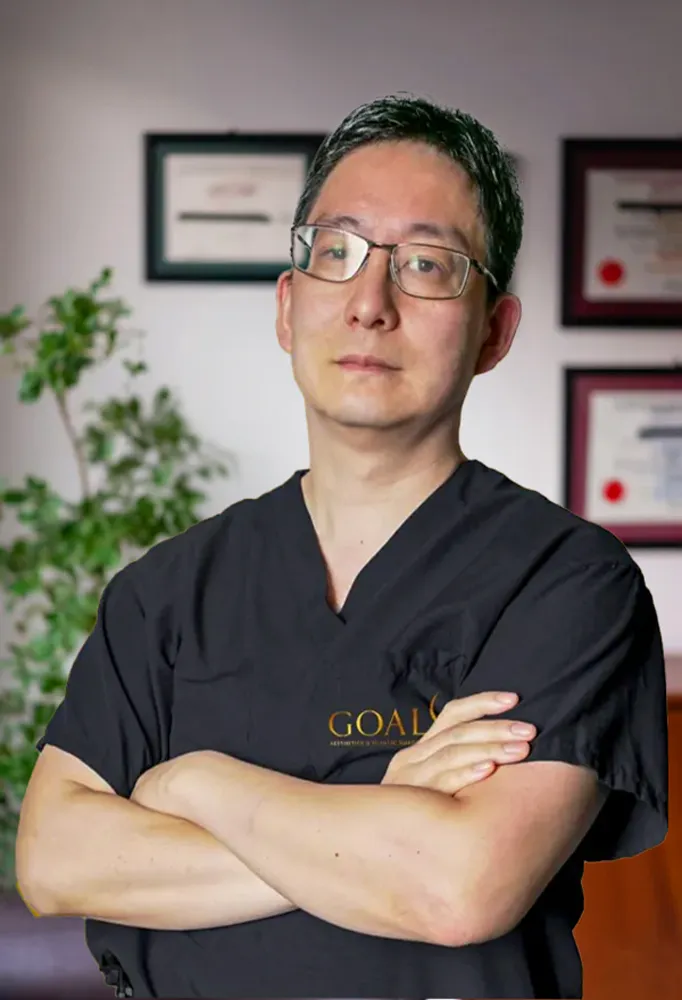
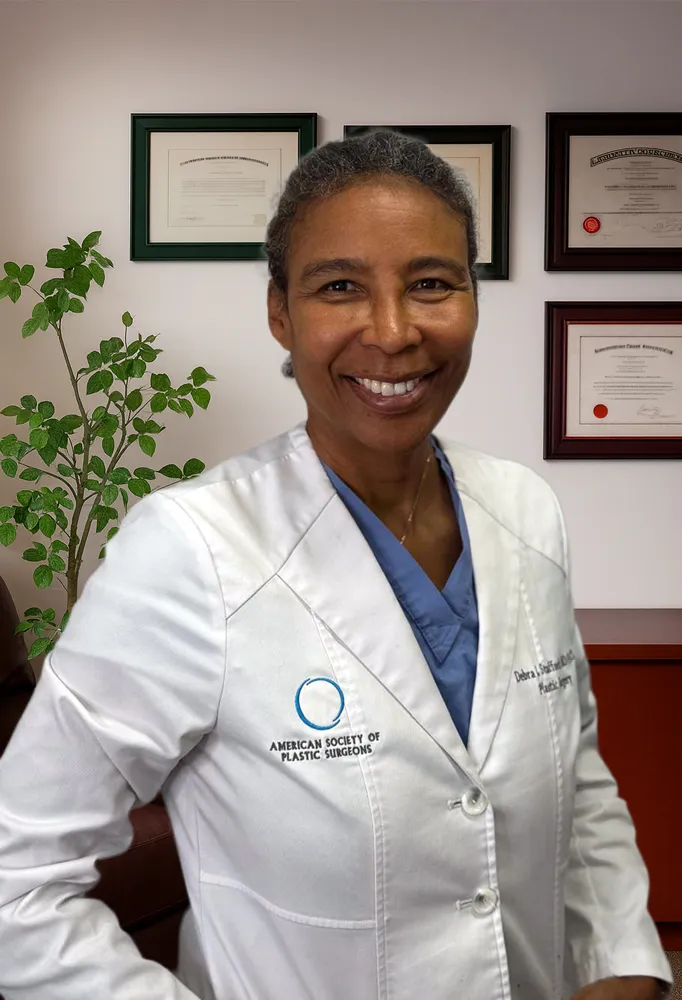
Surgeons: Dr. Sergey Voskin, Dr. Andrew Hsu, Dr. Debra L. Stafford
Overview
Rhinoplasty is surgery to change the shape, size, or structure of the nose, working with the underlying bone and cartilage rather than the skin alone.
Through incisions inside the nostrils — and, for more work, a fine one across the columella — the bone and cartilage are reshaped rather than simply reduced. Where breathing is obstructed, a deviated septum is corrected in the same operation.
How it works
Your surgeon assesses the nose in thirds and against your face, not against a photograph of someone else's.
Bone and cartilage are reduced, repositioned or grafted — often all three in one nose.
The structure is rebuilt so it holds its shape and you can still breathe through it in ten years.
Candidacy
A dorsal hump, a wide or drooping tip, asymmetry, or a nose that has been broken and never sat right since.
A bump along the bridge you notice most in profile and in photographs.
Bulbous, drooping, or pulled down when you smile.
A deviated septum or collapsing valves can be corrected in the same operation.
Generally seventeen and up, and doing it for yourself rather than for anyone else.
How rhinoplasty compares with non-surgical nose filler.
| What it changes | Bone and cartilage — the structure itself | Adds volume to smooth a contour |
|---|---|---|
| Can it reduce size | Yes | No — filler only adds |
| Breathing problems | Can be corrected at the same time | Not addressed, and can worsen |
| How long it lasts | Permanent | Nine to eighteen months |
| Recovery | Splint for a week, swelling for a year | Same day |
Your journey
Here is how it goes, step by step.
Sit down with your surgeon in Los Angeles, go over your goals and your medical history, and confirm rhinoplasty is the right operation.
What is being done, where the incisions go, what it will cost, and what result is realistic for your anatomy.
Bloodwork and medical clearance, what to stop taking, and how to set your home up for the first week.
You arrive, you are marked and prepped, and the operation is performed by a licensed U.S. surgeon in an accredited facility.
Follow-ups, drains or sutures out where relevant, and clear instructions you can actually follow.
Swelling resolves over months, not days. The final result is judged at the end of that, not the week after surgery.
Recovery
Recovery is a sequence, not a date. This is the shape of it.
A splint on the nose. Bruising around the eyes, worst at day two or three.
Splint off. You look like yourself again, swollen.
Presentable. The tip stays swollen longest.
Final shape. A nose takes a full year to finish settling and there is no shortening that.
Benefits
Rhinoplasty changes the structure of the nose permanently. It is also the slowest facial procedure to reveal itself — the bridge settles within weeks, the tip takes a year — and patience is genuinely part of the treatment.
The goal is proportion, not a particular shape borrowed from someone else.
Where function is corrected alongside shape, most patients notice the airway first.
Bone and cartilage do not return to where they were.
Eighty per cent shows in a month. The tip takes a full year, sometimes longer.
Safety
Every procedure is performed by a licensed U.S. surgeon in an accredited facility. Goals is a management company; the medical practice and the surgeon responsible in your state are named in our terms.
Our surgeons
Each surgeon’s training and licenses are listed on their own page.
Pricing
Rhinoplasty starts at $12,000. Your price is confirmed at consultation and depends on what your case actually needs. A $500 deposit reserves your surgery date.
Financing available, with monthly plans.
Reserves your date and comes off your balance.
No hidden fees. Everything is detailed up front.
Prices shown are starting prices and depend on the number of areas treated. Final pricing is confirmed at your consultation. Cosmetic procedures are not covered by insurance.
Try it
Pick a procedure to see an estimate. Your numbers stay on your device. We do not see or save them.
This is an estimate, not a quote. It splits the starting price over the months you pick, with no interest. Lenders set your real rate and terms. Your price is confirmed at your consultation.
Why Goals
Our clinic on 18433 Roscoe Blvd, easy to reach across Northridge.
Thorough aftercare and in-person follow-ups in Los Angeles, not a phone call to another state.
Rhinoplasty is not an occasional case here. Volume is what makes a surgeon predictable.
Your quote is confirmed at the consultation and does not move afterwards.
Consultation, consent and aftercare in English or Spanish.
Clinics
FAQ
Bring several. They are the most useful thing in the consultation — but the surgeon is matching the result to your face and your cartilage, not to someone else's.
It can improve it if a deviated septum is corrected. Say so at consultation, because that changes the operation.
The bridge settles in weeks. The tip takes a year, and longer with thicker skin. Most of the change you want is visible at one to three months, but the last refinement is slow.
It should not make it worse, and it often makes it better when a deviated septum or weak valves are corrected at the same time. Tell your surgeon if one side is already blocked.
Small changes are common and are often the hardest to do well, because there is nowhere to hide. Bring photographs of what bothers you, not photographs of noses you like.
Learn more
This page is about rhinoplasty at Goals in Los Angeles. The clinic is at 18433 Roscoe Blvd, Northridge, CA 91325, and consultations there are free and carry no obligation. Surgeons operating here include Dr. Sergey Voskin, MD, Dr. Andrew Hsu, MD. Everything below — what the operation does, who it suits, what recovery involves and what it costs — is the same wherever you have it done, because the anatomy is. What changes from clinic to clinic is who you meet, how far you travel, and how easily you can get back for follow-ups, and those are the things worth deciding on.
Our Los Angeles clinic is at 18433 Roscoe Blvd, Northridge, CA 91325, and it is where your consultation, your procedure and your follow-ups all happen — you are not consulted in one place and operated on in another. Consultations are free, run in English or Spanish, and end with a written quote rather than a range. Patients travelling in for rhinoplasty should plan to stay locally for the first night or two rather than fly home the same day, and to be back at the clinic for their early follow-up. Whichever clinic you choose, the surgeon is licensed in that state and the facility is accredited, and the practice responsible for your care is named in our terms rather than left vague.
Rhinoplasty reshapes the nose by altering its underlying framework: the paired nasal bones at the top, the cartilage that forms the middle vault, and the lower cartilages that make the tip. The skin drapes over whatever framework it is given, so surgery works from the inside out. A hump is reduced by taking down bone and cartilage together, and the roof that is opened by doing so has to be closed by repositioning the bones. A wide or bulbous tip is refined by reshaping and suturing the lower cartilages rather than simply cutting them away, because cartilage that has been over-resected loses support and collapses inward over the years. Grafts, usually taken from your own septum, are used to rebuild support where it is needed.
A great many noses that look wrong also work poorly, and the two are frequently the same problem. A deviated septum pushes the nose off centre and blocks one side. Weak or collapsing internal valves narrow the airway when you breathe in hard. These can and should be corrected in the same operation — septoplasty and valve repair alongside the cosmetic work — and doing so is one of the marks of a surgeon who understands the nose as an airway rather than as a sculpture. Reducing a nose without reinforcing its support is exactly how patients end up breathing worse afterwards than they did before.
Good candidates have finished growing — generally seventeen and above — are in good health, and can describe what specifically bothers them about their nose. That last point matters more than it sounds. The best outcomes come from patients who want their own nose improved, not replaced with someone else's, and who understand that their skin thickness sets a limit on how much definition is achievable. Thick skin hides fine refinement; thin skin shows every irregularity. Realistic expectations, discussed honestly at the consultation with imaging, are the difference between a happy patient and a revision.
Under general anesthesia in an accredited facility, usually taking two to four hours. There are two approaches. Closed rhinoplasty places all incisions inside the nostrils and leaves no external scar; it suits straightforward reductions. Open rhinoplasty adds a small incision across the columella, the strip of skin between the nostrils, which lets the surgeon lift the skin and see the framework directly. That visibility matters for tip work, for asymmetry, and for revisions, and the scar becomes almost invisible. The framework is then modified: hump reduction, osteotomies to reposition the bones, cartilage reshaped and sutured, grafts placed for support. A splint goes on the outside for about a week.
The splint comes off at six or seven days, and that is when most patients get their first real look — at a nose that is still swollen. Bruising around the eyes is common in the first week and largely gone by two. You breathe through your mouth for the first several days because of internal swelling, which is uncomfortable and temporary. Most people return to work at ten to fourteen days. No glasses resting on the bridge for around six weeks, no contact sport for three months. Then comes the part nobody enjoys: swelling in the tip resolves over a full year, sometimes eighteen months in thick skin, and the nose you are judging at three months is not the nose you will have.
Rhinoplasty has the highest revision rate of any cosmetic operation — commonly quoted between five and fifteen per cent even in expert hands. The reason is that healing is not entirely controllable: scar tissue contracts unevenly, cartilage has memory and can shift, and thick skin can mask a technically excellent result. This is not a reason to avoid the operation; it is a reason to choose a surgeon who does noses regularly, to look at their results in profile and from below rather than only from the front, and to accept that if a revision is needed it is done at a year, not at three months.
Rhinoplasty at Goals starts at $12,000, confirmed at consultation, with a $500 deposit to reserve your date. Functional correction performed at the same time may be handled differently and is discussed openly. Risks include bleeding, infection, breathing difficulty, asymmetry, contour irregularity and the possibility of revision. When you meet your surgeon, ask how many rhinoplasties they perform, ask specifically about how they will preserve or rebuild support, and ask to see before-and-after photographs of patients with skin like yours, taken at a year. A surgeon showing you only three-month results on thin-skinned patients is showing you the easy half of their practice.
About Rhinoplasty
Rhinoplasty at other Goals clinics
Get started
A consultation for rhinoplasty is free and carries no obligation. A surgeon will tell you what is realistic for you.
Prefer to talk now? (833) 462-5769
Free · No obligation
Tell us how to reach you. A patient coordinator calls you back — usually the same day.
Free · No obligation
Ask me anything. I usually reply straight away.
If you share your number, a Goals coordinator may call or text you about your consultation. Message and data rates may apply.
Nora is an automated chat. She cannot give medical advice or say whether a procedure suits you.