The Disproportion Nobody Can Explain
Weight comes off your face, your waist and your chest, and the legs stay exactly as they were. This is the most reliable sign there is.
Awake FlexSculpt liposuction, using a lymphatic-sparing technique, to remove the diseased fat lipedema lays down in the thighs, calves and arms — the fat that never responds to dieting.
From $7,250

Goals Aesthetics & Plastic Surgery – Atlanta
3576 Chamblee Tucker RdMon–Sat, 10:00–19:00 local time
Surgeons: Dr. Sergey Voskin, Dr. Alla Zemlyak, Dr. Patrick Narh-Martey
Overview
Lipedema treatment is a specialized form of liposuction designed to remove the abnormal fat this condition deposits, using techniques that work with the lymphatic system rather than against it.
Awake, under local anesthesia. Tumescent fluid goes in first, then fine cannulas take the lipedemic fat out working along the lymphatic channels rather than across them. That distinction is the whole point: lipedema sits on top of a lymphatic system that is often already under strain, and conventional aggressive liposuction can leave the swelling worse than it found it. Volume is staged by area rather than done in one sitting — usually thighs and knees first, then calves, then arms — and compression goes on before you leave the table.
How it works
Lipedema is diagnosed by examination and history, not by a scan. Symmetry, the cuff at the ankle or wrist, tenderness to pressure, easy bruising, and a body that slims everywhere except the affected limb.
Which areas, in what order, over how many sessions. Thighs and knees usually first because they carry the most weight and give the most relief.
Tumescent fluid first, then fine cannulas along the line of the lymph channels. Compression goes on before you leave the table.
Candidacy
Women whose legs or arms stay heavy no matter how much weight comes off everywhere else, especially with tenderness to pressure, easy bruising, a cuff of fat that stops at the ankle or wrist, and a family history of the same shape.
Weight comes off your face, your waist and your chest, and the legs stay exactly as they were. This is the most reliable sign there is.
Pressure that would not bother anyone else is painful, and you bruise from things you cannot remember doing.
The fat stops abruptly and the foot or hand is spared, which is what separates lipedema from ordinary weight and from lymphedema.
A mother, an aunt or a sister with the same shape. Lipedema is strongly familial and almost exclusively affects women.
How lipedema treatment compares with conventional liposuction.
| What it treats | Lipedemic fat — a disease of the fat tissue, not a consequence of eating | Ordinary fat that diet has not shifted |
|---|---|---|
| Technique | Lymphatic-sparing: fine cannulas worked along the lymph channels, not across them | Whatever plane is quickest to the fat |
| Anesthesia | Awake, under local. You can stand so the contour is judged upright | Commonly general |
| How it is staged | By area, over more than one session, so each region settles before the next | Usually one sitting, as much as can be taken safely |
| What it is measured by | Pain, heaviness and mobility as much as circumference | Circumference |
Your journey
Here is how it goes, step by step.
Sit down with your surgeon in Atlanta, go over your goals and your medical history, and confirm lipedema treatment is the right operation.
What is being done, where the incisions go, what it will cost, and what result is realistic for your anatomy.
Bloodwork and medical clearance, what to stop taking, and how to set your home up for the first week.
You arrive, you are marked and prepped, and the operation is performed by a licensed U.S. surgeon in an accredited facility.
Follow-ups, drains or sutures out where relevant, and clear instructions you can actually follow.
Swelling resolves over months, not days. The final result is judged at the end of that, not the week after surgery.
Recovery
Recovery is a sequence, not a date. This is the shape of it.
Compression stays on. The entry points weep tumescent fluid for a day or two, which looks alarming and is normal. You walk the same day, and you are asked to.
Bruising at its worst, soreness like the day after a very hard workout. Most desk work resumes somewhere between day three and day five.
Swelling comes down steadily. Manual lymphatic drainage is usually recommended through this stretch and it genuinely helps. Compression continues.
The contour settles. The heaviness and the tenderness generally ease well before the shape finishes changing, which is the part patients say they notice most.
Results
Real patients of Goals, published with written consent.
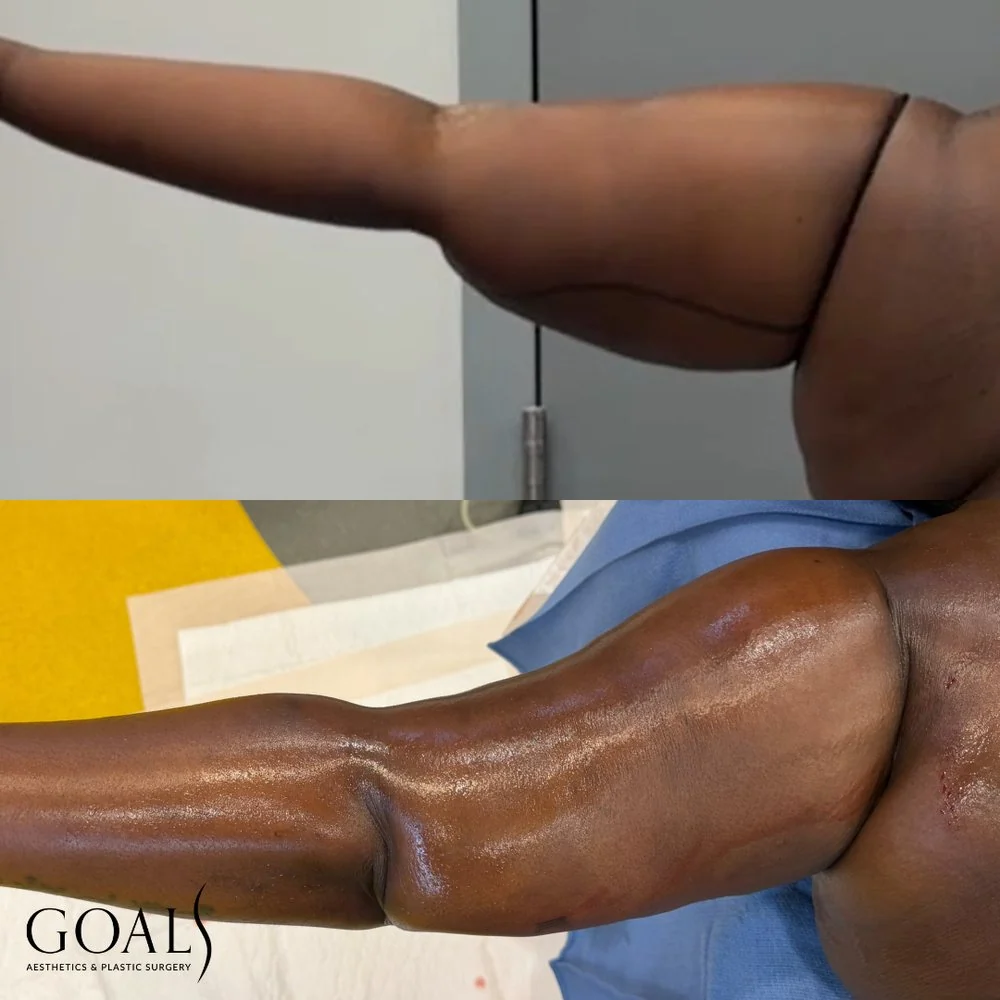
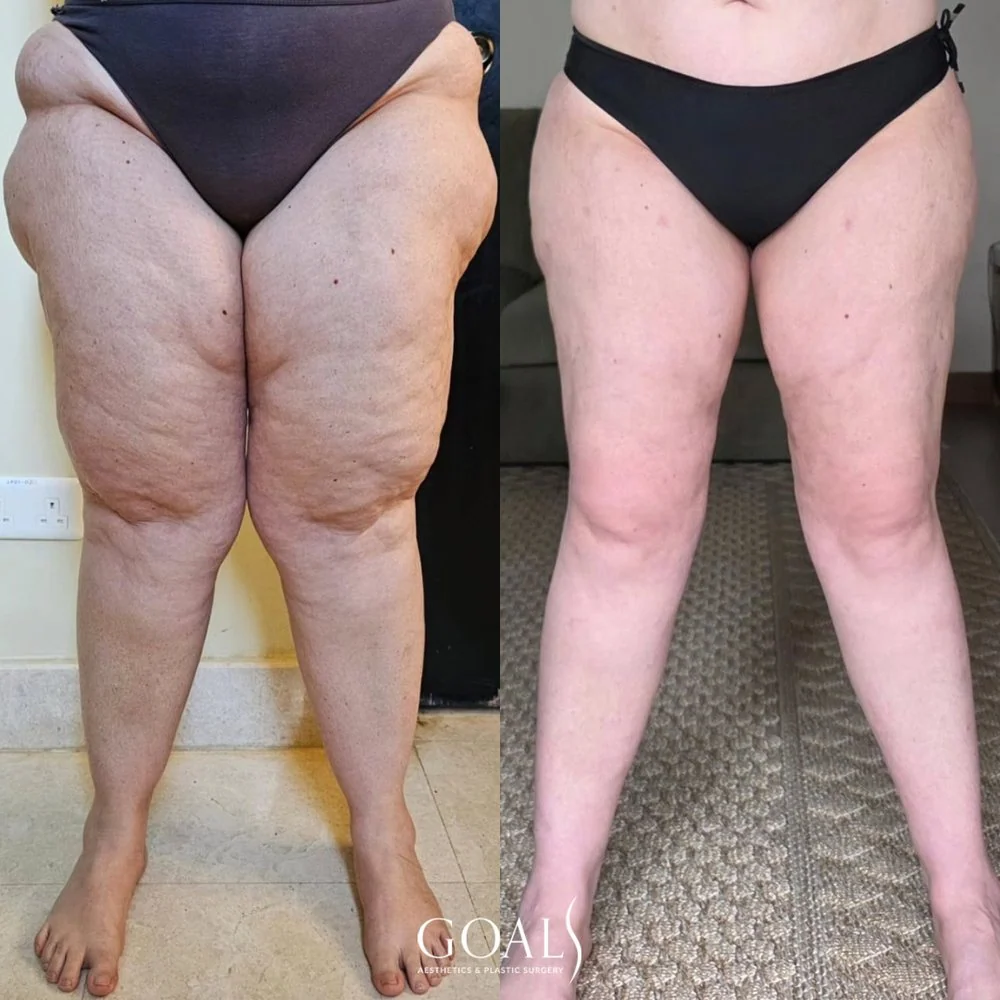
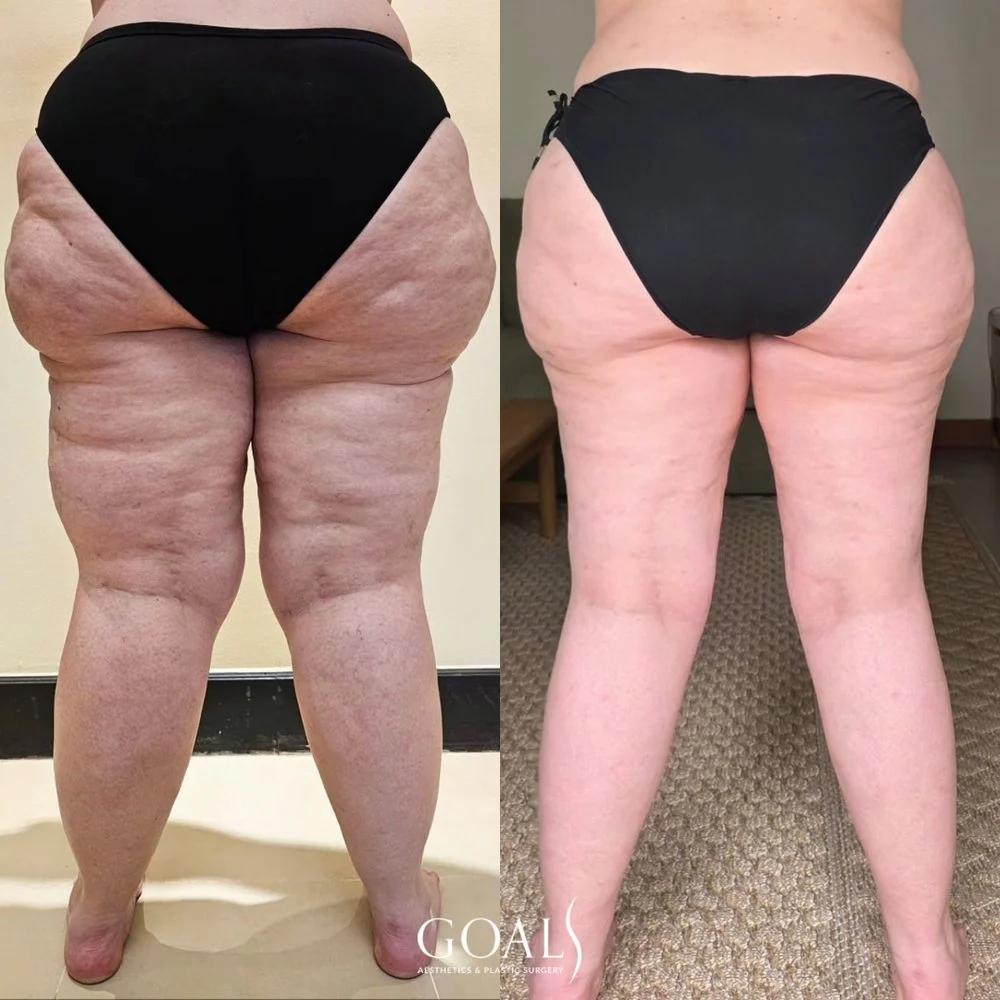
Real patients, published with written consent. Photographs are not retouched or AI-generated. Individual results vary — these images show outcomes for these patients and are not a guarantee of your own.
Try it
Type your height and weight. Your numbers stay on your device. We do not see or save them.
BMI is just one number. Your surgeon also looks at your health and your goals. BMI alone does not decide if you can have surgery.
Benefits
Lipedema surgery is judged differently from cosmetic liposuction. Circumference matters, but so do pain, bruising, mobility and how the limb feels at the end of the day — and those improve on their own schedule. Swelling masks the contour for the first six weeks, so the result is what is there at six months, not at six weeks.
Tenderness and heaviness usually ease well before the shape finishes changing, and it is the change patients report as the one that mattered.
The treated area comes back into proportion with the rest of you, which is what a lifetime of dieting could never do.
Lipedemic fat that is removed does not return in that area. Untreated areas can still progress, which is why the plan is staged rather than partial.
Less rubbing, less weight to carry, and for a lot of patients the first exercise in years that does not hurt.
Safety
Every procedure is performed by a licensed U.S. surgeon in an accredited facility. Goals is a management company; the medical practice and the surgeon responsible in your state are named in our terms.
Our surgeons
Each surgeon’s training and licenses are listed on their own page.
Pricing
Lipedema Treatment starts at $7,250. Your price is confirmed at consultation and depends on what your case actually needs. A $500 deposit reserves your surgery date.
Financing available, with monthly plans.
Reserves your date and comes off your balance.
No hidden fees. Everything is detailed up front.
Prices shown are starting prices and depend on the number of areas treated. Final pricing is confirmed at your consultation. Cosmetic procedures are not covered by insurance.
Try it
Pick a procedure to see an estimate. Your numbers stay on your device. We do not see or save them.
This is an estimate, not a quote. It splits the starting price over the months you pick, with no interest. Lenders set your real rate and terms. Your price is confirmed at your consultation.
Why Goals
Our clinic on 3576 Chamblee Tucker Rd, easy to reach across Atlanta.
Thorough aftercare and in-person follow-ups in Atlanta, not a phone call to another state.
Lipedema Treatment is not an occasional case here. Volume is what makes a surgeon predictable.
Your quote is confirmed at the consultation and does not move afterwards.
Consultation, consent and aftercare in English or Spanish.
Clinics
FAQ
It is a disease of the fat tissue itself, not a consequence of eating. It is almost exclusively female, it usually starts at puberty, pregnancy or menopause, it is symmetrical, it spares the hands and feet so the fat stops abruptly at the wrist or ankle, and it hurts — pressure that would not bother anyone else is painful. Weight loss slims the parts that are not affected and leaves the affected parts much as they were, which is the single most reliable sign.
Lipedemic fat that is removed does not return in that area. Lipedema is progressive though, and untreated areas can still advance, so this is treatment rather than cure, and staging matters.
Because it can help lower some of the risks that come with general anesthesia, and because being awake lets you shift position so the surgeon can assess the contour standing rather than only lying down. It also makes staged sessions far easier to tolerate.
It depends on the stage and how many areas are involved. Early-stage thighs may be one session; advanced disease across thighs, calves and arms is commonly three or more, spaced to let each area settle. You are given the number at consultation, not discovered along the way.
Sometimes, and inconsistently. Some U.S. insurers cover liposuction for lipedema when conservative treatment has been documented and failed; many still class it as cosmetic. We can tell you what your policy is likely to say and what documentation helps, but we cannot promise an outcome we do not control.
No, and anyone who says otherwise is selling something. Compression, lymphatic drainage and a good diet slow progression and manage symptoms, and they matter before and after surgery. They do not remove fat that is already there.
Yes. Lipedema is a clinical diagnosis made on examination and history — there is no blood test and no scan that confirms it. Bring what you know about your family, and about what happened to your shape at puberty, pregnancy or menopause.
Getting to a weight you can hold usually helps, because it removes the ordinary fat and leaves the lipedemic fat clearly visible to work on. But you are not expected to reach a goal weight you have never been able to reach — that expectation is precisely what has failed lipedema patients for decades.
The instrument is related; the intent is not. Body contouring removes fat to change a silhouette. Lipedema surgery removes diseased tissue to reduce pain and restore function, and it is planned around the lymphatics. The consultation is a different conversation.
Lipedema is progressive, though the speed varies a great deal. Left alone it tends to advance through its stages, mobility narrows, and in some patients the lymphatic system eventually decompensates. That is a reason to be assessed, not a reason to panic.
Learn more
This page is about lipedema treatment at Goals in Atlanta. The clinic is at 3576 Chamblee Tucker Rd, Atlanta, GA 30341, and consultations there are free and carry no obligation. Surgeons operating here include Dr. Alla Zemlyak, MD, Dr. Patrick Narh-Martey, MD. Everything below — what the operation does, who it suits, what recovery involves and what it costs — is the same wherever you have it done, because the anatomy is. What changes from clinic to clinic is who you meet, how far you travel, and how easily you can get back for follow-ups, and those are the things worth deciding on.
Our Atlanta clinic is at 3576 Chamblee Tucker Rd, Atlanta, GA 30341, and it is where your consultation, your procedure and your follow-ups all happen — you are not consulted in one place and operated on in another. Consultations are free, run in English or Spanish, and end with a written quote rather than a range. Patients travelling in for lipedema treatment should plan to stay locally for the first night or two rather than fly home the same day, and to be back at the clinic for their early follow-up. The surgeon is licensed in Georgia and the facility is accredited, and the practice responsible for your care is named in our terms rather than left vague.
Lipedema is a disorder of the fat tissue itself. Fat is laid down abnormally and symmetrically, almost always in the legs and often in the arms, and it behaves differently from ordinary fat: it is tender to pressure, it bruises easily, and it does not respond to calorie restriction. It affects women almost exclusively and typically begins or worsens at a hormonal transition — puberty, pregnancy, or menopause. It runs in families. Estimates put it at around one in nine women, which would make it more common than most conditions with their own clinics, and yet most patients spend years being told to eat less.
Four things separate it. It is symmetrical — both legs, both arms, to the same degree. It spares the hands and feet, so the fat stops abruptly at the wrist or ankle in what is usually called a cuff or a bracelet. It hurts, and ordinary fat does not. And it is disproportionate: weight loss slims the face, the waist and the chest and leaves the affected limbs largely untouched. That last one is the sign patients recognise immediately, because they have lived it.
Lymphedema is a failure of lymphatic drainage and it typically involves the foot or the hand, is often one-sided, and pits when you press it. Lipedema spares the extremities, is symmetrical, and does not pit early on. They can occur together — long-standing lipedema can overload the lymphatics and produce a secondary lymphedema, sometimes called lipo-lymphedema — and that combination changes both the surgical plan and the aftercare, which is a reason the distinction is made carefully at consultation rather than assumed.
In lipedema the lymphatic system is frequently already working at its limit. Liposuction performed without regard for it can damage lymph channels and leave a patient with worse swelling than they started with. The technique used at Goals is lymphatic-sparing: tumescent infiltration first, then fine cannulas moved along the direction of the lymph channels rather than across them, with volume staged over more than one session rather than taken in a single aggressive sitting. This is the whole reason to have it done somewhere that treats lipedema specifically rather than somewhere that treats fat.
The procedure is performed under local anesthesia with the patient awake. That removes the risks that come with general anesthesia, it makes staged sessions far easier to come back for, and it lets the surgeon assess the contour with the patient standing — which matters in a condition where the shape you are correcting is a standing shape. Most patients are walking the same day, and are asked to.
Compression garments, manual lymphatic drainage and an anti-inflammatory diet are worth doing. They slow progression, they help with pain and swelling, and they make surgical results better both before and after. What they do not do is remove fat that is already there. Any clinic telling you that compression alone will reverse established lipedema is selling you something. The honest position is that conservative care and surgery do different jobs and most patients need both.
Lipedema is graded in stages by how the fat and the skin surface behave, and the plan follows the stage and the number of areas involved. Early disease confined to the thighs may be a single session. Advanced disease across thighs, calves and arms is commonly three or more, spaced so each area settles before the next is done. You are told the number at consultation. A clinic that discovers it as it goes along is a clinic to leave.
Treatment at Goals starts at $7,250 and the number depends on the areas treated and how many sessions the plan runs to, which is why it is quoted at a free consultation rather than over the phone. Insurance is inconsistent: some U.S. insurers will cover liposuction for lipedema where conservative treatment has been documented and has failed, and many still class it as cosmetic. We will tell you what your policy is likely to say and what documentation tends to help. We will not promise you an outcome we do not control.
About Lipedema Treatment
Lipedema Treatment at other Goals clinics
Get started
A consultation for lipedema treatment is free and carries no obligation. A surgeon will tell you what is realistic for you.
Prefer to talk now? (833) 462-5769
Free · No obligation
Tell us how to reach you. A patient coordinator calls you back — usually the same day.
Free · No obligation
Ask me anything. I usually reply straight away.
If you share your number, a Goals coordinator may call or text you about your consultation. Message and data rates may apply.
Nora is an automated chat. She cannot give medical advice or say whether a procedure suits you.