Patchy Beard
Gaps and uneven spots where your facial hair never filled in right.
Fuller cheeks, jaw, and sideburns with FUE, done in-office under local anesthesia. Your hair restoration surgeon is U.S.-trained and shapes facial hair to grow in naturally.
From $5,000
12,000+
Hair Procedures Performed
150+
Years of Combined Surgical Experience
4.9
Based on 8,500 Patient Reviews
Come to our New York clinic for consults, pre-op clearances, and post-op follow-ups. Easy to reach whether you drive in or commute, with parking close by.
We handle patchy, thin, or scarred facial hair of every kind for a full beard.
Gaps and uneven spots where your facial hair never filled in right.
Thin coverage on the cheeks that never joins up into a full beard line.
A soft, patchy jaw and chin you want sharpened with denser facial hair.
Grafts set over acne, surgery, or injury scars where hair stopped growing.
Filling a thin or gapped mustache and the soul patch for even cover.
Reshaping short, patchy, or receding sideburns to frame the face evenly.
If you've got patchy growth, thin cheeks, or a weak jaw, you're likely a good fit. Donor hair comes from the back of your scalp and grows in as permanent facial hair you can shave and style.
Gaps or thin spots you can see in your beard.
Loss that's held steady or slowed over the past 1-2 years.
You want a sharper, fuller beard line that oils and styling can't deliver.
Enough healthy hair across the back and sides of the scalp.
Ready to follow the pre- and post-op instructions.
Want to pair your transplant with something else, or weigh other options? We cover the full hair restoration range.
About Beard & Facial Hair Transplant
Beard & Facial Hair Transplant near you
Bring back natural growth with transplant techniques built for lasting, believable results. A good fit if you're dealing with thinning or hair loss, or just want more density from a plan made around you.
See the real before-and-after changes our patients have had.
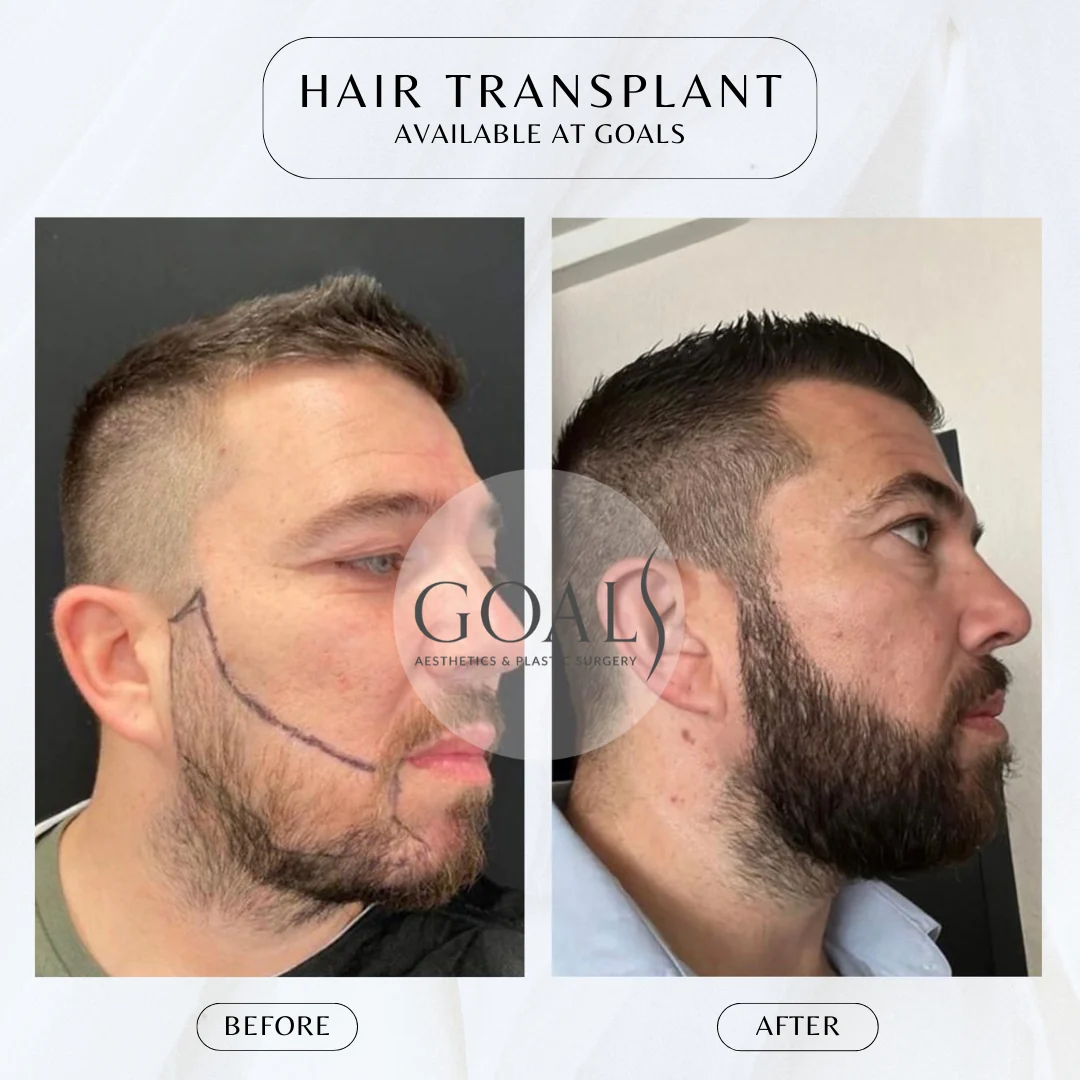
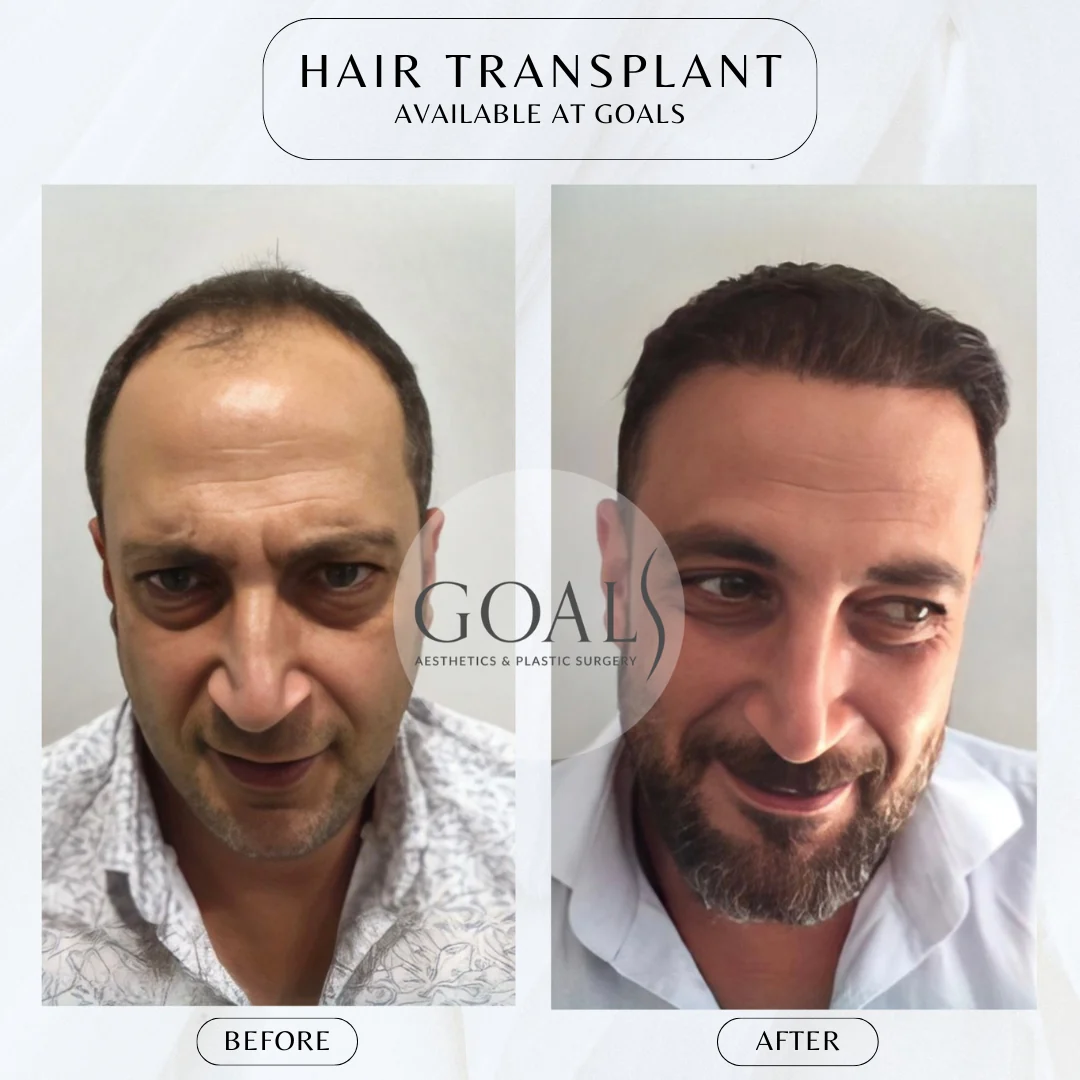
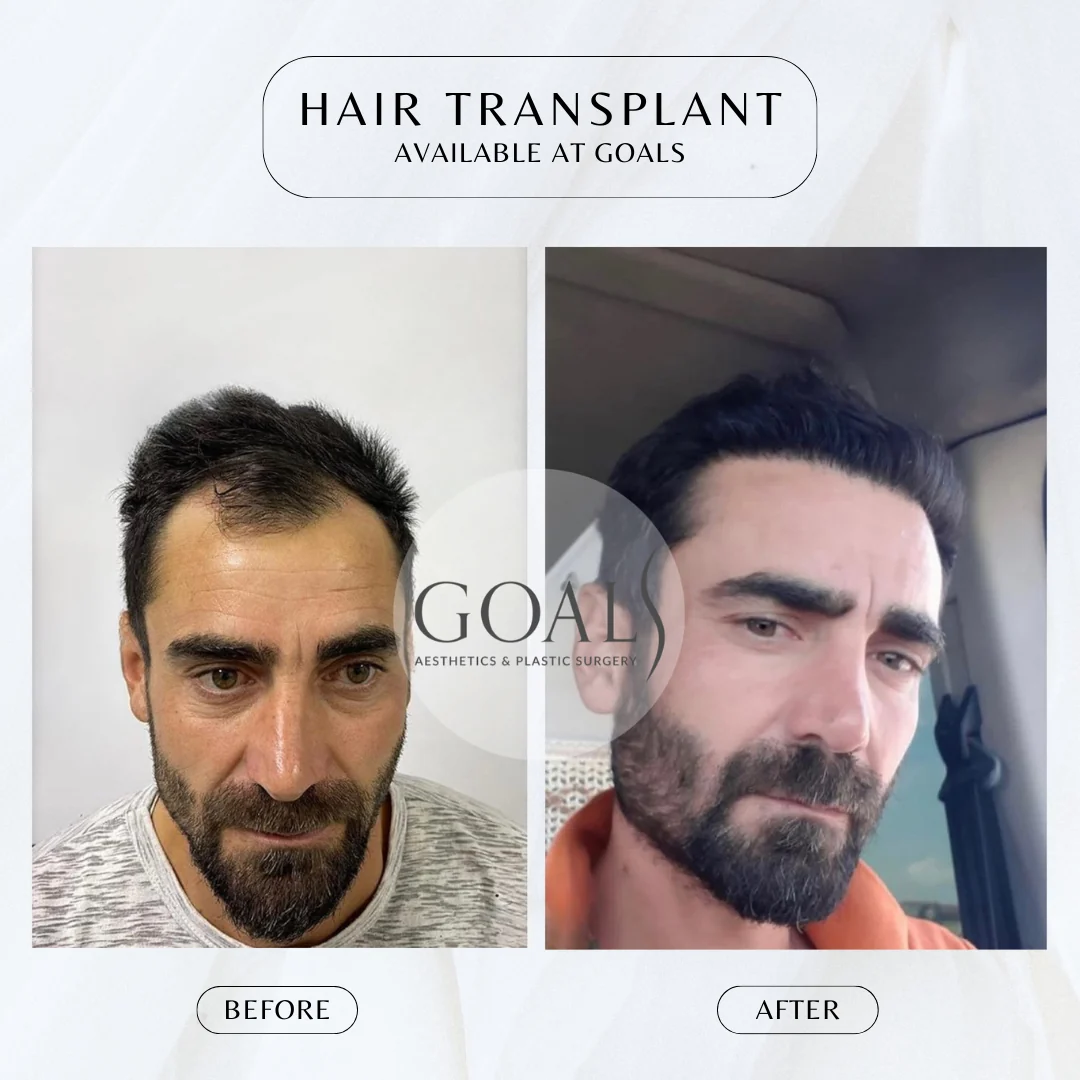
Real patients of Goals, published with written consent. Photographs are not retouched or AI-generated. Individual results vary — these images show outcomes for these patients and are not a guarantee of your own.
Work it out
Runs in your browser. Nothing is sent to us and nothing is saved — a height and a weight are your business.
BMI is one measure among several and it says nothing about how you are built. Surgeons weigh it alongside your health and your goals; it does not decide anything on its own.
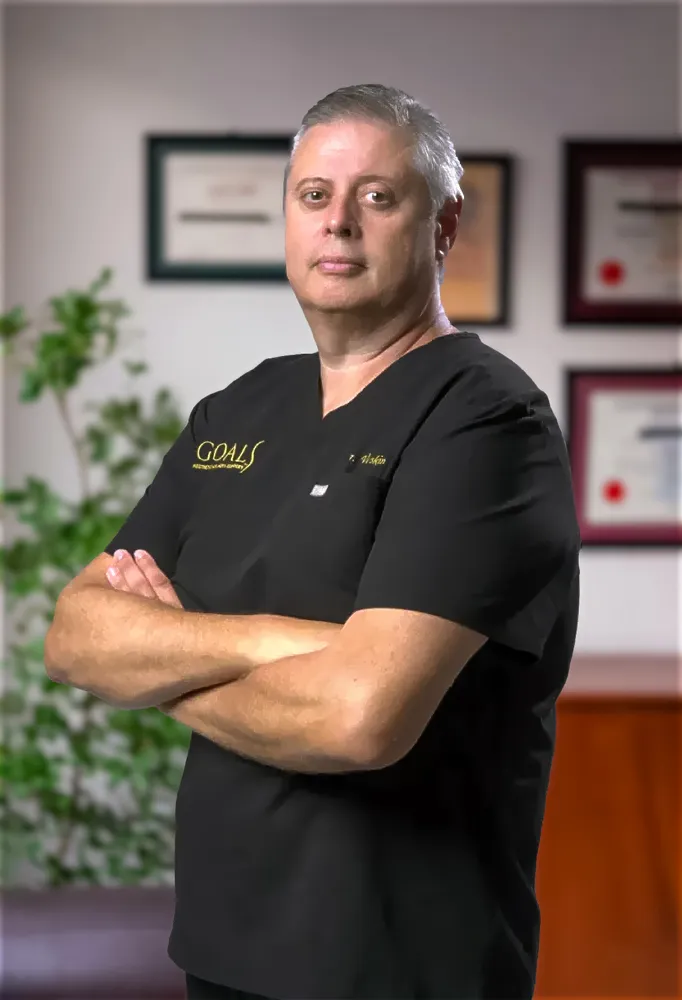
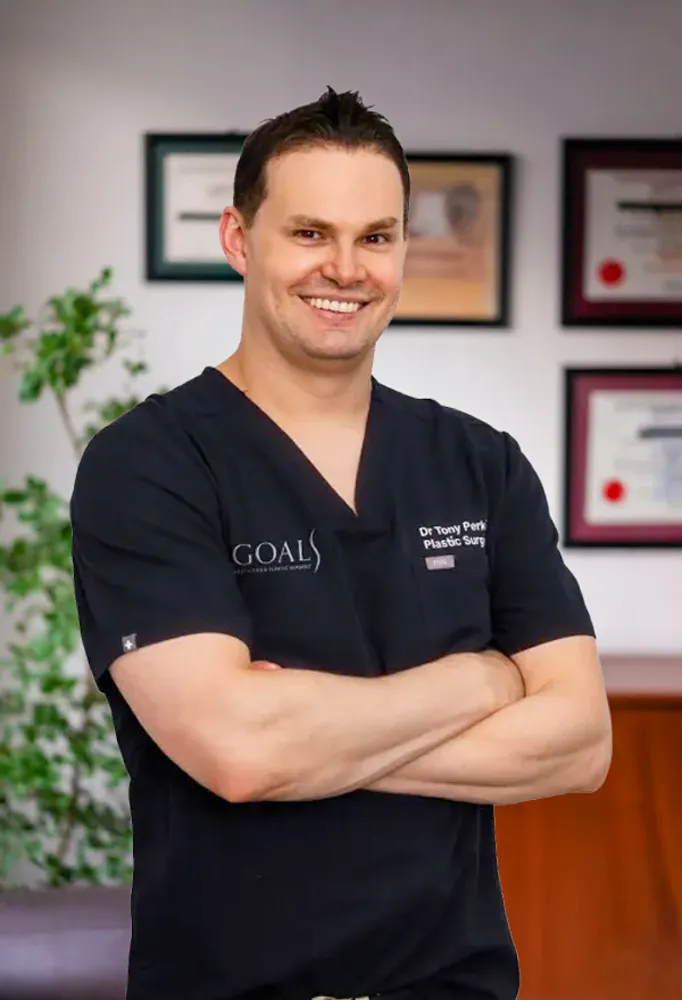
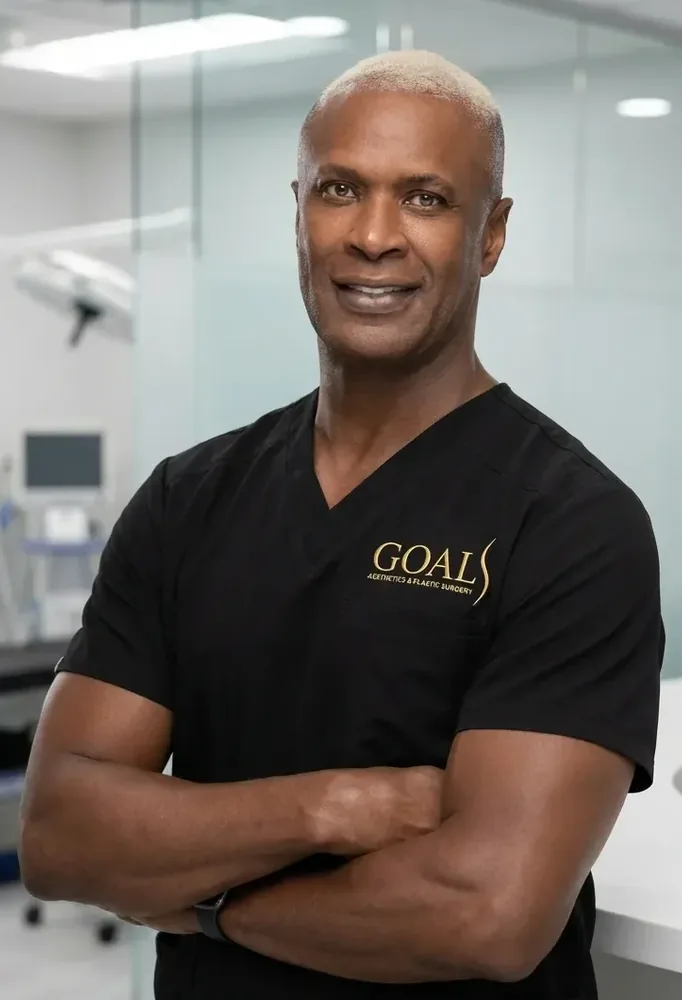
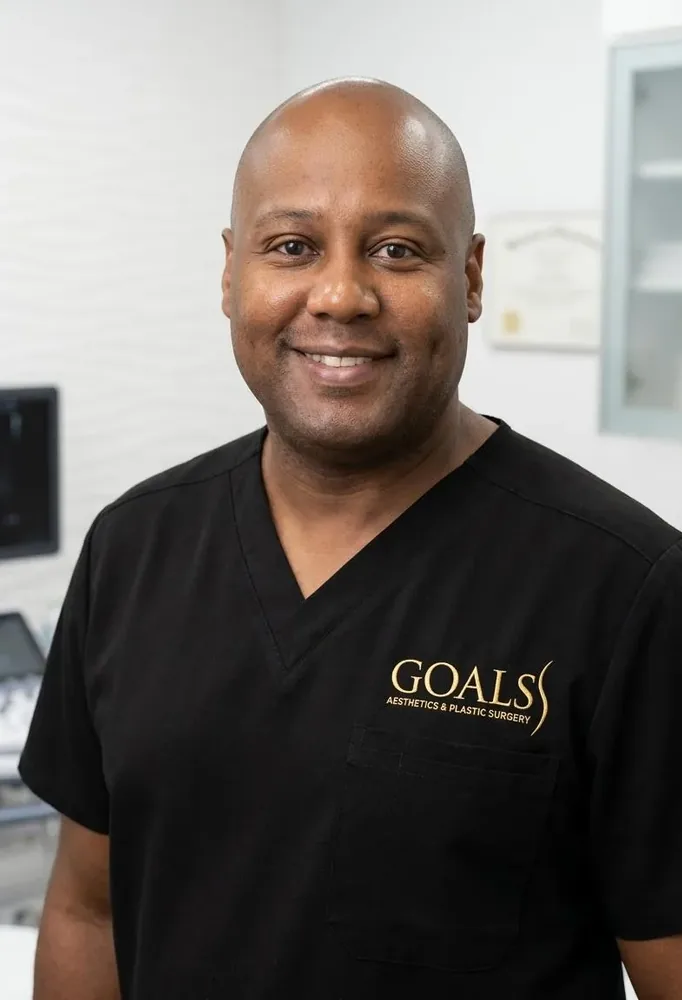
Every transplant is done by a U.S.-credentialed hair restoration surgeon, not a technician. Meet the team before you ever book your consultation.
Credentials differ by surgeon and are listed in full on each surgeon's page.
"We get why overseas "cheap hair transplant packages" look tempting. But the hidden risks (rushed surgery, language gaps, no local follow-up, complications once you're home) can turn a bargain into a real mess."
| Left Step | Right Step |
|---|---|
| Left StepYou spend weeks comparing clinics online, wiring money abroad, then booking flights and a hotel. | Right StepYou come in, or hop on a video call, with a U.S.-trained surgeon who maps your beard goals, donor hair, and facial-hair angles. |
| Left StepYou land somewhere you barely speak the language. The consult is rushed, squeezed into the same day as surgery. | Right StepTesting, consent forms, and planning all happen ahead of time, in your language, under U.S. medical standards. |
| Left StepThe surgery happens in a place you've never set foot in, often packed with patients and short on time to watch you afterward. | Right StepOn the day, the donor area is numbed with local anesthesia, and light sedation is there if you want it, so extraction is pain-free. |
| Left StepYou fly home tired and swollen. A week on, your scalp turns red and starts to ooze, and you've no idea if that's normal. | Right StepYour surgeon takes grafts from the back of your scalp and sets each at the angle your beard grows. |
| Left StepYour only fallback is a local ER or urgent care, where nobody did your surgery and nobody has the details of what was done. | Right StepIf something feels off while you heal, you call the same local team that treated you. We see you in person, tweak your meds, and sort any problem fast. |
| Left StepMore time and money go to ER visits and prescriptions, while the overseas clinic "helps" you over WhatsApp and nothing more. | Right StepThe donor area heals in days, no stitches, and follow-ups track your new growth until the final result is in. |
| Factor | Overseas Package | Goals U.S. Clinic |
|---|---|---|
| Total cost (real) | Base price plus flights, hotels, more days off, maybe ER bills once home. | Similar once all care is counted, with clear pricing and no surprises. |
| Travel & time off work | Long flights, jet lag, several days away from work and family. | A same-day local procedure, barely any travel, quicker back to normal. |
| Safety & sterility | Hit or miss; you're trusting foreign rules and little time on site. | An accredited U.S. clinic with tight infection control you check. |
| Surgeon & team | Credentials are hard to check, and you may never see the surgeon again. | Credentialed hair restoration surgeons you meet before and after. |
| Emergency backup | No local clinic; ER doctors just guess what was done abroad. | In-person follow-up, plus local urgent help if a complication shows up. |
| Follow-up care | Messages only, and real hands-on help is hard to get. | Booked in-person checkups, progress photos, and medication tweaks. |
| Communication | Language gaps, odd time zones, patchy replies. | A team in your language, written instructions, a 24/7 phone line. |
| Legal protections | Little recourse if something goes wrong once you're back. | Backed by U.S. patient safety laws and standards. |
Safety comes first here. We pair precise FUE tools with careful angle work and tight protocols, so grafts stay protected and facial hair looks natural.
Fully equipped, sterile procedure rooms inside U.S. accredited sites.
Local anesthesia keeps you pain-free, with light sedation on offer.
Reach your surgeon and medical team easily when questions come up.
Clear instructions, medications, and a follow-up plan to stop infection.
Grafts set at the angle facial hair grows, so the beard looks real.
One local team runs your consult, your surgery, and all the follow-up.
Beard hair exits at tricky angles, so surgeons place each graft to match your growth.
A U.S.-accredited clinic. No trip abroad, no language barrier, no follow-up gaps.
Experienced hair restoration surgeons you meet before and after surgery.
You're covered by U.S. patient safety laws, with real recourse if needed.
Transplanted beard hair is permanent. Grow it, trim it, or shave it clean.
"My cheeks never connected, and now the line is solid. They matched the angle so it grows in like it was always mine."
"Had a bare scar on my jaw. They filled it in and now you can't spot it. Took a few months to grow, looks natural."
"Patchy since my twenties. One session, healed fast, filled in by month six. Best thing I've done for my confidence."
Testimonials reflect individual experiences. Results vary by patient.
Every beard transplant happens on-site at our New York clinic, in a fully equipped, sterile operating room. We never send it to a partner site.
We're open Monday through Saturday. Book online in a couple of minutes or just call us, and the team will lock in your consultation date and time.
Usually the back of your scalp, where hair resists thinning. Those grafts keep their own cycle and grow as permanent facial hair once placed.
No. With FUE the grafts go in through tiny openings, so there's no facial scar, just faint dots back in the scalp donor area.
Yes. Once healed, transplanted facial hair is permanent. Grow it out, trim it, or shave it clean like the rest of your beard.
Sessions usually run 4-8 hours, based on graft count. Growth shows around 3-4 months, with full results by 9-12 months.
A beard transplant moves your own follicles into the cheeks, jaw, chin, sideburns, or mustache to build fuller, even facial hair. It addresses what no oil, supplement, or minoxidil routine reliably touches: patchy growth, gaps that never close, thin stretches along the beard line. For some men the patchiness is genetic. For others it traces back to a scar from acne, surgery, or an old injury where the hair stopped. What you get is permanent facial hair that grows, thickens, and takes a razor like the beard you already have.
At Goals Plastic Surgery every beard transplant is an in-office procedure under local anesthesia, run by U.S.-trained hair restoration surgeons. That matters, because a beard is not a scalp, and the differences are not cosmetic. If you have been comparing beard transplant New York options, the sections below start with what makes facial hair a distinct surgical problem, because every other decision follows from it.
Three things separate facial hair work from scalp work, and together they explain why experience with one does not automatically transfer to the other.
The exit angles are shallow. Scalp hair leaves the skin at a relatively steep, consistent angle across a given area. Facial hair does not. It lies much flatter against the skin, and the angle shifts as it crosses the cheek, turns down the jaw, and changes again around the chin and upper lip. A graft placed at a scalp-appropriate angle stands proud of the face rather than lying flat, and that single error is visible from across a room.
The skin moves. A scalp is anchored and comparatively stable. Facial skin sits over muscle that is in near-constant motion, and it slides, stretches, and compresses as you talk and change expression. Creating recipient sites at a consistent depth and angle in tissue that shifts under the instrument is a different technical proposition to doing it in fixed tissue.
The grafts have to match. Beard hair is typically coarser than scalp hair, and it grows predominantly as single hairs rather than in the natural groupings scalp hair forms. Donor follicles are therefore selected for texture and growth pattern rather than taken indiscriminately, and single-hair grafts are used along the borders so the edge of the beard reads soft rather than abruptly defined.
The method for facial hair is FUE. Follicles come out of the donor area one at a time and go into the beard individually, leaving faint dots in the scalp and nothing on the face. Precision and quick healing both matter more in a zone people look directly at every day, which is why it is the standard choice here rather than the strip approach used for larger scalp cases.
The design conversation is the part men most often rush and most often regret rushing, because placement decisions cannot be revised afterward the way a haircut can.
The beard line has more influence on the result than the graft count does. Where the cheek line begins, how sharply it falls toward the jaw, how far the mustache extends, how the sideburns connect: these define whether the finished beard looks like it grew there or like it was installed. A line set too high or too straight reads as artificial even when every individual graft was placed perfectly.
Age is part of this. A beard designed to look right at twenty-eight has to still look right at fifty, and facial hair that is dense and low in a way that suits a young face can look heavy and out of place later. The same restraint that applies to a hairline applies here.
So the useful preparation is to arrive knowing how you actually wear your facial hair. Short and neat, full and grown out, stubble most of the time. Which gaps bother you and which you have stopped noticing. What you have tried to grow before and what it looked like. The men who are happiest afterward are the ones who planned the shape carefully with their surgeon rather than asking for the densest coverage available.
Good candidates are men with patchy or sparse growth, thin cheeks that never link into a full line, a soft jaw or chin they would like defined, gappy mustache coverage, or uneven sideburns. Men who cannot grow hair in particular zones for genetic reasons do well, and so do men covering a scar where growth stopped, whether from acne, an injury, or previous surgery.
Facial hair that has thinned with age responds too. So does the situation of men transitioning who want facial hair that matches how they see themselves, which is a common and straightforward indication rather than an unusual one.
The single requirement is donor hair. You need enough healthy follicles, usually at the back of the scalp, to harvest without leaving the donor area visibly depleted. Because that supply is finite and does not regenerate, a careful surgeon plans within it rather than against it.
A beard transplant is not the same job as eyebrow restoration, though both involve placing single-hair grafts into a small and highly visible area. If you are weighing facial hair work against restoring hair elsewhere, our New York hair restoration team can talk the options through with you.
Your graft count comes from how much area is being filled and how dense you want the result. A mustache or a couple of specific gaps takes a modest number. A full beard built out of sparse patches takes considerably more.
Distribution matters as much as the total. Single-hair grafts go along the edges to keep the border soft and natural, with slightly tighter packing through the body of the beard where density reads as fullness. Since donor hair is finite, the surgeon plans with restraint and keeps the line believable rather than piling it on, because a beard set too dense or too low looks wrong and ages badly.
Density is judgment as much as arithmetic. Your surgeon reads the direction your existing facial hair grows and lines each transplanted graft up with it, so new growth folds into what is already there. Get the angle and the border right and a moderate graft count reads as a full, natural beard. Get them wrong and no number rescues it. The range of results is in our before & after gallery.
A few things in the weeks and days beforehand affect how the day goes and how well the grafts take. Your surgeon will go through your medications and supplements at consultation, and some may need pausing beforehand on medical advice. Blood thinners are the obvious category, but vitamin E and omega-3 supplements also affect bleeding and are easy to forget about precisely because they seem harmless. Do not stop anything prescribed without checking first.
Keep the skin on your face in reasonable condition in the run-up. Avoid harsh exfoliants, abrasive treatments, and significant sun exposure, and keep the skin hydrated. Recipient sites are being created in that tissue, and skin that is irritated or sunburnt is not a good starting point.
Arrange a ride home. The procedure is done under local anesthesia rather than general, but you will have had a long session with sedation involved, and driving yourself afterward is not the plan.
Finally, be complete about your medical history, including any tendency to scar unusually or heal slowly. Complications are uncommon, and the ones that do occur are mostly minor bruising and swelling, but the team can only account for what they know about.
Everything happens in a single visit at our accredited New York clinic. The donor area at the back of the scalp is prepped and numbed, then the surgeon harvests the grafts, creates the recipient sites at the planned angles, and places each follicle individually. Sessions typically run four to eight hours depending on graft numbers. There is no general anesthesia and no overnight stay, and you go home the same evening with written aftercare and a direct line to the team that treated you.
For the first few days the recipient area looks pink with tiny scabs around each graft, and those drop off within a week or so. Do not pick at them, and leave the razor alone until your team clears you. Soreness is usually mild and manageable with over-the-counter pain relief. Sleep so nothing rubs against the grafts for the first couple of nights, skip the gym and heavy sweating for about a week, keep the area out of direct sun, and follow the gentle washing routine you are given.
Most men are back to normal activity within a week. Then the transplanted hairs shed, generally in the first few weeks, which alarms anyone who was not warned. It is meant to happen. The follicle stays exactly where it was placed and enters a resting phase before restarting.
Growth comes in over the following months. Expect the beard to look noticeably fuller somewhere around the six-month mark, with the full result settling between nine and twelve months, at which point you can grow it, trim it, or shave it as you please. Progress at this pace is hard to judge from daily observation, so monthly photographs from the same angle are worth taking. We track your progress in person throughout.
Beard transplant pricing tracks the number of grafts, the areas being filled, and the complexity of your case, so the figure is confirmed at consultation after the surgeon has examined your beard and donor area rather than guessed from a photograph. The price is locked in before you book, with no add-ons after surgery and no hidden facility or anesthesia fees. Financing options are available if spreading the cost suits you better, and someone will walk you through the terms. Every plan includes follow-up care with the same team from procedure day through to your final result.
One point worth weighing against a cheaper quote. Facial hair is the most scrutinised area on the body, and the difference between a beard that looks like it grew there and one that does not comes down to angle and border judgment across thousands of individual placements. That is time and experience, and it is also donor hair you cannot get back if it is spent badly the first time.
About Beard & Facial Hair Transplant
Beard & Facial Hair Transplant near you
Whether you're weighing FUE, FUT, or another hair restoration option, our team will build you a safe, realistic plan that fits.
Prefer to talk now? (833) 462-5769
Free · No obligation
Tell us how to reach you. A patient coordinator calls you back — usually the same day.