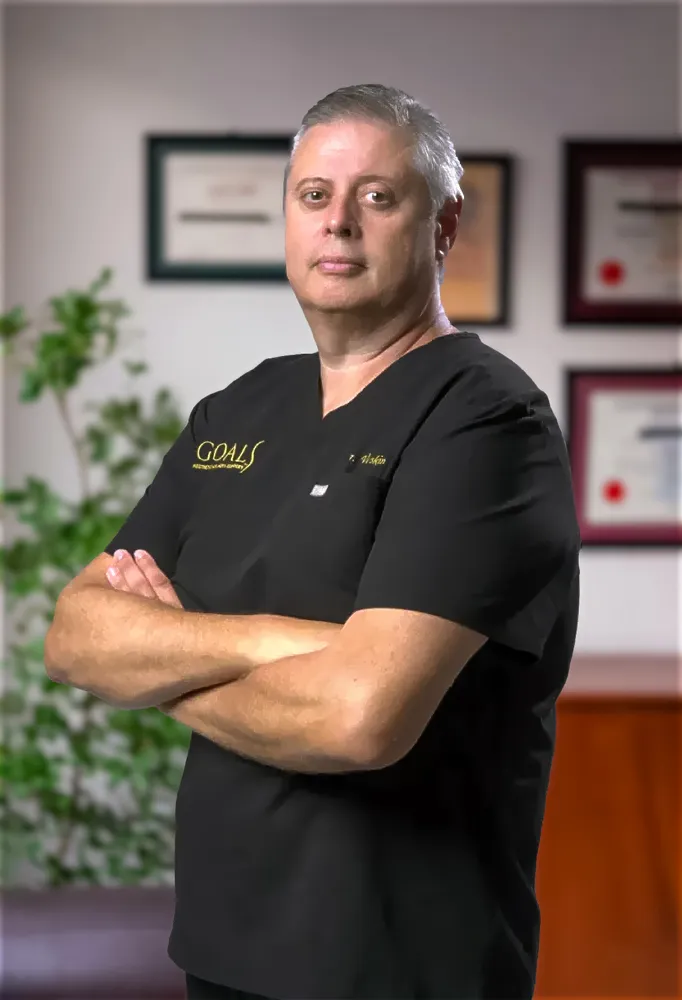
Patchy Cheeks
Cheeks that stay thin or bare no matter what, grafted to even out.
Patchy beard, thin jaw, nyppy moustache? We fill it in a single day, moving your own scalp hair into place at the right angle under local anesthesia.
From $5,000
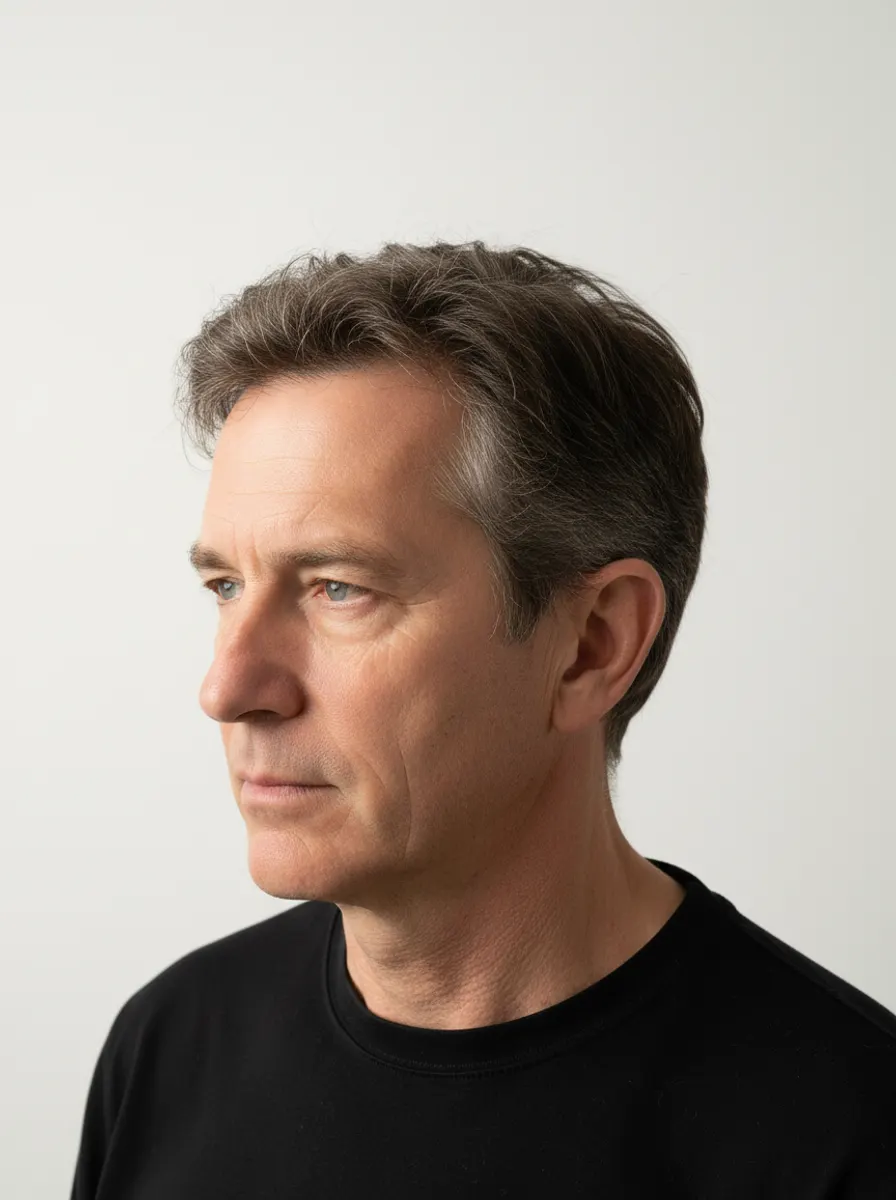
Goals Aesthetics & Plastic Surgery – Central Park
116 Central Park SMon–Sat, 10:00–19:00 local time
Surgeon: Dr. Sergey Voskin
Procedures
Wherever a beard runs thin, cheek, jaw, or moustache, we can build it back.
Cheeks that stay thin or bare no matter what, grafted to even out.
A weak or uneven jaw line, given more density and a cleaner edge.
The break between moustache and chin, closed so the beard joins up.
Sideburns that are stubby or gone, rebuilt to frame and blend.
Scars from acne, injury, or surgery, grown over so hair hides them.
A sparse beard overall, thickened to a natural, even fill.
Candidacy
A transplant makes sense if your beard grew in thin or blotchy and you want it fuller for good. The fix is your own hair, relocated from the back of the scalp to the gaps.
Bald patches that just never grow.
No autoimmune loss active in the beard.
Done with fillers and daily upkeep, you want it permanent.
A solid donor supply at the back of the scalp.
A fuller beard that still looks natural, not overdone.
Thinning on top as well, or comparing routes? These are the other hair procedures we offer.
About Beard & Facial Hair Transplant
More at the Central Park clinic
Non-surgical options
Noticing thinning on the scalp? For early loss or heavy shedding, these non-surgical options build density and guard what you have, and they work alongside a transplant later.
Clinics
Choose the office that works for your day. Consult, pre-op clearance, and post-op visits can all happen at whichever Goals location is closest, or easiest to park at.
Look at the before and after on real Central Park patients.
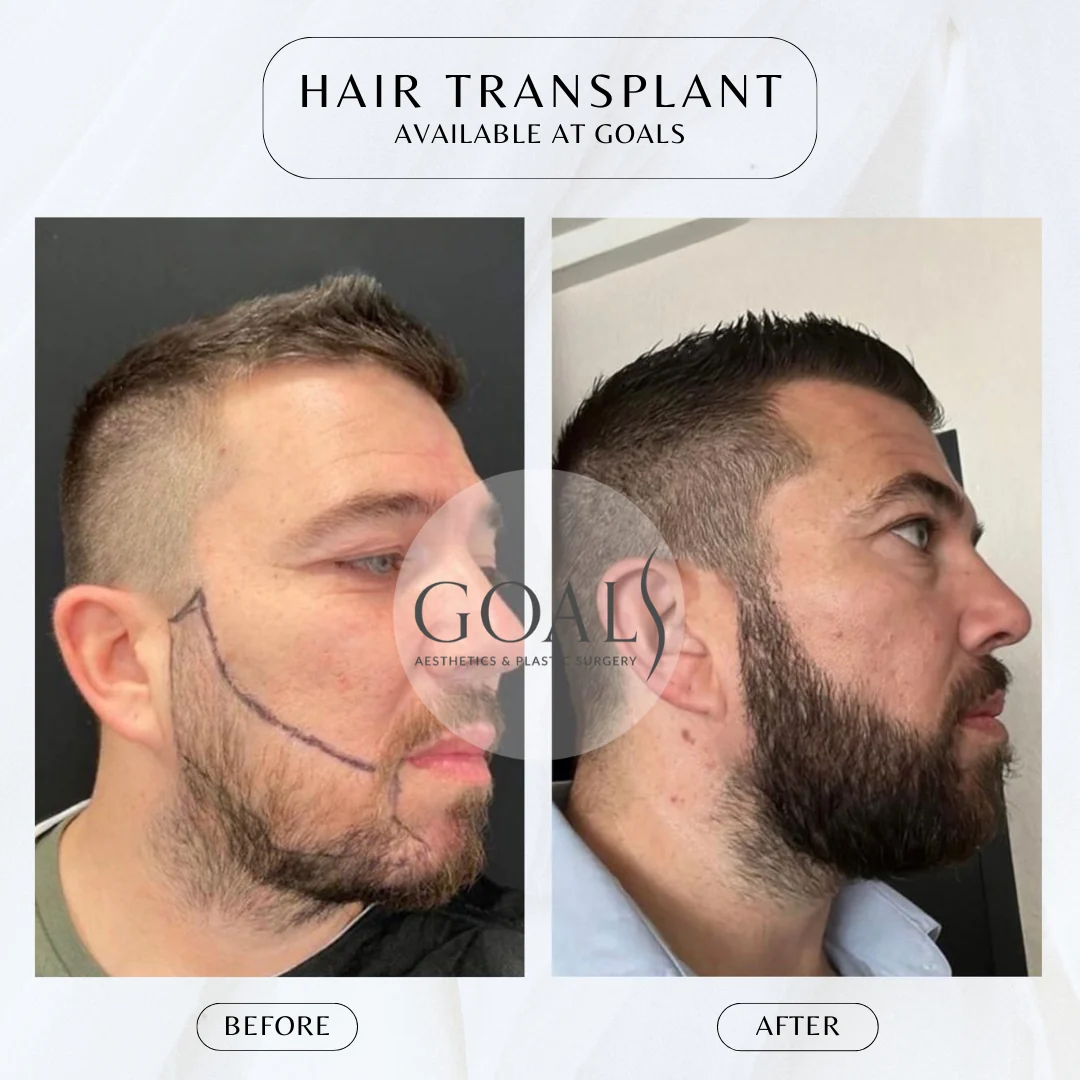
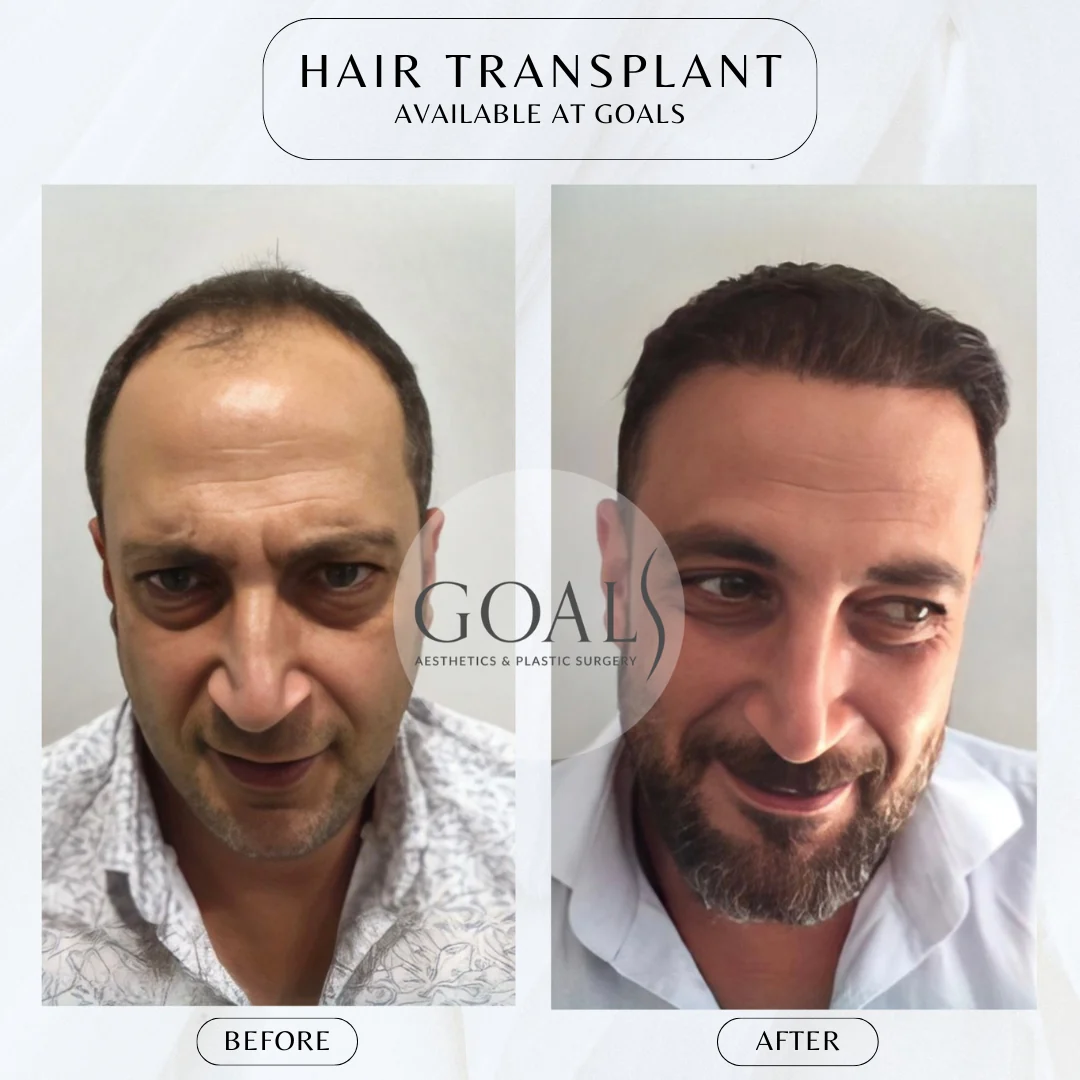
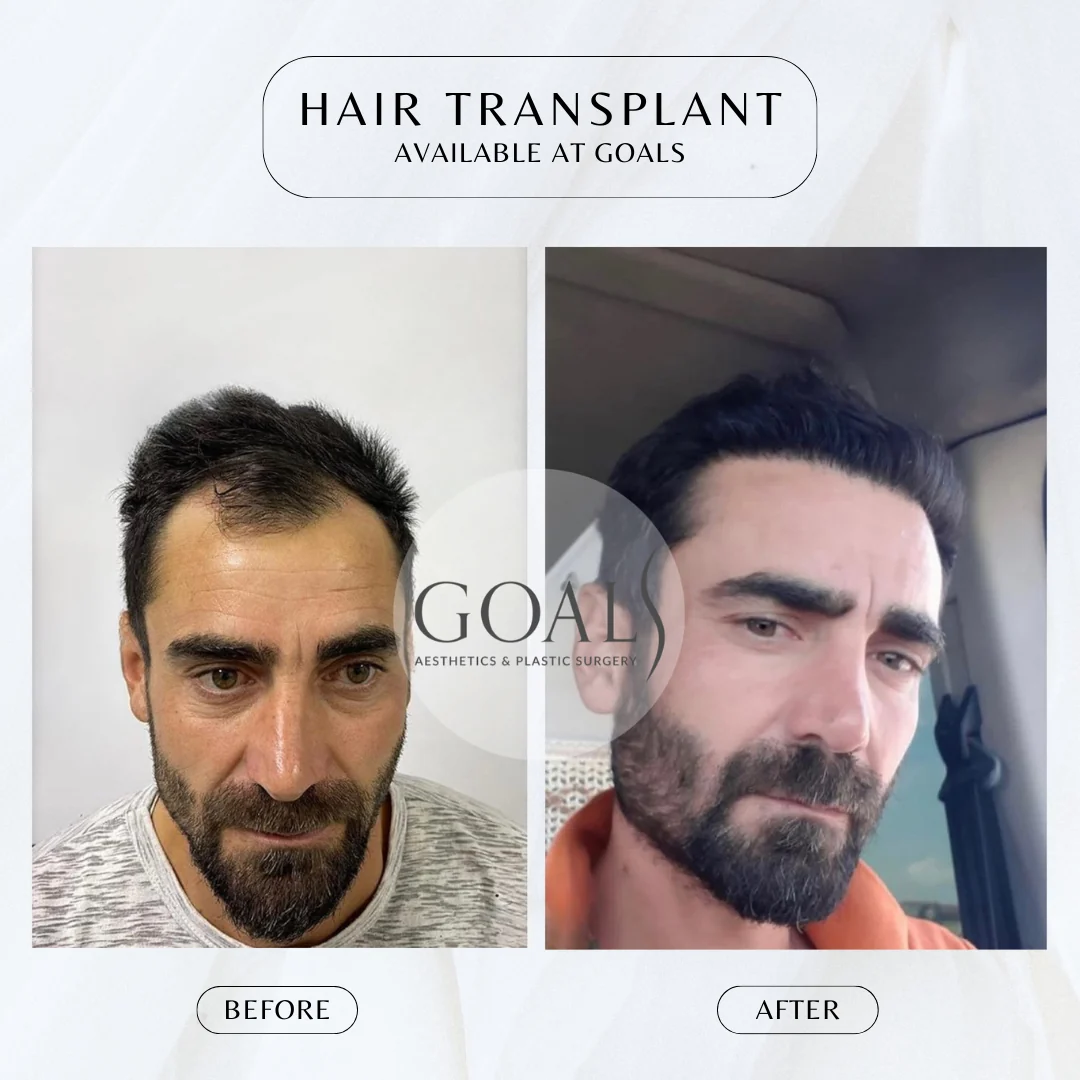
Real patients, published with written consent. Photographs are not retouched or AI-generated. Individual results vary — these images show outcomes for these patients and are not a guarantee of your own.
Try it
Type your height and weight. Your numbers stay on your device. We do not see or save them.
BMI is just one number. Your surgeon also looks at your health and your goals. BMI alone does not decide if you can have surgery.
Our surgeons
Safety comes first on every case. Tight protocols, current tools, results that hold up. Get to know our team of licensed surgeons.
Each surgeon’s training and licenses are listed on their own page.
Those overseas "budget beard transplant" deals look good on paper. The catch is what they hide: rushed angle work, a language barrier, nobody to see after, and problems that follow you home and cost more.
| Flying Abroad | U.S. with Goals |
|---|---|
| Flying AbroadYou spend weeks vetting clinics, wire a deposit abroad, then book flights and a hotel. | U.S. with GoalsYou meet a licensed surgeon first, in person or by video, who plans the beard and looks over your donor. |
| Flying AbroadYou touch down where you hardly speak the language, and surgery day doubles as your consult. | U.S. with GoalsBloodwork, forms, and the plan are handled up front, in your language, to U.S. clinical standards. |
| Flying AbroadThe angle makes the beard, and a factory-pace clinic botches it more than it nails it. | U.S. with GoalsSurgery day, you enter an accredited clinic, sterile room, local anesthesia, and the grafts go in. |
| Flying AbroadYou fly home sore and puffy. Days later the grafts crust and redden, and nobody can say if that is normal. | U.S. with GoalsMost of the day goes to it, but you are comfortable, break as you like, and sleep at home that night. |
| Flying AbroadAll you have is an urgent care or ER, run by people with no record of your case and no idea what was done. | U.S. with GoalsIf healing throws a curveball, the same local team picks up and sees you in person to sort it. |
| Flying AbroadYou burn more time and cash on visits and prescriptions, while the clinic abroad just texts you. | U.S. with GoalsFollow-ups and progress reviews stay with one clinic and one team, all the way through the beard filling in. |
| Factor | Overseas Package | Goals U.S. Clinic |
|---|---|---|
| Total cost (real) | The upfront price, plus airfare, hotel, time off, maybe an ER bill. | Similar all in, except the quote is spelled out first, no add-ons later. |
| Beard angle work | Facial angles are unforgiving; rushed clinics miss. | Each graft matched to how your beard actually grows. |
| Safety & sterility | Whatever the local rules allow, on a tight schedule. | A U.S. room run to accredited-facility standards. |
| Who does surgery | Hard to confirm who operates, and you likely never meet them again. | A licensed restoration surgeon who sees you start to finish. |
| Candidacy check | They may cut through active loss that dooms the grafts. | We rule out autoimmune loss first so grafts survive. |
| Follow-up care | Messages only, and real hands-on help is scarce. | Set visits, progress photos, and med changes when needed. |
| Communication | Translation snags, bad time zones, slow answers. | Your own language, written steps, a line open 24/7. |
| Legal protections | Barely any recourse if things go sideways at home. | Covered by U.S. patient-safety law and rules. |
Safety
Everything here is built around safety. Tight protocols and modern equipment keep the risk down and the outcome dependable.
Accredited U.S. sites with sterile, fully stocked procedure rooms.
Placement matched to how your beard grows on your face.
Numbed locally, skipping the risk of general anesthesia.
Your surgeon and care team stay reachable for questions.
A set plan for aftercare, meds, and check-ins to prevent infection.
Why Goals
The same local team runs consult, surgery, and follow-ups.
Surgeons who do facial work handle the angle and design.
Accredited and stateside, so no travel, no translation, no dropped follow-up.
A licensed restoration surgeon who sees you start to finish.
U.S. patient-safety law protects you, with real recourse if needed.
A single all-in quote, with no facility fees sprung on you later.
FAQ
From the back of your scalp, where the hair is thickest and permanent. Those follicles get moved into the beard and keep growing. Once you heal, the new hair acts like the rest of your beard, so you trim, shave, and style it like normal.
Yes. Once it fully grows in, usually inside a year, the hair is permanent and acts like any beard hair. Shave it, trim it, grow it long, shape it however you want. There is no special upkeep to it.
No line scar. We use follicular unit extraction, pulling grafts one at a time, which leaves only tiny dots in the scalp donor that your hair hides. Done right, the beard heals with nothing visible.
Yes, as long as the angle is right. Beard hair grows at a totally different angle than scalp hair, so we map your beard and set each graft to your own direction and density. Done with care, it just reads as your beard.
You reach the same Central Park team that treated you. Since we are a U.S. clinic, you can come in if something feels off, and we adjust your meds or check the grafts in person instead of texting it out from overseas.
The transplanted hairs shed in a week or two, which is expected. New growth kicks in around 3 to 4 months, thickens from there, and the beard hits full density by about 8 to 12 months. The scalp donor heals in a week or so.
Learn more
This page is about beard & facial hair transplant at Goals in Central Park. The clinic is at 116 Central Park S, New York, NY 10019, and consultations there are free and carry no obligation. A licensed U.S. surgeon operates here. What follows explains the procedure itself, which does not change with the address.
Some men never get the beard they want. The cheeks come in patchy, the moustache refuses to reach the chin, or a scar leaves a bare strip along the jaw. Waiting does nothing, and neither do supplements, because a follicle that was never there does not appear later.
Most men arrive having spent a year or two on minoxidil, supplements, microneedling, or growth serums. It is worth being precise about why those did not fix a patchy beard, because the reason explains what surgery does differently.
Topical treatments act on follicles that already exist. They can thicken a hair that is growing thinly, extend how long it stays in its growth phase, and make a sparse area look somewhat denser. That is a real effect and not nothing.
What they cannot do is create a follicle where none exists. A cheek that has never grown hair does not contain dormant follicles waiting for the right product. It contains skin. No topical, supplement, or device changes that, which is why men with genuinely bare zones see results everywhere except the place they were actually treating.
A transplant is the only approach that adds follicles rather than improving existing ones. That is the whole distinction, and it is why facial hair transplant Central Park patients who came in after years of topicals tend to describe the outcome as the first thing that addressed the actual problem.
Before anything is planned, your facial hair loss needs to be stable. This is the check that discount and overseas clinics most often omit, and skipping it can waste your donor supply entirely. Alopecia barbae is an autoimmune condition in which the immune system attacks beard follicles specifically. It typically shows up as smooth, well-defined round patches rather than the diffuse patchiness of ordinary sparse growth, and it can appear and spread over months.
The critical point is that the condition does not distinguish between original follicles and transplanted ones. Grafts placed into an active autoimmune process are attacked by the same mechanism that cleared the area in the first place, which means spending permanent donor hair on follicles that will not survive.
So we screen for it before planning. If it is active, that gets treated first and surgery waits until things have been quiet for a meaningful period. This is not a delay tactic. It is the difference between a transplant that lasts and one that disappears, and it is worth asking any clinic directly how they handle it. Two other conditions worth ruling out at the same time are scarring processes affecting the face and any recent medication change that could explain sudden loss. Both are uncommon, and both change the plan when present.
Angle is what makes a beard read as grown rather than placed, and it is the single hardest part of this procedure. Beard hair does not project outward. It lies close to the skin and sweeps, and the direction changes as it crosses your face. Along the jaw it runs one way, across the cheeks it flattens out, on the chin it angles downward, and around the moustache it turns again toward the lip. Each zone has its own geometry.
Scalp hair, which is what the donor grafts are, sits at a completely different angle in its original home. Place a beard graft the way you would place a scalp graft and it stands away from the face rather than lying against it. That single error is visible from across a room, and no quantity of additional grafts corrects it.
There is a second complication. Facial skin sits over muscle that moves constantly, so the surgeon is creating recipient sites in tissue that shifts under the instrument and then has to hold its position while it heals. Scalp tissue does not behave that way. This is why facial work rewards surgeons who do faces specifically rather than one scalp routine applied everywhere. It is slow, deliberate work, and the slowness is the point.
No two beards fail identically. Some men have cheeks that never filled in, others a soft jawline, a gap where the moustache should meet the chin, thin sideburns, or a bare soul patch. Grafts also go into scars from acne, injury, or old surgery so hair finally grows over them.
Graft numbers follow directly from how much you are filling. Evening out two thin patches takes a fraction of what building a beard from almost nothing requires, and a full rebuild across every zone can climb into the thousands.
Hair calibre changes the arithmetic more than people expect. Thick, dark hair reads as full at a lower density because each strand blocks more light and contrasts more against the skin. Fine or light hair needs more grafts to produce the same visual result. Two men with identical bare areas can therefore need noticeably different numbers.
Large cases are sometimes split across two sessions, and the reasoning is worth understanding rather than reading as upselling. Splitting protects your donor supply by allowing the scalp to recover between harvests, and it lets the second session refine density based on how the first one actually grew in. Building the whole beard in one sitting is possible in some cases and unwise in others, and which applies depends on your donor density. At the consult you get a real range rather than a number chosen to sound appealing, and the range comes from mapping your face against your donor supply. Our before & after gallery shows what different graft counts actually produce.
The day opens with design. The beard shape is marked with you, the zones to be filled are agreed, and density is settled before anything else happens. Then the donor patch at the back of your scalp is trimmed and numbed, and grafts are removed one at a time using follicular unit extraction, which leaves small dot marks rather than a linear scar. The surgeon opens tiny recipient sites in the beard, each angled for its specific zone, and places the grafts.
You stay awake and comfortable throughout, take breaks as needed, and go home the same evening with instructions and medication. Sessions run several hours depending on graft numbers.
The first day or two brings redness, mild swelling, and small crusts around each graft. That settles across the first week. The donor patch closes in roughly seven to ten days, and once the scabs clear you can buzz it again. Most men are comfortable being seen within a few days, even if the beard still looks worked-on early.
The grafts are fragile during that first week, and the face is considerably harder to leave alone than a scalp. Do not touch, scratch, or pick the crusts, and do not shave the area until you are cleared. Keep it out of the sun, and sleep so your face is not pressed into the pillow for the first few nights. Wash exactly as instructed. The first seven days determine how many grafts survive, and there is no recovering a graft dislodged early.
Around one to two weeks in, the transplanted hairs fall out. This is the part that alarms men who were not warned, and it is entirely normal. The follicle remains under the skin exactly where it was placed and enters a resting phase before restarting.
New growth appears around three to four months. It thickens through the months after that, and the beard reaches full density somewhere between eight and twelve months. The hairs that emerge early behave like scalp hair at first, growing faster and finer than beard hair does, and they gradually adapt in texture as they mature in their new location.
Once matured, you shave, trim, and shape it like any beard, because that is what it is. The follicles are permanent.
It builds slowly and there is no way to speed it up. Photographs from the same angle in the same light, taken monthly, are more reliable than daily observation, which is incapable of registering change at this pace. Month five is where men most often conclude nothing is happening, and it is almost always too early to draw that conclusion.
A patchy jaw is not the only reason people come in. Grafts placed into scars from acne, injury, a cleft-lip repair, or previous surgery grow hair over marks that never had follicles, which conceals them more effectively than anything topical.
Facial hair restoration is also part of gender-affirming care, for transgender men and nonbinary patients building a fuller beard through transition. The surgery itself is unchanged: healthy scalp follicles, natural angles, permanent once they take. What differs is the design conversation, which is handled on your terms.
Many men with a patchy beard are also thinning on top, and the two can be planned together. Your scalp donor area is a single finite resource serving both, so if the supply is strong there is often enough for the beard and a receding hairline both, staged across sessions or combined so you are not recovering twice. If your donor is more limited, the honest conversation is about which comes first.
At consultation your whole donor supply is assessed rather than just the area relevant to today’s question. Our Central Park hair restoration hub covers the full range of scalp options, including FUE and FUT, and what one donor area can realistically support.
What you get from us is a clear quote after the consult, all in, with no facility or anesthesia fees appearing afterward. Monthly financing is available if spreading the cost suits you better. We examine your beard, assess what your scalp donor can give, rule out active facial hair loss, mark the zones you want filled, and give you a straight read on grafts and cost. Nobody is pushed to sign that day. If beard restoration Central Park is the right call for you, pre-op testing and consent are arranged ahead of your date. If it is not, we say so.
It is not instant and it is not cheap, and anyone claiming otherwise is selling something. But a year out from a well-planned transplant, most men simply have a beard and stop thinking about it.
The short version: a surgeon takes healthy follicles from the back of your scalp and sets them into the beard one graft at a time, each at the angle your facial hair grows. You stay awake, it happens in-office under local anesthesia, and you go home the same day. What follows covers the screening step most clinics skip, how the design actually gets made, and how to think about beard transplant cost Central Park without the usual sticker games.
Cost tracks two things: graft count and case complexity. A full rebuild runs higher than filling one or two zones. We do not publish a flat figure, because your beard is not the next man’s, and a low number advertised online usually means the real bill arrives later. If you have been searching beard transplant cost Central Park, the honest answer only exists after someone has mapped your beard and assessed your donor area.
About Beard & Facial Hair Transplant
More at the Central Park clinic
Get started
First beard consult, or still comparing a transplant with other routes? Our team lays out your facial hair goals and puts a safe, realistic plan together.
Prefer to talk now? (833) 462-5769
Free · No obligation
Tell us how to reach you. A patient coordinator calls you back — usually the same day.
Free · No obligation
Ask me anything. I usually reply straight away.
If you share your number, a Goals coordinator may call or text you about your consultation. Message and data rates may apply.
Nora is an automated chat. She cannot give medical advice or say whether a procedure suits you.