Receding Hairline
A hairline that's crept back and needs rebuilding to frame your face again.
Curl-aware FUE for Afro-textured hair, done in-office under local anesthesia. Your hair restoration surgeon is an expert in working with coily, curly follicles daily.
From $5,000
12,000+
Hair Procedures Performed
150+
Years of Combined Surgical Experience
4.9
Based on 8,500 Patient Reviews
Come to our New York clinic for consults, pre-op clearances, and post-op follow-ups. Easy to reach whether you drive in or commute, with parking close by.
We handle every kind of hair loss and thinning, for both men and women.
A hairline that's crept back and needs rebuilding to frame your face again.
A thinning crown or vertex where you want density brought back.
Patchy, uneven spots across the scalp that need filling in evenly.
Grafts set into scarred spots and patches where hair no longer grows.
Filling in receded temples and edges so the hairline looks whole again.
Grafts matched to your curl so your natural pattern stays intact.
If you have a receding hairline, a thinning crown, or patchy spots, you're likely a good fit. Our techniques keep your natural curl pattern, so the result looks full and real.
Hair loss you can spot in the mirror or photos.
Loss that's held steady or slowed over the past 1-2 years.
Our techniques hold onto your curl pattern so it still looks full and natural.
Enough healthy hair across the back and sides of the scalp.
Ready to follow the pre- and post-op instructions.
Want to pair your transplant with something else, or weigh other options? We cover the full hair restoration range.
About Afro Hair Transplant
Afro Hair Transplant near you
Bring back natural growth with transplant techniques built for lasting, believable results. A good fit if you're dealing with thinning or hair loss, or just want more density from a plan made around you.
See the real before-and-after changes our patients have had.
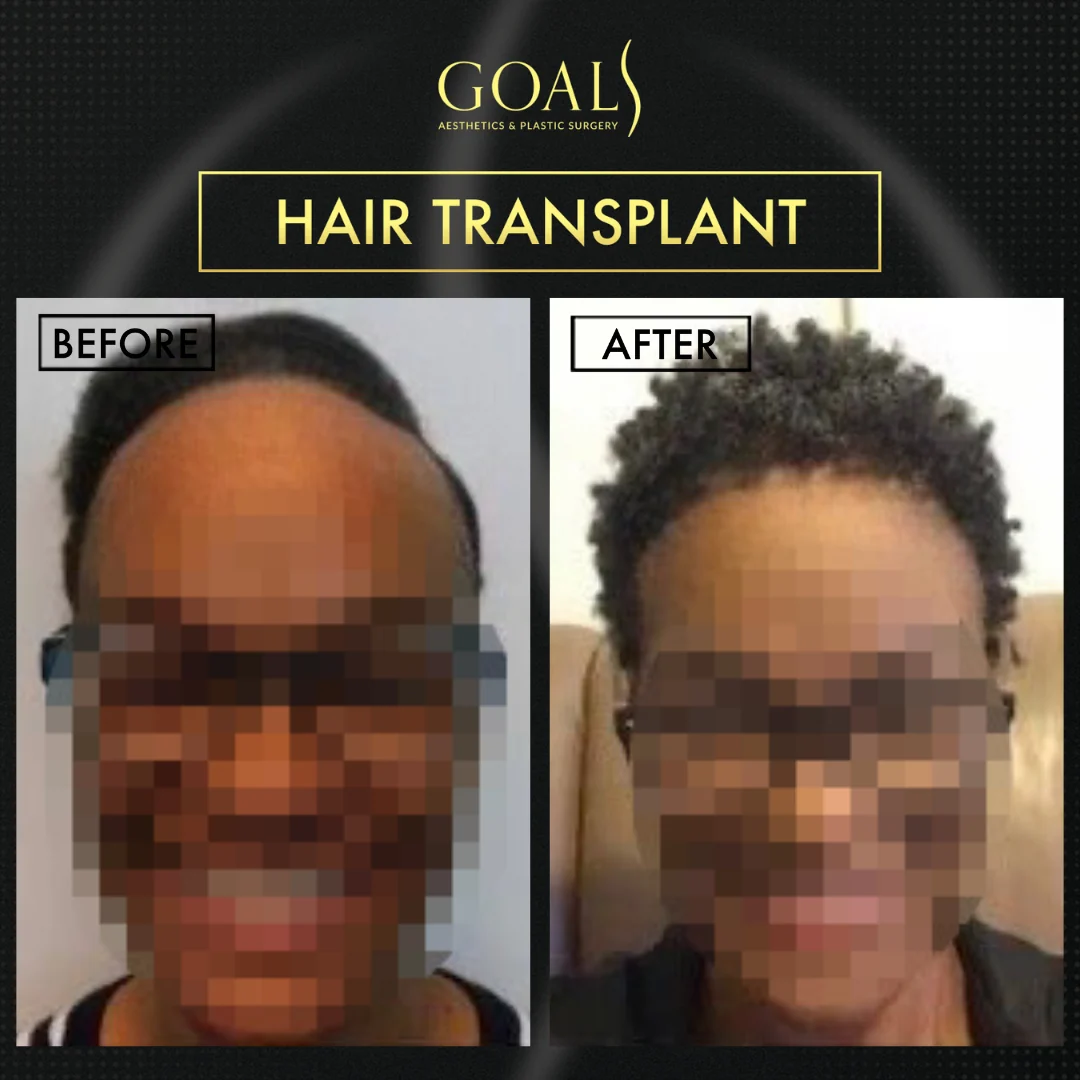
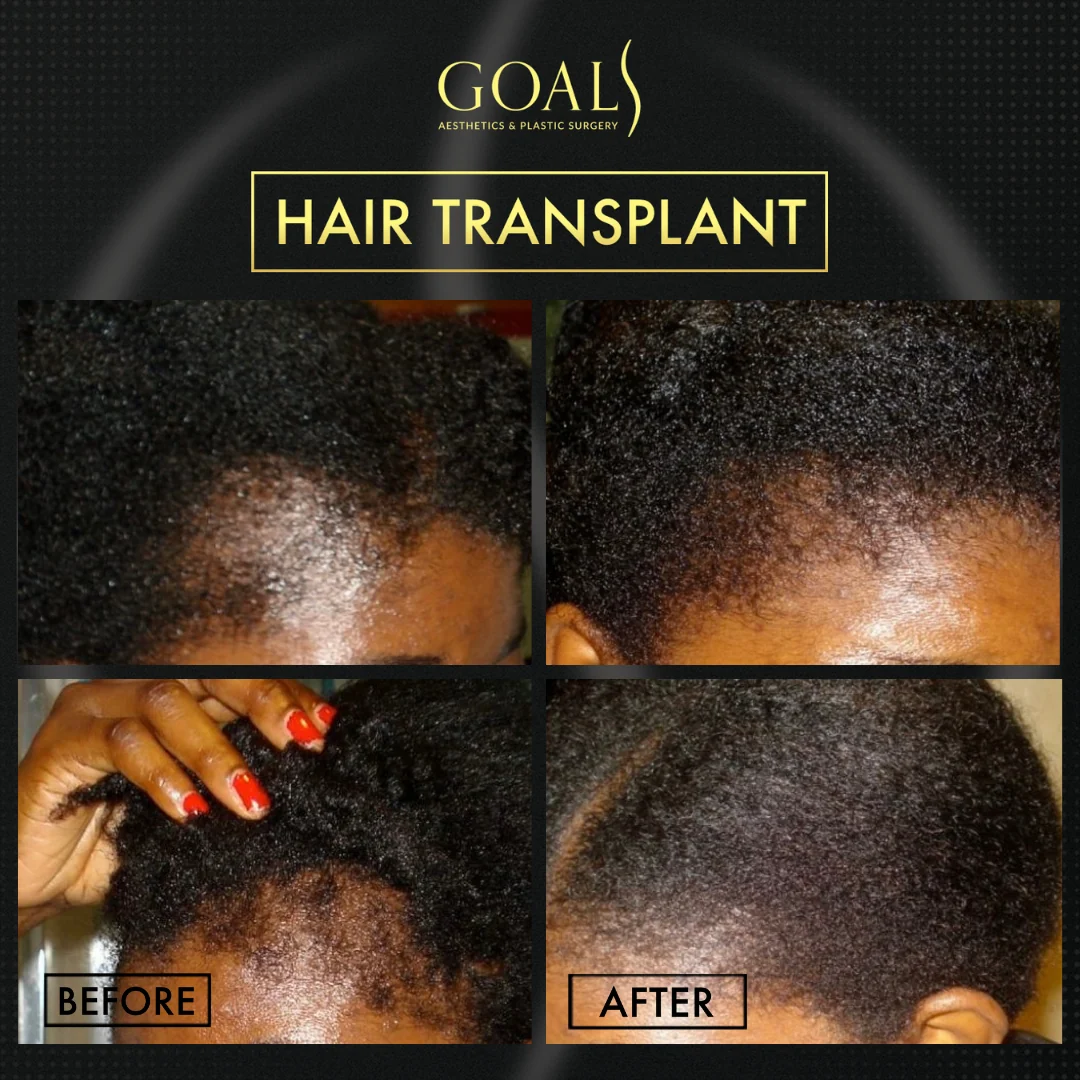
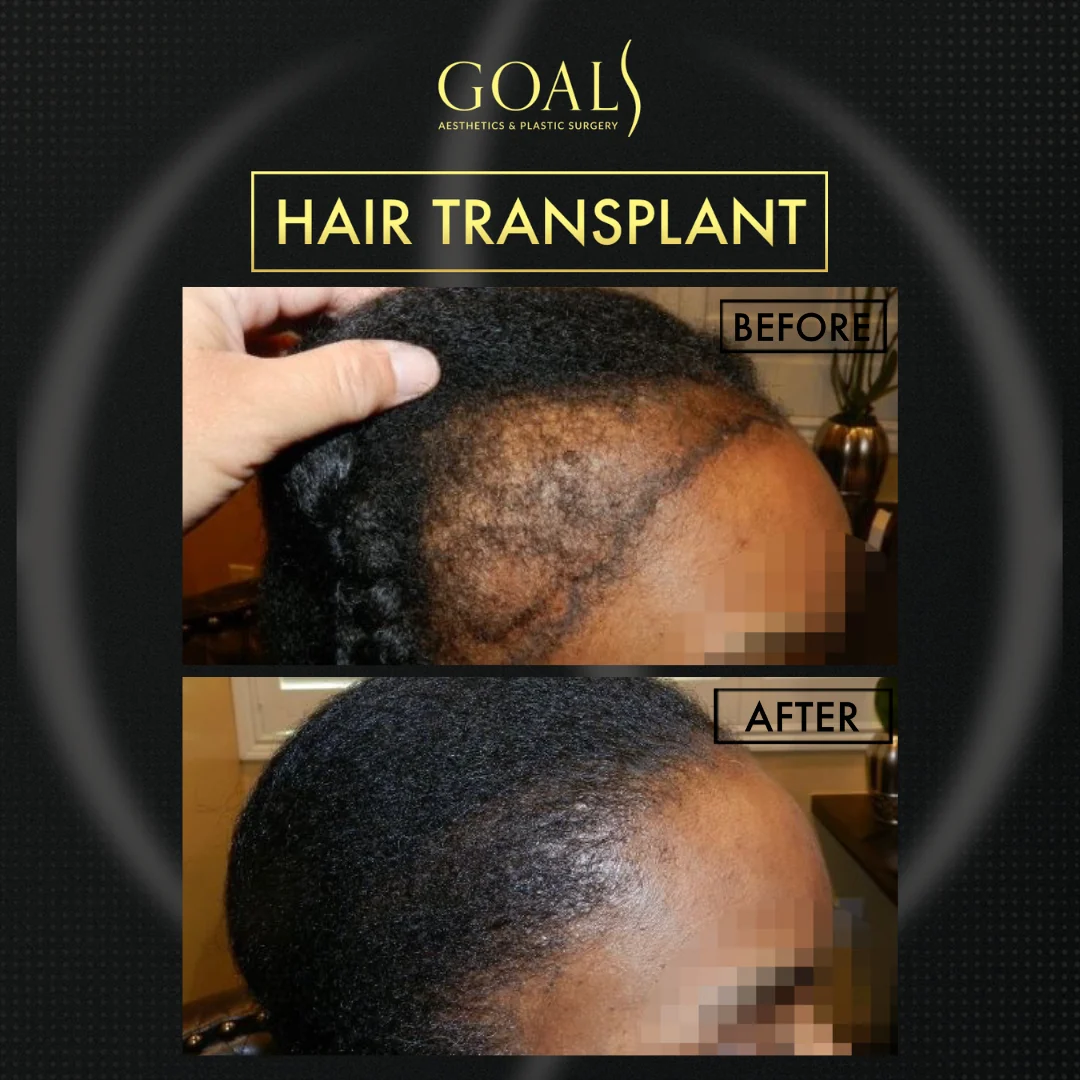
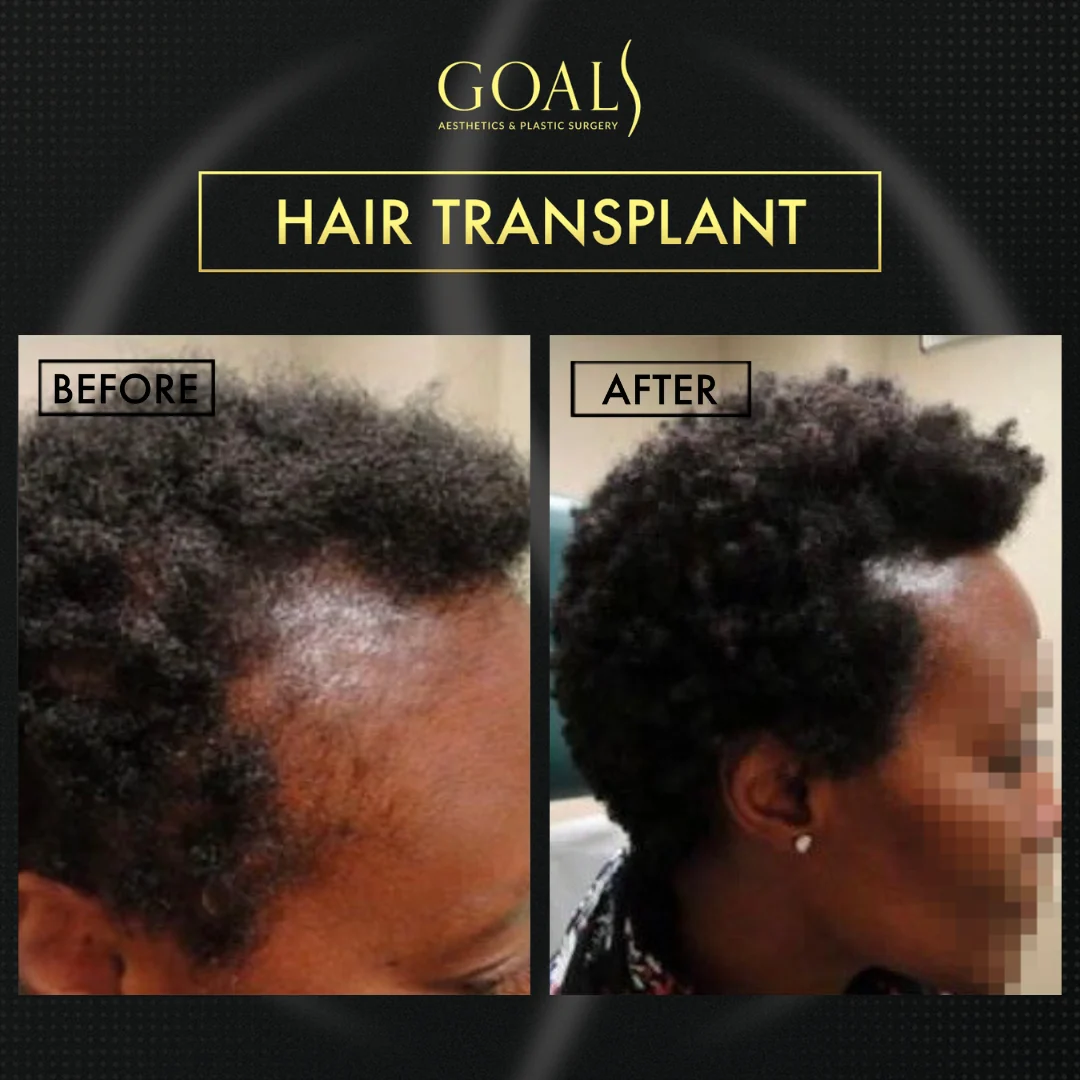
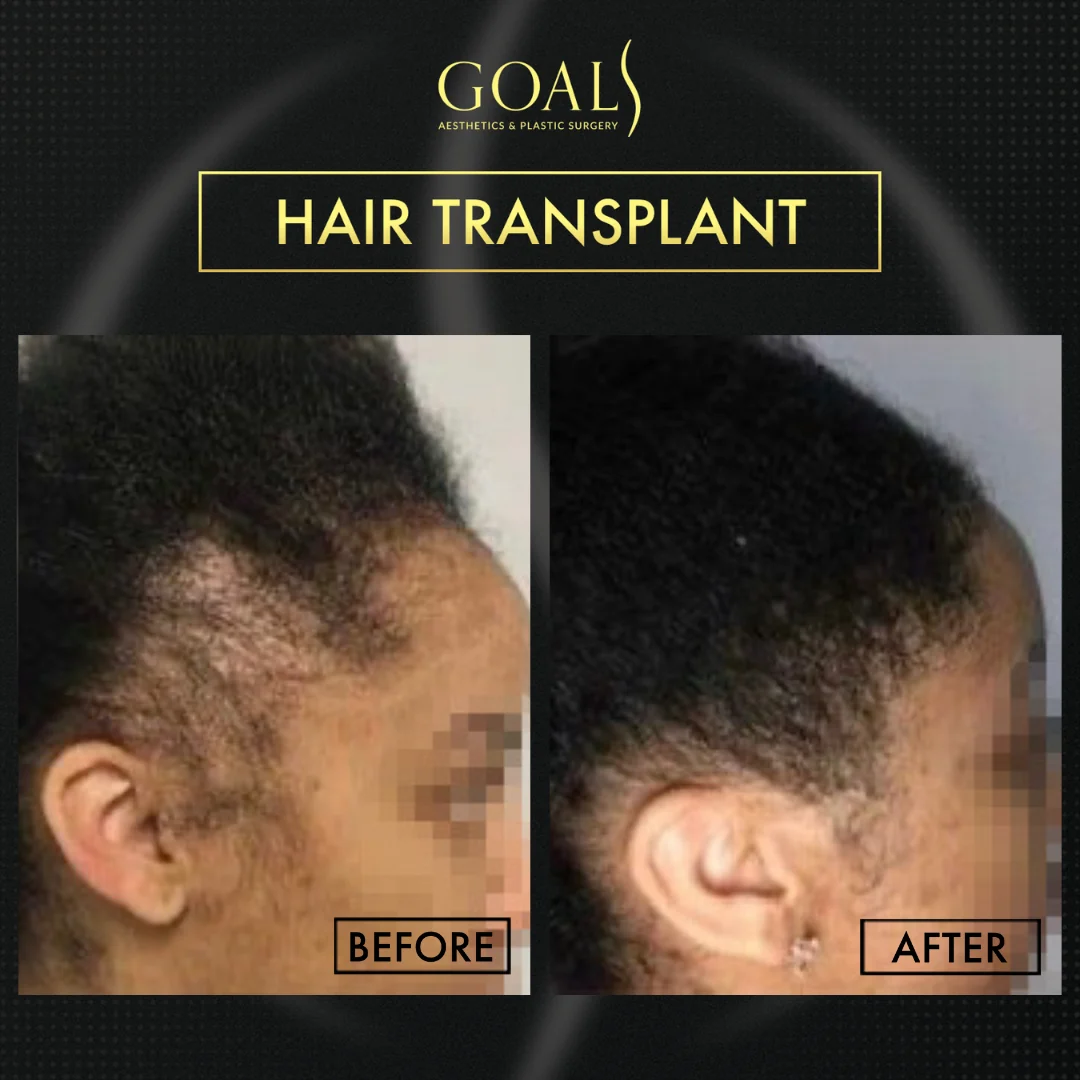
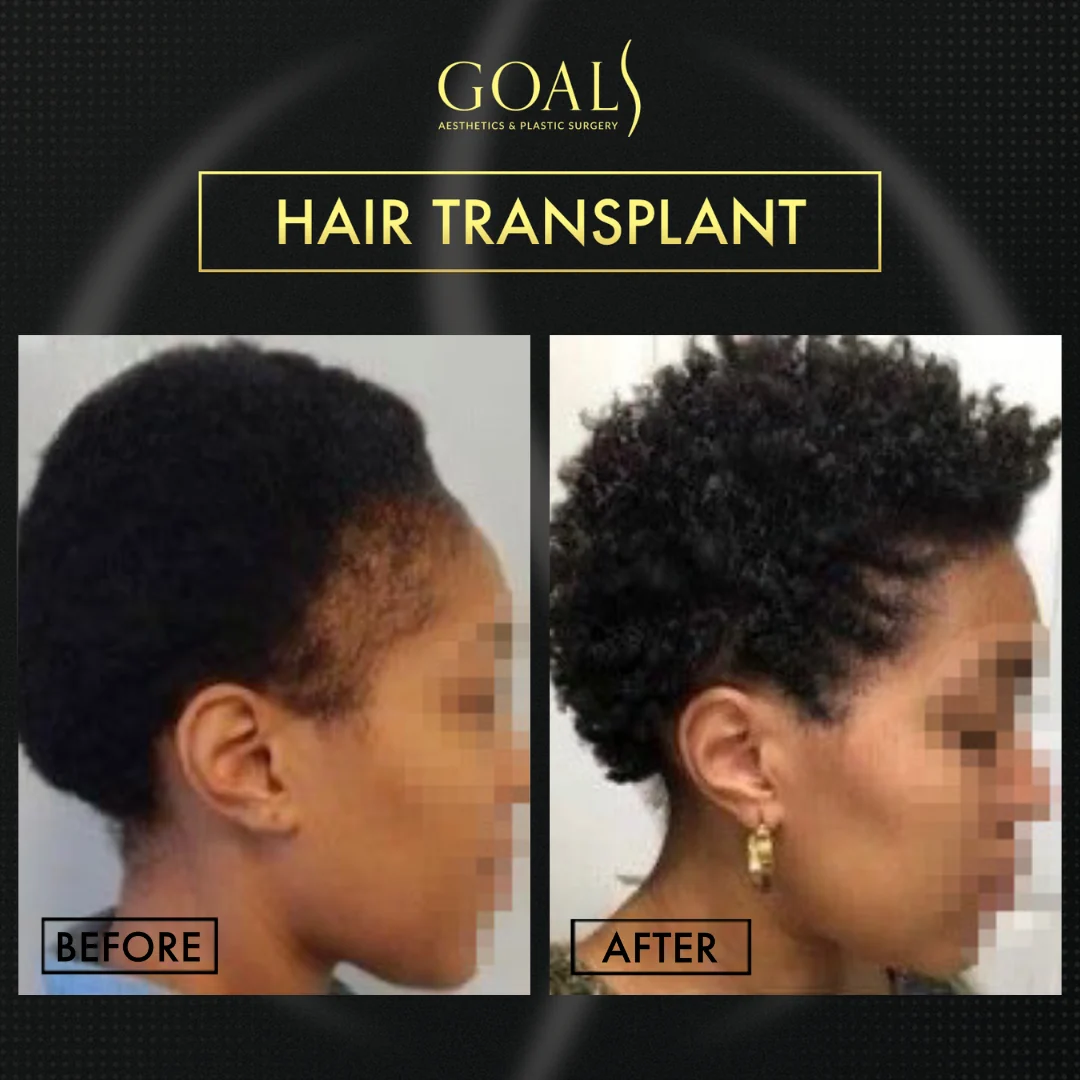
Real patients of Goals, published with written consent. Photographs are not retouched or AI-generated. Individual results vary — these images show outcomes for these patients and are not a guarantee of your own.
Work it out
Runs in your browser. Nothing is sent to us and nothing is saved — a height and a weight are your business.
BMI is one measure among several and it says nothing about how you are built. Surgeons weigh it alongside your health and your goals; it does not decide anything on its own.
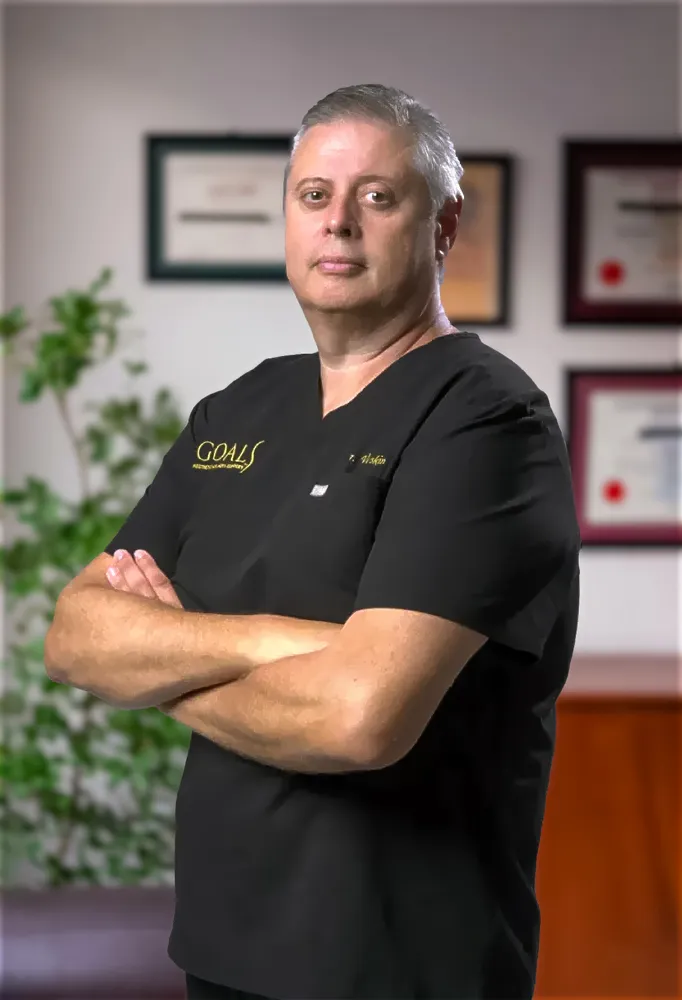
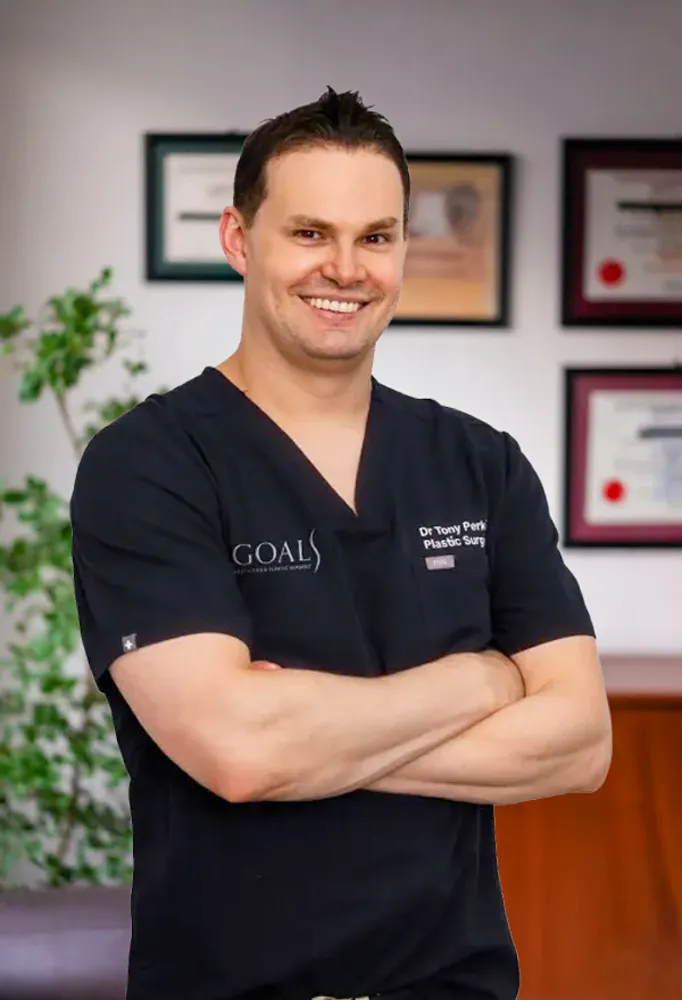
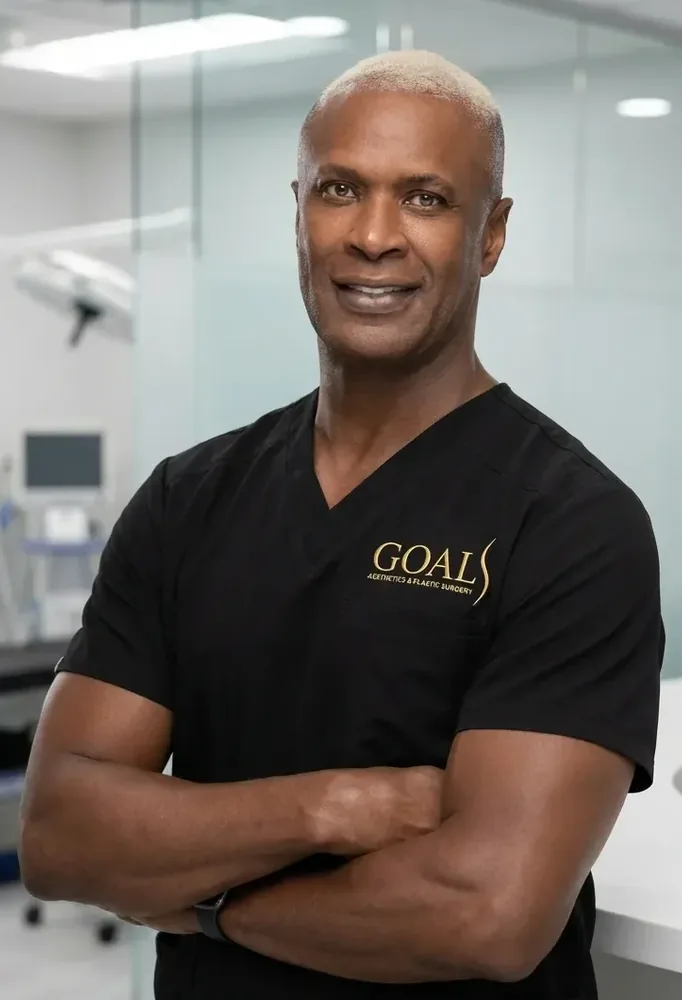
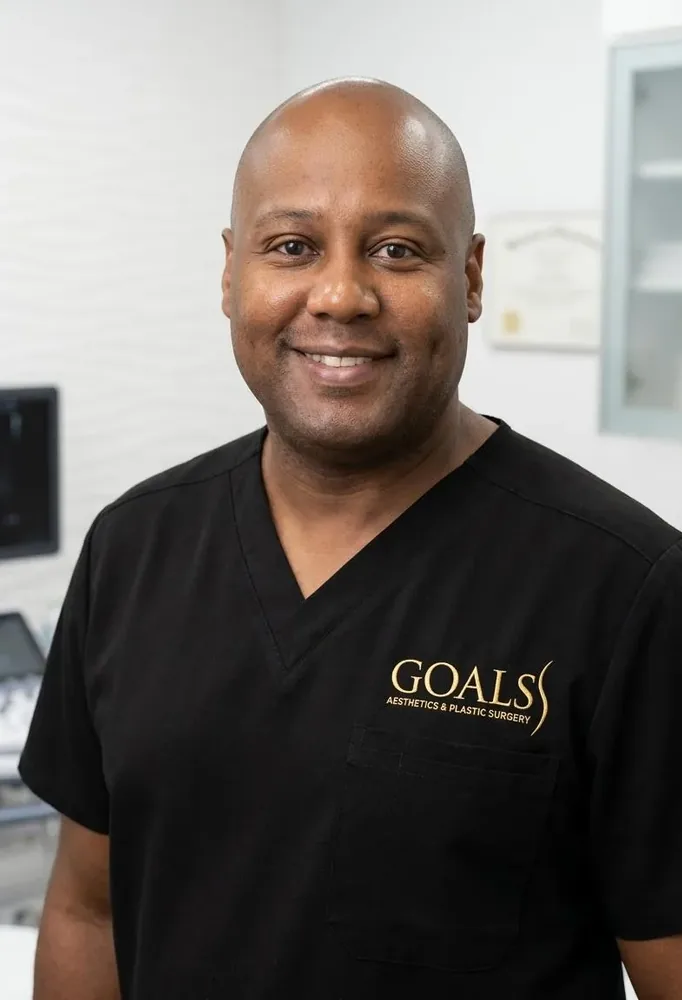
Every transplant is done by a U.S.-credentialed hair restoration surgeon, not a technician. Meet the team before you ever book your consultation.
Credentials differ by surgeon and are listed in full on each surgeon's page.
"We get why overseas "cheap hair transplant packages" look tempting. But the hidden risks (rushed surgery, language gaps, no local follow-up, complications once you're home) can turn a bargain into a real mess."
| Left Step | Right Step |
|---|---|
| Left StepYou spend weeks comparing clinics online, wiring money abroad, then booking flights and a hotel. | Right StepYou come in, or hop on a video call, for a consult with a U.S.-trained surgeon who checks your hair loss stage and plans your curl pattern. |
| Left StepYou land somewhere you barely speak the language. The consult is rushed, squeezed into the same day as surgery. | Right StepTesting, consent forms, and planning all happen ahead of time, in your language, under U.S. medical standards. |
| Left StepThe surgery happens in a place you've never set foot in, often packed with patients and short on time to watch you afterward. | Right StepOn the day, the donor area is numbed with local anesthesia, and light sedation is there if you want it, so extraction is pain-free. |
| Left StepYou fly home tired and swollen. A week on, your scalp turns red and starts to ooze, and you've no idea if that's normal. | Right StepYour surgeon pulls DHT-resistant follicles and sets each one to match your curl pattern and density. |
| Left StepYour only fallback is a local ER or urgent care, where nobody did your surgery and nobody has the details of what was done. | Right StepIf something feels off while you heal, you call the same local team that treated you. We see you in person, tweak your meds, and sort any problem fast. |
| Left StepMore time and money go to ER visits and prescriptions, while the overseas clinic "helps" you over WhatsApp and nothing more. | Right StepThe donor area heals in days, no stitches, and follow-ups track your new growth until the final result is in. |
| Factor | Overseas Package | Goals U.S. Clinic |
|---|---|---|
| Total cost (real) | Base price plus flights, hotels, more days off, maybe ER bills once home. | Similar once all care is counted, with clear pricing and no surprises. |
| Travel & time off work | Long flights, jet lag, several days away from work and family. | A same-day local procedure, barely any travel, quicker back to normal. |
| Safety & sterility | Hit or miss; you're trusting foreign rules and little time on site. | An accredited U.S. clinic with tight infection control you check. |
| Surgeon & team | Credentials are hard to check, and you may never see the surgeon again. | Credentialed hair restoration surgeons you meet before and after. |
| Emergency backup | No local clinic; ER doctors just guess what was done abroad. | In-person follow-up, plus local urgent help if a complication shows up. |
| Follow-up care | Messages only, and real hands-on help is hard to get. | Booked in-person checkups, progress photos, and medication tweaks. |
| Communication | Language gaps, odd time zones, patchy replies. | A team in your language, written instructions, a 24/7 phone line. |
| Legal protections | Little recourse if something goes wrong once you're back. | Backed by U.S. patient safety laws and standards. |
Safety comes first here. We use FUE built for Afro-textured hair, with tight protocols that guard every follicle and hold your curl.
Fully equipped, sterile procedure rooms inside U.S. accredited sites.
Local anesthesia keeps you pain-free, with light sedation on offer.
Reach your surgeon and medical team easily when questions come up.
Clear instructions, medications, and a follow-up plan to stop infection.
Each follicle goes in to keep and bring out your natural curl.
One local team runs your consult, your surgery, and all the follow-up.
Techniques made for Afro-textured hair that keep your natural curl pattern intact.
A U.S.-accredited clinic. No trip abroad, no language barrier, no follow-up gaps.
Experienced hair restoration surgeons you meet before and after surgery.
You're covered by U.S. patient safety laws, with real recourse if needed.
Grafts matched to your texture, so the result blends into your own curls.
"Years of braids wrecked my edges. They matched my curl so close I honestly can't find where the grafts begin."
"I was nervous it wouldn't match my curls. It blends right in, can't tell where the grafts start, and it looks full and natural."
"Curly hair needs someone who gets it, and they did. Six months on, my crown filled in and nobody's clocked it."
Testimonials reflect individual experiences. Results vary by patient.
Every Afro hair transplant happens on-site at our New York clinic, in a fully equipped, sterile operating room. We never send it to a partner site.
We're open Monday through Saturday. Book online in a couple of minutes or just call us, and the team will lock in your consultation date and time.
The donor follicles come from the back of your scalp, where hair resists thinning, then get placed to match your curl pattern and density.
Usually the back of your scalp, where hair resists thinning. Those follicles keep their own growth cycle and grow naturally once placed.
A receding hairline, thinning crown, temples, and patchy or scarred spots. Anywhere you want fuller, natural coverage.
Sessions usually run 4-8 hours, based on graft count. Growth shows around 3-4 months, with full results by 9-12 months.
An Afro hair transplant relocates your own hair into areas where it stopped growing, planned around coily and curly Afro-textured hair from the outset. The follicles being moved are DHT-resistant, so they keep growing once they settle. What separates this from any other transplant is not the goal but the anatomy, because textured hair behaves differently beneath the skin as well as above it, and that difference decides how the procedure has to be performed.
At Goals Plastic Surgery, every Afro hair transplant happens in-office under local anesthesia, performed by U.S.-trained hair restoration surgeons. If you have been reading up on african american hair transplant options around New York, the sections below start with the anatomy, because everything else on this page follows from it.
The visible curl in coily hair is not created at the surface. It is created by the shape of the follicle itself, which curves beneath the scalp rather than running straight down like a follicle in straight hair.
That curvature is the whole story. In straight hair, a surgeon extracting a follicle can see the direction of the hair above the skin and know with confidence what is happening below it, because the two match. In textured hair they do not. A hair emerging at one angle may belong to a follicle that curves considerably beneath the surface, and the path it takes is not directly visible.
Follicles in textured hair also tend to sit in the scalp at a sharper angle, and the groupings they form can be tighter and less predictable. Add the curvature and you have a structure that is more difficult to remove intact than a straight follicle, using instruments that were largely designed around straight hair to begin with.
None of this makes the procedure less effective. Textured hair transplants very well, and the results are permanent in exactly the same way. What it changes is how much the surgeon's specific experience matters, which is the subject of the next section.
The risk in extracting a curved follicle has a name: transection. It means the follicle is cut or damaged during removal rather than lifted out whole, and a transected follicle will not grow when it is placed.
This happens when the extraction punch travels straight while the follicle curves away from it. The surgeon cannot see the curve, so they have to anticipate it, reading direction from the surrounding hair and adjusting angle and depth as they go. Getting this right across thousands of individual extractions is a skill built through repetition on textured hair specifically. Experience with straight hair does not transfer cleanly.
Instrument choice matters alongside technique. Punch diameter has to accommodate the curve without taking more surrounding tissue than necessary, and there is a genuine trade-off in both directions. Too small and the punch clips follicles it was meant to spare. Too large and healing takes longer while donor density suffers.
Both harvesting methods work on textured hair. FUE removes follicles individually, leaves no linear scar, and is the more common choice here. FUT takes a strip of donor scalp and can yield a large number of grafts in one sitting, which earns its place when loss is extensive. Which suits you depends on your donor supply, the extent of the loss, and how you wear your hair.
The practical consequence for you as a patient is that graft survival in textured hair reflects who performed the extraction more than it reflects the technique on paper. This is worth asking about directly, and a surgeon who does this regularly will have a straightforward answer.
A substantial share of textured-hair patients are not dealing with pattern loss at all. They are dealing with damage from tension, and it follows a recognisable pattern.
Traction alopecia comes from styles that pull on the hair over long periods: tight braids, weaves, extensions, locs, and high tension ponytails. The pulling stresses the follicle repeatedly, and the areas that give way first are the ones under the most tension, which is why it usually appears along the hairline and at the temples. Thinning edges are the classic presentation.
The important thing about traction alopecia is that it moves through stages. Caught early, before the follicle is permanently damaged, the hair can recover on its own once the tension is removed. Surgery is not needed and would be premature.
Left long enough, the follicle scars over and stops producing entirely. At that point the loss is permanent and no change in styling brings it back. This is where a transplant becomes the appropriate answer, and it works well, because the surrounding scalp and donor supply are usually healthy.
Which stage you are at is not something you can determine from a mirror, and it is one of the most useful things an assessment establishes. It also shapes what happens afterward, because grafts placed into a hairline that goes straight back under tight braids are being asked to survive the same force that destroyed the original hair.
Scarring alopecia describes conditions where inflammation destroys the follicle and replaces it with scar tissue. Once that has happened the follicle is gone permanently, and the scalp in that area is different tissue to work with.
Central centrifugal cicatricial alopecia, usually shortened to CCCA, is the form most relevant here. It typically begins at the crown and spreads outward, and it disproportionately affects Black women. It is frequently mistaken for ordinary thinning for years before it is correctly identified, which matters because the underlying inflammation needs to be controlled before any surgical planning is sensible.
Transplantation into previously scarred areas is possible and we do it. The considerations are real, though, and worth stating plainly. Scarred tissue has a reduced blood supply compared with healthy scalp, which can affect how many grafts survive. And the condition needs to be quiet rather than active, because placing grafts into a scalp with ongoing inflammation risks losing them to the same process that caused the original loss.
Keloid history belongs in the same conversation. Keloids are raised scars that extend beyond the original wound, and the tendency to form them is more common in people with darker skin. If you have ever developed one, from surgery, piercings, or an injury, raise it at consultation before anything else is planned. It does not automatically rule out a transplant, but it changes how the donor area is approached and it is far better addressed at the planning stage than discovered afterward.
Textured hair has a genuine structural advantage in a transplant, and it is one of the few places where the anatomy works in your favour rather than against you.
A coiled strand occupies more space than a straight one and casts shadow across the scalp beneath it. Coverage is a function of how much scalp is concealed, not how many hairs are present, so a given number of grafts conceals more area in coily hair than the same number would in straight hair. The practical result is that a modest graft count can read as convincingly dense once everything has grown in.
Curl pattern varies considerably across Type 3 and Type 4 hair, from defined S-shaped curls through to tight Z-pattern coils with significant shrinkage, and the planning accounts for which you have. Matching matters as much as counting: each graft is placed to follow the direction and curl of the hair already growing around it, so new density integrates rather than sitting on top of what is there. Our before & after gallery shows how that reads across different textures and starting points.
Design follows the same logic. A hairline for textured hair is not a straight line softened at the edges. It accounts for how coils sit, how the hair frames the face, and how you intend to wear it, whether that is an afro, twists, locs, or something close-cut. Those are questions worth raising at consultation, because they change placement decisions that cannot be revised later.
Everything happens in a single in-office visit. The donor area is prepped and numbed with local anesthesia, then the surgeon extracts the follicles and places each one to match your curl direction and planned density. Sessions typically run four to eight hours depending on graft numbers, with larger cases taking most of the day. There is no general anesthetic and no overnight stay, and you go home the same evening with written aftercare and a direct line to the team that treated you.
The treated area looks pink for the first few days with small scabs around each graft, and those clear on their own. Follow the aftercare routine you are given rather than improvising, keep exertion light early on, and protect the scalp from sun until you are cleared. Discomfort is usually mild.
Then the transplanted hair sheds, which alarms people who were not warned about it. It is meant to happen. The follicle stays exactly where it was placed and enters a resting phase before restarting. Visible growth begins around three to four months and the full result lands somewhere between nine and twelve, with the new hair carrying your own curl pattern as it comes in.
Styling can resume once you are cleared, and the transplanted hair is permanently yours to cut, shape, and wear as you like. Tension styles deserve a more careful conversation, particularly if traction alopecia is what brought you in. If you want to weigh non-surgical options alongside surgery, our New York hair restoration team can talk you through PRP and mesotherapy, both of which are also used to support the native hair around new grafts.
Pricing follows your graft count and which areas are being restored, so the figure is confirmed at consultation once someone has examined your scalp rather than a photograph of it. The price is fixed before you book, with no facility or anesthesia charges appearing afterward. Financing is available if spreading the cost suits you better, and someone will talk you through the terms properly. Every plan includes follow-up care with the same medical team from procedure day through to your final result.
One consideration specific to textured hair. The variable that most affects your result is not the number of grafts purchased but how many of them survive extraction intact, and that comes down to the experience of the person holding the punch. A lower quote from a clinic that does not routinely work with coily hair is not the saving it appears to be, because grafts lost to transection spend donor supply that cannot be replaced.
About Afro Hair Transplant
Afro Hair Transplant near you
Whether you're weighing FUE, FUT, or another hair restoration option, our team will build you a safe, realistic plan that fits.
Prefer to talk now? (833) 462-5769
Free · No obligation
Tell us how to reach you. A patient coordinator calls you back — usually the same day.