
Tags That Catch
Tags that snag on clothing, jewelry, or razors and get irritated.
Quick, in-office skin tag removal at our Atlanta clinic using cautery, cryotherapy, or excision. Most tags come off in minutes under local numbing, little to no downtime.
From $30 each

Start with Savings
Book a consultation and get discount on your first treatment.
Goals Aesthetics & Plastic Surgery – Atlanta
83 Walton St NWMon–Sat, 10:00–19:00 local time
Surgeons: Dr. Sergey Voskin, Dr. Alla Zemlyak, Dr. Patrick Narh-Martey
12
Clinics Across the U.S.
100,000+
Cosmetic procedures performed across our network
10+
Years in Aesthetics & Skin Care
Simple, Safe Skin Care with Quick In-Office Treatments
Skin tags are small, soft growths that hang from the skin, common on the neck, underarms, eyelids, and skin folds. They are harmless but can catch on clothing or jewelry and feel bothersome. At our Atlanta clinic we remove them in a short visit using cautery, cryotherapy, or excision, matched to the tag's size and spot.
Your provider looks at each tag, confirms it is benign, and picks the best method for its size and spot. Numbing is used for cautery or excision.
The tag is frozen, cauterized, or snipped at its base. Each takes only a minute or two, and several can be treated in one visit.
A small scab may form and falls off on its own over one to two weeks. There is little to no downtime, so you head back to your day, with simple aftercare to keep the spot clean.
Removal suits anyone bothered by skin tags, for comfort or looks. It is a good fit if tags catch on clothing, sit in a visible spot, or you simply want them gone.
Tags that snag on clothing, jewelry, or razors and get irritated.
Tags on the face, neck, or eyelids you would rather not see, removed with care for a clean result.
Several tags in folds or underarms you want cleared in a single short visit.
You would rather skip drugstore kits and have tags removed safely by a provider.
Not sure which method fits?
Experienced surgeons skilled in skin work.
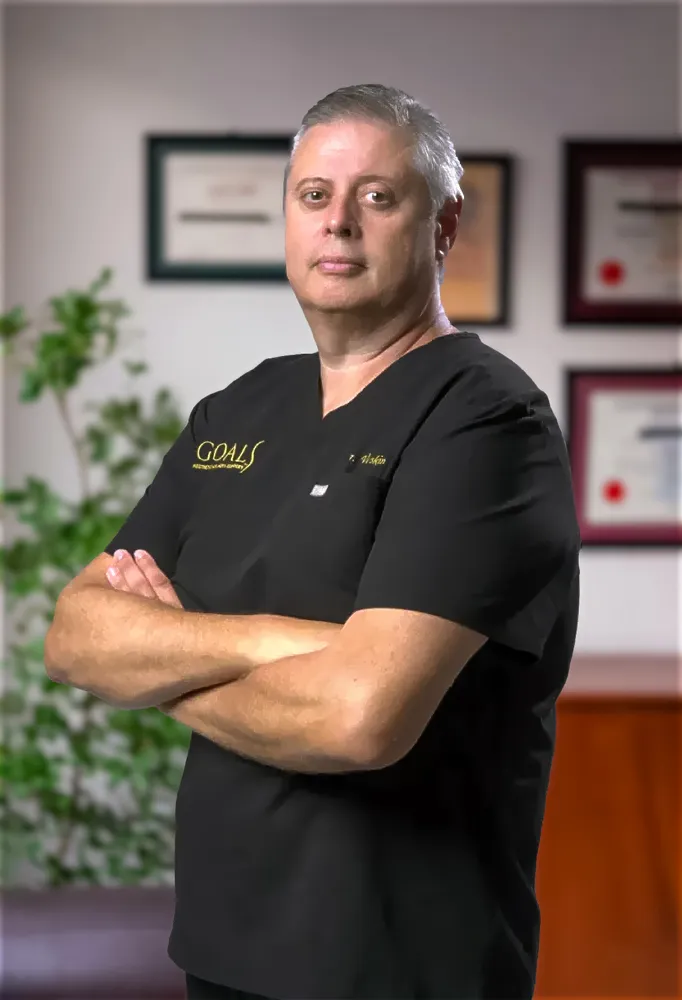
Dr. Sergey Voskin, MD
Operates at Atlanta Walton St.

Dr. Alla Zemlyak, MD
Operates at Atlanta Walton St.

Dr. Patrick Narh-Martey, MD
Operates at Atlanta Walton St.
Credentials differ by surgeon and are listed in full on each surgeon's page.

Results vary with your skin, your starting point and how many sessions you have. Your consultation covers what is realistic for you, before you commit to anything.
Prefer to talk now?(833) 462-5769
Knowing how a clinic visit differs from drugstore kits in method, comfort, safety, and result helps you choose. For the face or eyelids, a clinic is safer.
| Criterion | In-office at Goals | At-home kits |
|---|---|---|
| Method | Cautery, cryotherapy, or clean excision. | Freeze sprays, bands, or topical patches. |
| Comfort | Local numbing keeps it painless. | Can sting; no numbing used. |
| Eyelid/face | Safe near eyes and delicate areas. | Not advised. |
| Safety | Tag confirmed benign first; sterile, low risk of scarring. | Misuse risks burns or marks. |
| Result | Removed fully, clean in one visit. | Slow, may need repeats. |
6 Steps to Clearer Skin.
Meet our team, point out the tags that bother you, and get a clear plan for how each will be removed.
Book your visit and get simple notes so you arrive ready. Most removals happen the same day as the consult.
Your provider confirms each growth is a benign tag, then numbs the area if cautery or excision is the method.
Each tag is frozen, cauterized, or snipped at the base. The work is quick, and several can be cleared in the same sitting.
A small scab may form. Your provider shows you how to keep it clean and what to expect as it heals.
Scabs fall off within one to two weeks. Reach out anytime and we will check the area if you wonder.
Results are immediate: the tag is gone the moment it comes off. The treated spot heals over one to two weeks, leaving smooth skin with little or no mark.
The tag is gone and the spot heals flat and clear.
No more tags catching on collars, straps, jewelry, or razors all day.
On your neck or your eyelid, removing a bothersome tag can help you feel more at ease in photos, at work, and in everyday Atlanta life.
Most tags come off in minutes, often the same day as the consult.
Careful technique keeps marks small and often fading.
We check each growth before removing it, keep the area sterile, and numb where needed, so the visit stays comfortable and the result is clean and predictable.
Each spot is confirmed to be a harmless skin tag before removal, so anything unusual is flagged early.
Clean, sterile tools and care keep the risk of infection or marks low.
Clear aftercare, plus easy access to our local team with questions.
Final cost depends on how many tags you have and the method used. Confirmed at your consultation, fixed before treatment.
Flexible financing / payment plans
Price locked in at the booking stage after consultation.
Transparent pricing: no hidden fees, everything clearly detailed in the contract.
Prices shown are starting prices and depend on the number of areas treated. Final pricing is confirmed at your consultation. Cosmetic procedures are not covered by insurance.
Work it out
Runs in your browser. Nothing is sent to us and nothing is saved.
An estimate, not a quote. It divides the starting price over the months you choose and assumes no interest. Goals works with several lenders and your rate, term and approval are settled with them — the financing page has the detail, and your price is confirmed at consultation.
Easy-to-reach Walton location clinic with parking and a private, calm setting.
Clear aftercare and easy in-person follow-ups at the Atlanta clinic.
Providers who handle minor skin work daily.
Many tags come off the same day as your consultation.
Thousands of minor procedures done well across our U.S. network.
“I had a tag on my neck that kept catching on collars. Gone in two minutes, no fuss. The Atlanta team was great.”
“One near my eye made me nervous. They numbed it and removed it carefully, and you cannot tell now. I had a few others done the same visit. I really wish I had come sooner.”
“Quick, clean, and painless. The spot scabbed a week, then healed flat. Exactly what I wanted.”
“Had several tags under my arms removed at once. Barely felt it, healed fast, no marks left. Very happy with the result.”
Testimonials reflect individual experiences. Results vary by patient.
Friction is the common thread, skin rubbing against skin, clothing, or jewelry, which is why they appear in areas like the neck, underarms, and folds. Age, pregnancy, weight changes, insulin resistance, and genetics all make them more likely, but the growths themselves are harmless extra skin.
No. A genuine skin tag is benign, cannot be passed to anyone, and will not turn into anything harmful. The one caveat is that not every small growth is a tag, which is why a provider checks each one first to confirm before removing it.
Anyone can, but they are more common with age and in people who are pregnant, have gained weight, have insulin resistance or type 2 diabetes, or have a family history of them. If your parents got skin tags, you are more likely to as well.
Yes. Anything that changes color, size, or shape, bleeds without reason, or simply looks irregular should be examined by a provider rather than assumed to be a tag, and anything out of the ordinary is referred for medical evaluation.
Rarely. A tag is a stable growth of your own tissue, so it usually does not shrink or vanish by itself. If one bothers you, having it removed in-office is the reliable way to be rid of it, rather than waiting or trying to remove it at home.
If you have noticed a small, soft flap of skin appear somewhere it was not before, it helps to understand what it is and why it showed up. Skin tags are extremely common, entirely harmless, and there is usually a clear reason they form where they do.
Rather than a step-by-step on getting them removed, this page is about the growths themselves: what a skin tag is made of, what they look like, why your body forms them, and why some people collect a few over a lifetime while others keep getting them. Understanding that not only takes the worry out of finding one, it also makes the decision about whether to clear it a straightforward one. For people in the Atlanta area, knowing what they are dealing with is the natural first step.
In medical terms a skin tag is an acrochordon, a soft, benign growth that hangs from the skin on a slim stalk. Structurally it is nothing dramatic: just surplus tissue, made of loose collagen fibers and tiny blood vessels wrapped in a layer of ordinary skin.
That stalk, the narrow base it dangles from, is what gives a tag its characteristic look and distinguishes it from a flat spot or a mole. Because it is built from the same ordinary components as the skin around it, a tag is not a foreign body or anything that has invaded the skin; it is simply your own skin growing a little extra tissue in one spot. Knowing what it is physically made of is reassuring in itself, since there is nothing sinister about its makeup.
Skin tags are usually the same color as your skin, or sometimes a shade darker, which is part of why they blend in until they catch on something. In size they range widely, from a tiny speck barely larger than a grain of rice to a growth several millimeters across, occasionally larger.
Some people have a single tag they have lived with for years without much thought; others develop little clusters in the same area. They tend to be soft and movable rather than hard or fixed, and they often sit on that thin stalk rather than lying flat against the skin. This typical appearance, soft, skin-colored, on a small stalk, is part of what a provider looks for in confirming a growth is a simple, harmless tag.
If there is one factor running through nearly every skin tag, it is friction. Tags overwhelmingly appear in places where skin rubs against skin, clothing, or jewelry through the day: the neck, the underarms, the eyelids, beneath the breasts, and in the groin and other folds.
That repeated rubbing seems to encourage the skin to form these little growths, which is why they cluster in exactly those high-friction zones and why someone who wears a necklace or a snug collar often notices them right where the rubbing happens. It does not fully explain every tag, since the exact mechanism is not pinned down, but friction is the thread that connects most of them, and it is why the typical locations are so predictable.
Beyond friction, a few common circumstances make tags more likely. They become more frequent with age, and many people first notice them somewhere in their thirties or forties, simply as a normal part of how skin changes over time.
Pregnancy is another frequent trigger, driven by the hormonal shifts and weight changes that come with it, and tags that appear during pregnancy sometimes stay afterward. Weight gain plays a role too, partly because it creates more skin folds where friction occurs, so the number of tags often climbs alongside it. None of these is a cause for concern in itself; they simply explain the timing of when many people find tags appearing.
Two further factors are worth knowing about because they explain a lot of cases. There is a recognized association between skin tags and insulin resistance and type 2 diabetes, which is part of why some people who develop many tags are encouraged to keep an eye on their general health, though having tags certainly does not mean you have either condition.
Putting all of this together explains one of the most common questions: why does one person carry a single tag for decades while another keeps clearing a handful every few years? The answer is that the contributing factors, friction, age, weight, the hormonal and genetic influences, vary from person to person, so everyone has their own tendency.
Someone with a strong genetic predisposition, more skin folds, or particular health factors will simply form them more readily than someone without. This is worth understanding because it sets realistic expectations: knowing your own pattern helps you and a provider decide whether you are dealing with the occasional one-off or an ongoing tendency to manage over time.
The reassuring headline is that a genuine skin tag poses no danger, cannot be passed to anyone, and will never develop into something harmful. That said, not every small growth is a skin tag, which is exactly why each one should be looked at before it is removed. A growth that shifts color, bleeds for no reason, enlarges quickly, or simply looks irregular falls outside the ordinary, harmless profile of a tag and deserves a closer look.
This is why a provider examines each growth first to confirm it is a simple tag, and refers anything that looks out of the ordinary for medical evaluation. It is also the clearest reason not to guess at home: telling a harmless tag from something that needs attention is a job for a trained eye, not a drugstore kit.
One thing people often hope is that a tag will simply disappear by itself, but in practice that rarely happens. Because a tag is a small, stable growth of your own tissue rather than a blemish or an irritation, there is no natural process that makes it shrink and vanish the way a spot might.
Very occasionally a tag may lose its blood supply and drop off by itself, but counting on that is neither reliable nor comfortable, and attempting to force it at home risks bleeding, infection, or a lasting mark. For a tag that bothers you, having it removed properly is the dependable way to be rid of it, since waiting for it to go on its own usually means waiting indefinitely.
When you do decide to clear one, removal is quick and simple, done right in the office. After confirming the growth is a harmless tag and numbing the area with a local anesthetic, a provider removes it using whichever method suits it: excision, a clean snip at the base with sterile scissors or a blade, or electrocautery, which uses controlled heat to take off the tag and seal the spot at once.
Each takes only a minute or two, several can be treated in one visit, and there are no stitches involved. It is a small, straightforward procedure, which is part of why understanding the tag matters more than worrying about the removal.
Recovery is genuinely easy, with little to no downtime, so you can return to your normal routine the same day. A small scab tends to form at each treated spot and falls away on its own, usually within about five to ten days, leaving little or no visible mark.
As for cost, there is no single flat price, since it depends on how many tags you have and the method used, and it is confirmed clearly at your consultation with no hidden fees. Because removal is almost always cosmetic, it is generally paid out of pocket rather than covered by insurance, and financing and payment plans are available if you would like to spread the cost.
Understanding what a skin tag actually is makes the decision easy, and a provider can confirm each one in person before anything is done. Our Walton Street clinic is at 83 Walton Street NW in downtown Atlanta, convenient from across the metro including Midtown, Buckhead, and Decatur. Every growth is checked first to confirm it is a harmless tag, the work is done in a sterile setting, and the area is numbed where it helps.
If you are also thinking about your skin more broadly, microdermabrasion in Atlanta is a gentle exfoliating option, and you can read more about the treatment in general on the main skin tag removal page. You can browse the full services in Atlanta, meet the team, see real outcomes in the before and after gallery, read more on the blog, or book a consultation.
There is also a strong genetic thread: if your parents tended to get skin tags, there is a fair chance you will too. These links are simply part of the picture of why tags form, and they help explain why they run in some families and accompany certain health patterns, without making the tags themselves any more harmful.
About Skin Tags Removal
Skin Tags Removal at other Goals clinics
Whether you are considering skin tag removal, a non-surgical skin treatment, or another aesthetic service, our team will build a safe, realistic plan for you.
Prefer to talk now? (833) 462-5769
Free · No obligation
Tell us how to reach you. A patient coordinator calls you back — usually the same day.