
Body Contouring
Awake liposuction, FlexSculpt, Lipo 360.
Goals Aesthetics
Dr. Gregory Morrow is Medical Director at Goals and has been operating for over 31 years. His work here is liposuction and contouring, built on three decades of general and breast surgery.

31+
Years in practice
1991
Qualified since
Gaithersburg, Maryland
Primary location
Dr. Gregory Morrow took his M.D. at the University of Alabama at Birmingham and did his surgical residency at Howard University. Three decades in general, breast and colorectal surgery followed, including posts as Chief Medical Officer and Chief of Surgery at a Washington medical center, before he moved into aesthetic body contouring. He belongs to the American College of Surgeons and is Medical Director at Goals.
Awake liposuction, FlexSculpt, Lipo 360.
Augmentation, lift and reduction, with a general surgery breast background behind it.
Chin and neck contouring, jawline definition.
FlexTuck, Tummy Tuck.
Gynecomastia Surgery.
J-Plasma Skin Tightening, PRP, injectables.
Dr. Gregory Morrow operates at the Goals clinic in Gaithersburg.
 Open in Maps
438 N Frederick Ave, Gaithersburg, MD 20877
Dr. Gregory Morrow holds active credentials and a medical license, belongs to the American College of Surgeons, and is Medical Director at Goals.
These are Goals patients of Dr. Gregory Morrow.



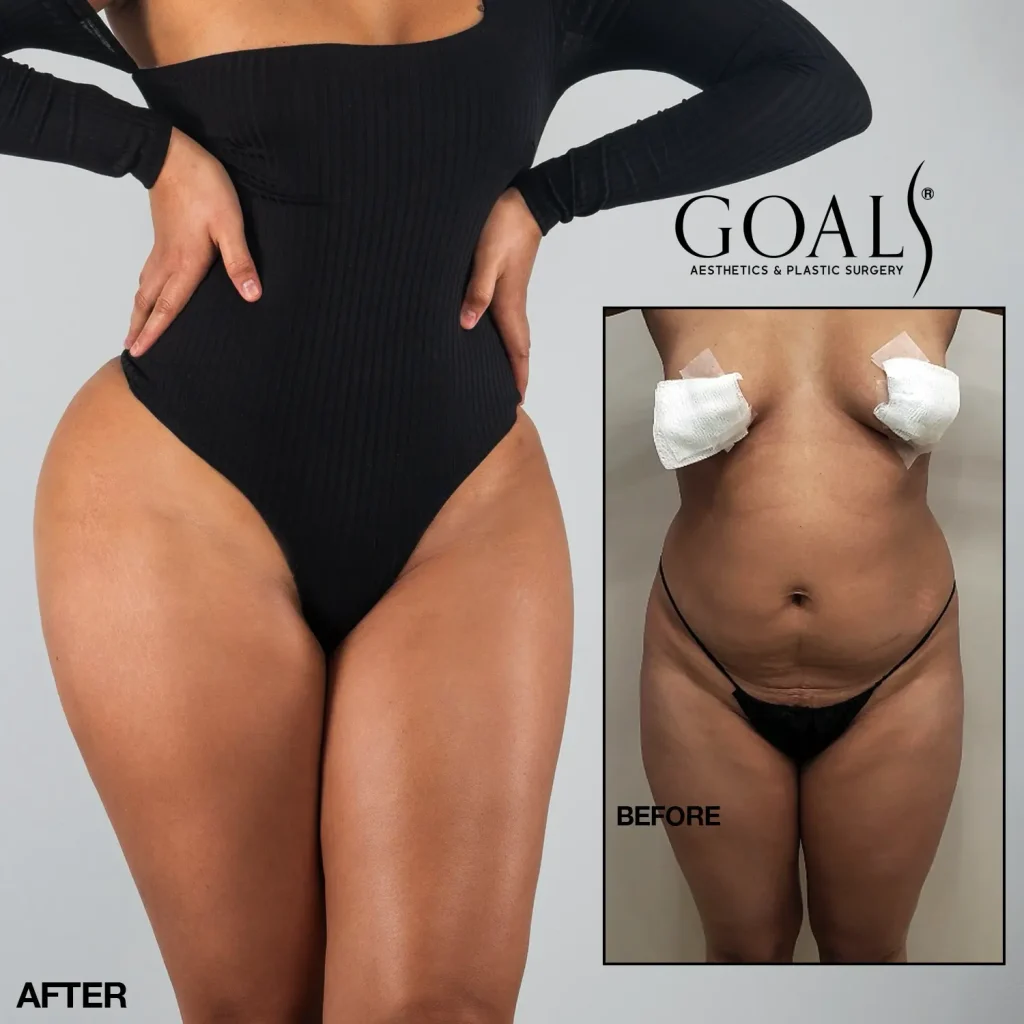


Real patients of Goals, published with written consent. Photographs are not retouched or AI-generated. Individual results vary — these images show outcomes for these patients and are not a guarantee of your own.
Work it out
Runs in your browser. Nothing is sent to us and nothing is saved — a height and a weight are your business.
BMI is one measure among several and it says nothing about how you are built. Surgeons weigh it alongside your health and your goals; it does not decide anything on its own.
“Awake lipo, abdomen and flanks. The thing that settled me was learning he had done thirty years of serious general surgery before any of this. That is a different kind of comfortable.”
“For the first twenty minutes he asked about my medical history and barely mentioned my goals. I got it afterwards. He wanted to know I was safe before he talked about results.”
“Gynecomastia, put off for years out of embarrassment. He was completely matter of fact about the whole thing, which was exactly what I needed from him.”
“Breast reduction after years of back pain. He treated it as a medical problem to solve rather than a cosmetic one, and that difference mattered more than I expected.”
Testimonials reflect individual experiences. Results vary by patient.
Liposuction and body contouring lead the list, with breast procedures and gynecomastia surgery alongside. Awake contouring under local anesthesia fills much of his operating week.
Clinical standards across the practice are his responsibility, on top of his own operating list. It means the person holding the cannula is also answerable when a protocol fails elsewhere.
He operates at the Goals clinic in Gaithersburg, Maryland. Coordinators fit your consultation and follow-up visits to your travel dates before a date is set.
Often, yes. Contouring alongside a breast procedure is a common pairing. He confirms it once he has reviewed your anatomy, your history and how long the combined case would run.
Three decades of deciding who is fit for an operation. The habit does not switch off when surgery becomes elective, and it turns up as a much longer conversation about health history.
Whenever a case permits it. Awake contouring lowers anesthetic risk and shortens recovery, and it lets him sit you up mid-procedure to check the shape. Candidacy is settled at evaluation.
Dr. Gregory Morrow reached aesthetic surgery the long way round. An M.D. from the University of Alabama at Birmingham, a surgical residency at Howard, then three decades in general, breast and colorectal surgery, including posts as Chief Medical Officer and Chief of Surgery at a Washington medical center. He is now Medical Director at Goals. What follows is the detail patients want before booking, and what that particular route changes about it.
Dr. Gregory Morrow holds an M.D. from the University of Alabama at Birmingham and a B.S. in Microbiology from Howard University, where he also completed his surgical residency. He is a member of the American College of Surgeons and has been operating for over 31 years.
The larger part of that career was not cosmetic at all. General, breast, colorectal and gastrointestinal surgery, much of it minimally invasive, plus senior posts as Chief Medical Officer and Chief of Surgery at a Washington medical center. He founded and still runs his own surgical practice. That is an unusual route into body contouring, and the difference is visible.
At Goals he is Medical Director, which carries responsibility for clinical standards across the practice alongside his own list. Hardly any patient thinks to ask who is accountable for standards at the place they are booking into. That is a fair thing to want to know, and on this page it has a name against it. It also means a complaint about protocol does not disappear into an inbox. There is somebody whose job it is to answer it.
His own operating is liposuction and body contouring, with breast procedures and gynecomastia surgery beside them. A good deal of the contouring happens awake, under local, which shortens recovery and removes a whole class of anesthetic risk. He works from Goals clinics in Gaithersburg, Maryland.
The background announces itself early. Patients describe the first half of a consultation being about their health rather than their goals, which is not the order most cosmetic appointments run in, and is the right one.
Most credentials on a surgeon's page describe training. Two on his describe accountability, which is a different and more interesting thing. A Chief of Surgery answers for other surgeons' outcomes as well as their own. A Chief Medical Officer answers for clinical governance across an entire institution. Neither post is decorative. They are jobs where other people's mistakes become your problem.
Somebody who has held both has spent years being audited and auditing others. That is a habit rather than a line on a page, and it does not fall away when the work becomes elective and the patient is paying privately. Being asked to justify a decision to a committee changes how you make decisions, permanently and whether or not the committee is still there.
The verifiable parts are verifiable in the usual way. He is licensed in Washington, DC, where most of his career has been spent, and a licence check through the relevant board takes about two minutes. The medical degree, the residency finished at Howard in 1996, and membership of the American College of Surgeons all stand up to a search. The society membership requires certification, so it rests on a credential rather than replacing one.
Ask about revisions early, while the question is hypothetical. Timeline, approach, who pays, and who performs it. Any surgeon should manage that inside a minute, and hesitation there is worth noting.
FlexSculpt tops his contouring list, generally as a 360 treatment handling abdomen, flanks and back as a single continuous shape. Going the whole way round keeps the finished outline continuous instead of leaving a visible border where the work stopped.
Most of it is done awake, under local. The gains are concrete. General anesthesia risk drops out entirely, recovery is faster, and a patient who is conscious can be brought upright mid-procedure so the two sides are compared under gravity rather than estimated flat on a table.
The fat transfer procedures, the Brazilian Butt Lift among them, use whatever the contouring removes. Running both in one session buys you a single anesthetic, a single recovery and a single block of time off. They are the same operation seen from either end.
Settle what liposuction is for before you book. It alters shape and leaves weight alone. What it targets is fat that has not shifted with diet or exercise, and it is not an obesity treatment. Skin is the second variable: fat comes out regardless, but whether the skin above it draws back is a separate question. Where laxity is significant, FlexTuck, a tummy tuck or J-Plasma is the better answer.
Not everybody suits the awake approach, and he will tell you. It suits anybody who can stay still and comfortable for the duration, while heavier combination cases sometimes want a different setup. That decision comes off your anatomy, not off what is easiest to schedule.
Breast surgery was in his practice long before the cosmetic work, and it changes how he approaches it. He performs augmentation, lift and reduction. Reduction in particular benefits from a general surgery background, because it is as often a physical complaint to fix as an appearance to change.
Gynecomastia surgery is a standing part of his list. It goes better when a surgeon treats it as chest contouring rather than plain excision, and men who have deferred the operation for years usually want it dealt with matter-of-factly rather than sympathetically.
The abdomen gets FlexTuck or the full tummy tuck, depending on skin laxity and muscle separation. A mommy makeover puts abdominal and breast work into a single operation where the total operating time allows.
Above the neck the offer is chin and neck contouring. That accounts for less of his volume than the body work, so if it is your main reason for coming in, put a percentage question to him.
Scars deserve their own part of the conversation whatever you choose. Every operation leaves one, and how noticeable it ends up depends partly on the surgeon and partly on you. Ask where the incisions go and what they usually look like after twelve months, so the healed version is not news.
Expect to be assessed before you are sold to. That is the most reliable thing patients report about him, and it follows directly from a career spent deciding whether people were fit for operations that were not optional.
In practice it means the first stretch of the appointment is medical. Your history, your medications, what your body has already been through. Only after that does the conversation turn to what you came in for. Patients occasionally find the order disconcerting. It is the correct order.
It also means dates move. A surgeon accustomed to institutional audit does not quietly proceed with a case that a screening result has flagged, because in the world he came from that is the sort of decision other people review afterwards. Frustrating if you have already booked time off. Considerably less frustrating than the alternative.
On the match, the usual rule. Liposuction, torso contouring, a breast procedure, gynecomastia surgery: that is where his volume is. A goal outside that should be said out loud in the room, with a colleague named who covers it.
Bring photographs if you have them and expect a straight reading. And think about timing before you fix a date. Scheduling around a wedding or a holiday tends to squeeze recovery into a space it does not fit, and he will say so instead of agreeing to a date that leaves you disappointed.
The Medical Director role puts him on both sides of the safety question. He operates under the practice's protocols and he is answerable for them, which is a stronger position than a surgeon who merely agrees that safety is important. Anyone can endorse a protocol. Owning the consequences when one is not followed is a different arrangement entirely.
Accredited U.S. facilities only, for every procedure, without exception. Accreditation is a defined list an inspector signs off rather than one the clinic publishes: instrument sterilisation, emergency equipment, staffing levels, anesthesia monitoring. That outside sign-off is what a cheaper overseas package cannot produce.
Nothing gets booked before screening. Bloods, cardiac risk, medications, and how you actually live. A result outside safe parameters holds the date until it has been dealt with rather than worked around.
Fat transfer runs to a fixed protocol at Goals facilities: grafts subcutaneous only, ultrasound following the cannula throughout. Where a patient is carrying extra weight, candidacy is a clinical question answered with numbers, settling whether the operation is safe now or whether staging it makes better sense.
Accredited centres also keep emergency airway equipment, run monitored recovery areas and drill staff on advanced response. Asking which accreditation a facility holds is fair, and so is asking when it was last inspected.
The first appointment inverts the usual order. Health history comes first and the result you want comes second, which is the opposite of how most cosmetic consultations run. The area gets examined, the skin assessed, and you get a direct read on what your anatomy permits. Generally the before & after gallery is open alongside, putting an outcome on a comparable frame. You leave with a written plan and nothing booked.
Bring your medications with you, including anything over the counter and anything you take irregularly. Given how the appointment is structured that list will get more attention than it usually does, and remembering it in the car park afterwards costs you a phone call.
The opening fortnight after surgery outweighs everything that follows it. Garments, positioning, lymphatic drainage. There is a physiological reason under each of them, and observing them is how the result survives.
Follow-up carries on across the first year, since contouring keeps settling for months. Swelling clears patchily rather than uniformly, so a contour looking lopsided at the six-week mark has generally evened out by the sixth month. He waits for tissue to stop moving before he acts.
Establish before you book which clinician you will see at those appointments, and how to reach one between them. Working from a single site makes that easier to pin down here than it often is. Get the answer before the operation rather than in the week you need it.
Have the numbers before you commit. A consultation should lay out the whole of it: the surgeon's fee, the facility, anesthesia, garments, every follow-up visit. Nothing should appear later that was absent from that list. Because operating time and complexity differ from patient to patient, the quote is assembled for your case rather than taken off a list.
What would a revision cost, and who absorbs it? That pair of questions goes unanswered by a quote more often than any other, and it is the pair you will care about in the unlikely event it arises.
Financing partners run monthly plans over a range of terms, with most applications decided the same day. Coordinators will go through what each option commits you to. Whatever is currently available is listed on the financing page, and reading it beforehand turns the consultation into questions rather than paperwork.
Budget the recovery as well as the date. Lost working days, the garments, each follow-up visit, and usually a person on hand at home through week one.
None of it substitutes for the appointment itself. Book it, take your history and your questions, and get a direct answer on what is realistic.
Goals runs its own review on top: operative history, complication rates and facility privileges read before a surgeon sees network patients, then kept under review afterward. He appears with the rest of the surgical team.
Awake liposuction, a breast procedure, gynecomastia surgery. Dr. Morrow will work through your health history before he talks about the result.
Prefer to talk now? (833) 462-5769
Free · No obligation
Tell us how to reach you. A patient coordinator calls you back — usually the same day.